
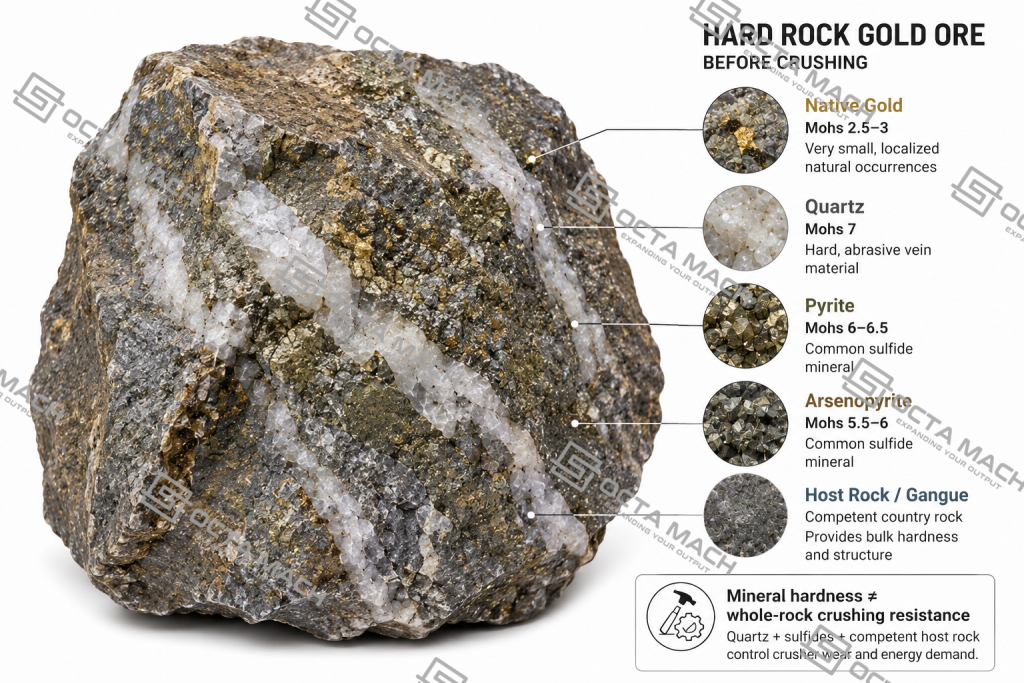
Gold ore is naturally mineralized rock containing recoverable gold as native gold, electrum, microscopic gold, or gold associated with minerals such as pyrite and arsenopyrite. In hard-rock deposits, gold commonly occurs within quartz veins, silicified host rock, sulfides and other gangue minerals. Native gold itself is relatively soft at about Mohs 2.5–3, but this value does not represent the crushing difficulty of the complete ore. Quartz has a Mohs hardness of 7, pyrite about 6–6.5, and arsenopyrite about 5.5–6, so quartz-rich or sulfide-bearing hard rock gold ore can behave as a hard and abrasive feed during crushing and grinding.
Run-of-mine gold ore may contain fines together with irregular blasted rock several hundred millimetres across. For preliminary design of a hard-rock gold ore crushing plant, a feed envelope up to about 0–600 mm can be used as a practical reference, but it is not a universal gold ore specification. Actual maximum lump size depends on blasting, mining method, fracture pattern, ore competency and mine handling. Published hard-rock gold projects range from approximately 130–400 mm feed in smaller plants to a 600 mm maximum feed in a larger crushing circuit, illustrating why crusher selection must start from the actual ROM size distribution rather than a fixed number.
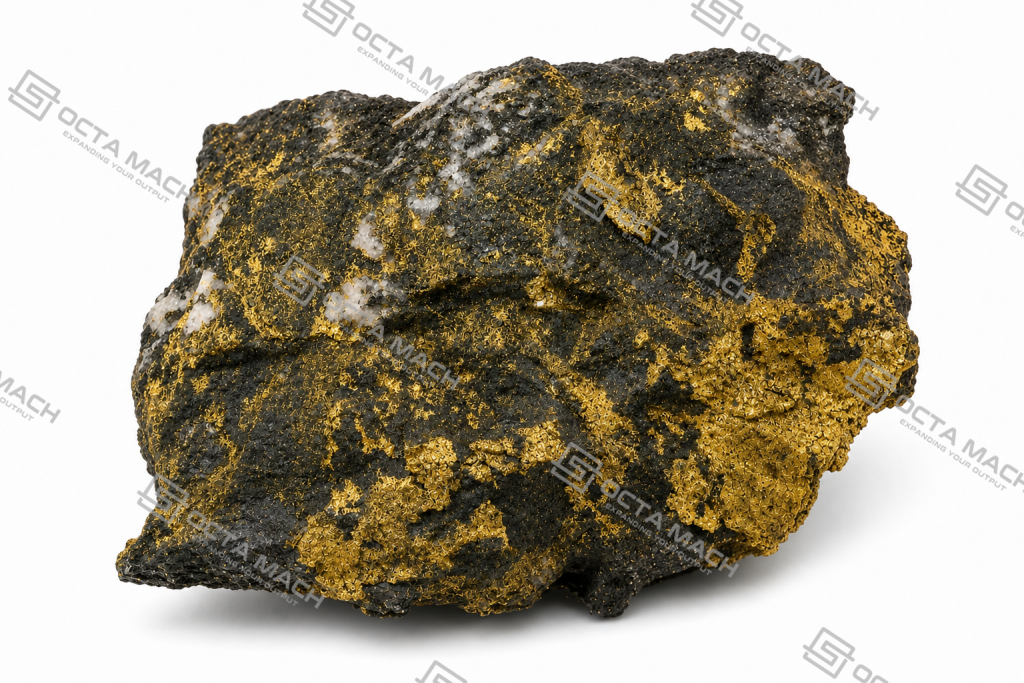
The purpose of gold ore processing is not simply to make smaller rock. Crushing and grinding progressively expose or liberate gold from quartz, sulfides and gangue so that gravity concentration, flotation, cyanide leaching or another appropriate recovery route can separate or dissolve the gold. The required final particle size therefore depends on mineralogy and metallurgical testwork rather than on a single “gold ore size.”
Gold Ore Characteristics Before Crusher Selection
Gold-bearing rock can look very different from one deposit to another. Visible metallic gold may occur along quartz fractures, but much of the gold processed industrially is too fine to identify by eye. In other ores, gold is enclosed within pyrite, arsenopyrite or other sulfides, and refractory ores may contain submicroscopic gold or carbonaceous material that interferes with conventional cyanide recovery. Mineralogical characterization is therefore required before the gold ore processing plant flowsheet is finalized.
| Ore Component / Property | Typical Engineering Significance |
| Native Gold | Mohs 2.5–3; may occur as visible or microscopic particles |
| Quartz | Mohs 7; common in vein-hosted gold and can strongly increase hardness and abrasiveness |
| Pyrite | Mohs 6–6.5; a common sulfide associated with gold |
| Arsenopyrite | Mohs 5.5–6; can host finely disseminated or locked gold |
| Gangue / Host Rock | Quartz, silicates, carbonates and altered rock determine much of the whole-rock crushing behavior |
| Ore Texture | Controls how much crushing and grinding is required before adequate liberation |
| Moisture / Clay | Influences feeding, screening efficiency, chute behavior and whether pre-screening or washing is required |
The important distinction is therefore between mineral hardness and whole-rock breakage behavior. Selecting a crusher according to the Mohs hardness of native gold would be misleading. A quartz-rich gold ore should normally be evaluated as hard, potentially abrasive rock, with abrasion, compressive strength, fracture pattern and feed gradation considered together.
Main Gold Ore Types and Their Processing Behavior
For mineral processing, Gold Ore is more useful when classified according to how the gold occurs and how it responds to recovery, rather than only by the color or appearance of the rock.
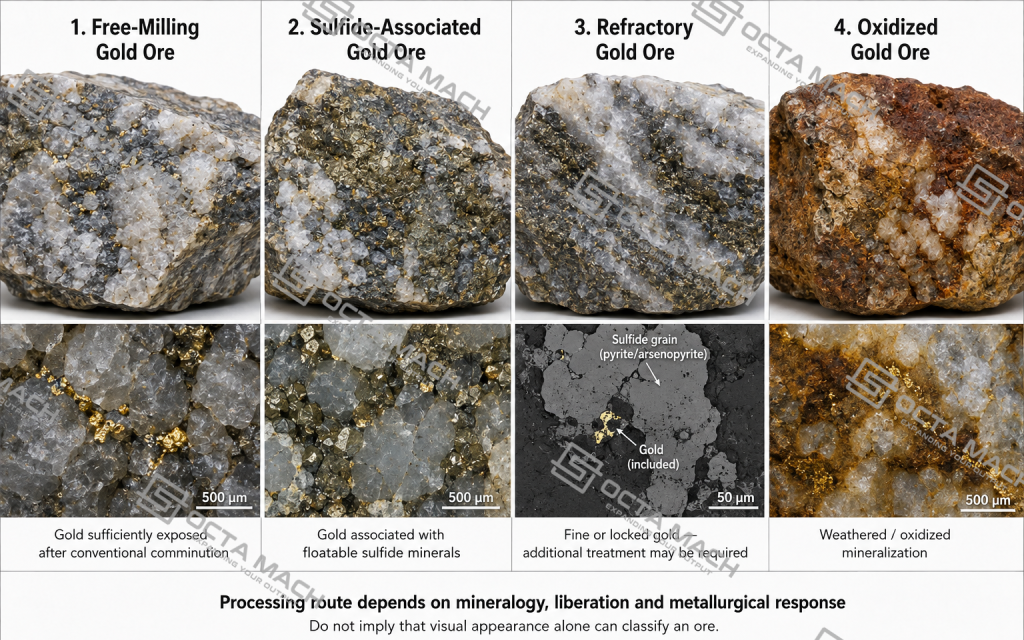
Free-Milling Gold Ore
Free-milling ore contains gold that can be sufficiently exposed by conventional comminution and then recovered by gravity concentration, direct cyanidation, or a combination of methods. Coarse liberated native gold may justify an early gravity-recovery stage before or within the grinding circuit.
Sulfide-Associated Gold Ore
Gold may occur with pyrite, arsenopyrite, chalcopyrite and other sulfides. When the valuable gold is associated with floatable sulfide minerals, grinding followed by flotation can produce a sulfide-rich concentrate for further treatment.
Refractory Gold Ore
Refractory gold ore cannot be treated as simply “harder gold ore.” Its difficulty is primarily metallurgical. Gold may be finely locked inside sulfides, present in solid solution, or associated with carbonaceous material capable of preg-robbing dissolved gold. Crushing alone cannot solve this problem; mineralogy, diagnostic testing and, where necessary, pretreatment are required before effective leaching.
Oxidized Gold Ore
Weathering can oxidize sulfides and change both ore competency and gold exposure. Some amenable oxide ores can be processed through crushing followed by heap leaching, while others require grinding and agitated leaching. Oxide gold ore does not automatically mean heap leaching; permeability, gold liberation, clay content and metallurgical response must first be established.
Typical Gold Ore Feed Size and Crushing Targets
There is no single finished particle size for Gold Ore. Each size target represents preparation for the next operation.
| Process Position | Practical Reference | Engineering Purpose |
| ROM hard-rock gold feed | Up to about 0–600 mm | Preliminary jaw-crusher-fed hard-rock reference; actual blast size must be confirmed |
| Primary jaw crusher discharge | Commonly around 80–160 mm in larger coarse-crushing duties | Reduce ROM lumps to a manageable secondary-crusher feed |
| Secondary / tertiary crushing | Commonly controlled to approximately 12–25 mm before conventional ball milling | Prepare a consistent feed for grinding |
| Grinding | Often tens to low hundreds of micrometres, depending on testwork | Liberate gold or gold-bearing minerals for downstream recovery |
The 12–25 mm grinding-feed range is a useful plant-design reference rather than a Gold Ore standard. OctaMach ball mills accept feed up to 25 mm depending on model, while operating gold circuits show examples around 12 mm and closed crushing circuits around 20 mm before milling.
Grinding size is even more ore-specific. A value around 74 μm (200 mesh) appears in many gold flotation and leaching circuits, but it must not be specified automatically. Gold grain size, mineral association, liberation, grindability and the selected downstream process determine the actual P80 target. A gold ore can remain poorly recoverable even after very fine grinding when the gold is metallurgically refractory.
Gold Ore Crushing Process
A conventional gold ore crushing process for hard, quartz-rich feed uses staged compression crushing rather than attempting extreme size reduction in one machine.
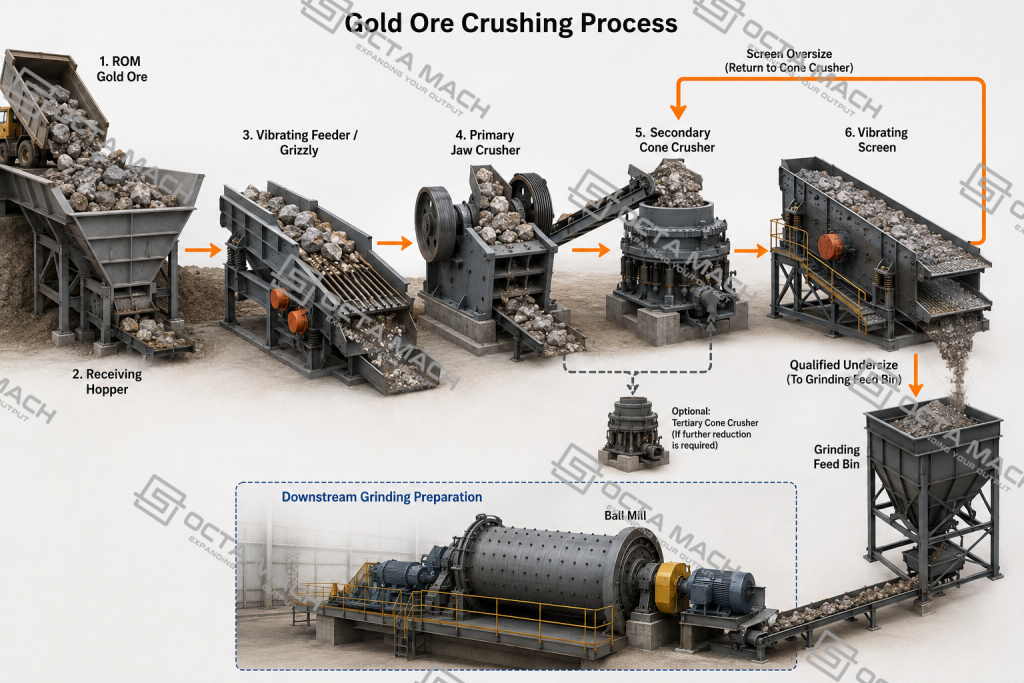
1. Feeding and Pre-Screening
ROM ore enters a receiving hopper and vibrating feeder. A grizzly or pre-screen can remove natural fines before primary crushing and stabilize the load entering the jaw crusher.
Pre-screening becomes more important when the mine delivers a broad size distribution or weathered material containing fines and clay. Wet or sticky material should be evaluated separately because it can reduce screen efficiency and obstruct chutes or crusher feed openings.
2. Primary Jaw Crushing
The Jaw Crusher for Gold Ore receives the largest ROM lumps and reduces them through compression between fixed and moving jaw plates.
The jaw feed opening must be selected from the actual maximum lump dimensions rather than nominal plant tonnage alone. OctaMach jaw crushers cover different feed openings and coarse-crushing duties; for example, larger PE units accommodate maximum feeds from several hundred millimetres upward depending on model.
3. Secondary Cone Crushing
After primary crushing, the material is more uniform and suitable for a Cone Crusher.
For hard and abrasive quartz-bearing Gold Ore, cone crushing provides continuous compression and better control of the secondary product. A Single-Cylinder Hydraulic Cone Crusher can perform intermediate hard-rock reduction, while an HP Series Multi-Cylinder Hydraulic Cone Crusher is suitable where higher secondary or tertiary duty and closed-circuit operation are required.
4. Closed-Circuit Screening
The vibrating screen separates material according to the required mill-feed cut.
Qualified undersize → grinding feed bin
Oversize → returns to the cone crusher
This distinction is important. Crusher CSS influences the discharge distribution, but CSS is not the guaranteed final particle size of the crushing plant. The screen cut, crusher product distribution and circulating load together determine the size actually delivered to grinding.
5. Grinding Preparation
Once the crushed Gold Ore meets the selected mill-feed requirement—commonly in the approximate 12–25 mm range for many conventional ball-mill circuits—it can enter the Gold Ore Grinding stage.
The Ball Mill then reduces the ore far below crusher product size through repeated impact and abrasion. At this point the objective changes from simple rock reduction to mineral liberation.
Gold Ore Grinding and Mineral Liberation
Grinding usually represents one of the most energy-intensive parts of a milling-based Gold Ore Processing Plant, which is why “grind as fine as possible” is not an appropriate design rule. Industrial gold comminution circuits are designed around the particle size needed to expose valuable mineral phases without creating unnecessary fines and energy consumption.
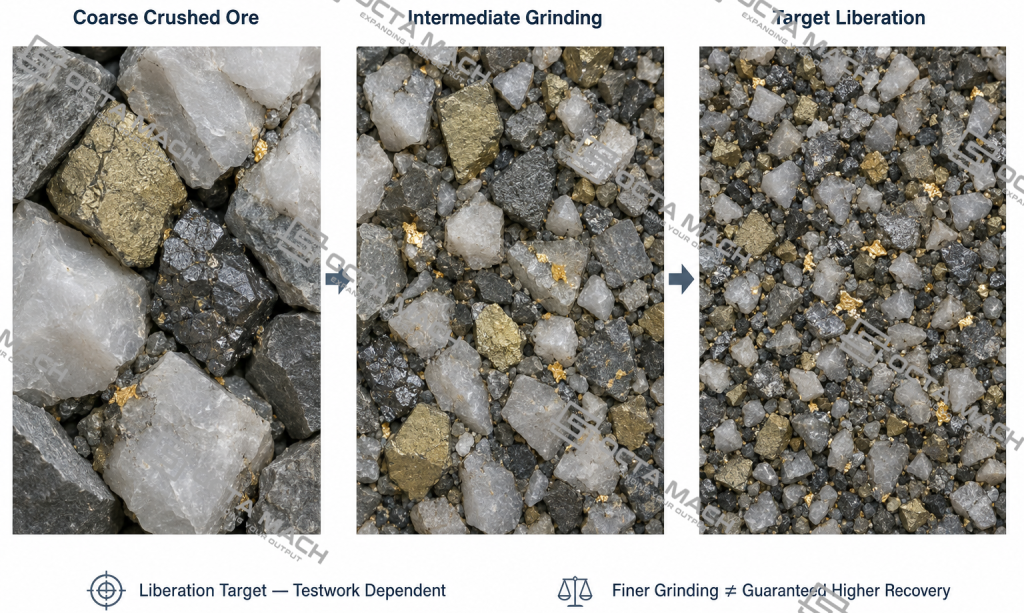
The correct grinding target should therefore be established using:
- gold particle-size distribution and occurrence;
- mineralogical association with quartz, pyrite, arsenopyrite or other minerals;
- liberation analysis;
- ore grindability;
- gravity-recoverable gold content;
- flotation response;
- cyanidation or other leaching response.
For coarse liberated gold, excessive grinding can also be unnecessary. For finely locked or refractory gold, simply making the ore finer may still be insufficient because the mineral host itself may require flotation or pretreatment.
Gold Ore Processing Routes After Crushing
The downstream Gold Ore Beneficiation route should be selected from mineralogy and metallurgical testwork.
| Gold Occurrence | Typical Processing Direction | Why |
| Coarse or liberated native gold | Grinding + gravity concentration | Uses the high density of liberated gold |
| Free-milling gold | Grinding + gravity where applicable + cyanide leaching / CIL / CIP | Gold is sufficiently exposed for conventional recovery |
| Sulfide-associated gold | Grinding + flotation, followed by concentrate treatment | Concentrates gold-bearing sulfide minerals |
| Refractory sulfide gold | Grinding + flotation and/or pretreatment before leaching | Gold may remain locked inside pyrite or arsenopyrite |
| Amenable oxidized ore | Crushing / sizing + heap leaching where applicable, or grinding + tank leaching | Route depends on permeability, liberation and leach response |
CIL and CIP should not be treated as identical processes. In CIL, leaching and activated-carbon adsorption take place within the same general circuit, while CIP normally performs adsorption after leaching.
Likewise, flotation should not be specified merely because an ore contains gold. It is particularly relevant when gold is associated with floatable sulfide minerals. Gravity concentration becomes attractive when sufficient gold is already liberated and has a suitable particle size for density-based separation.
Gold Ore Crushing Plant Capacity Configuration
The capacity figures below should be treated as Reference Crushing Capacity / Preliminary Configuration, not guaranteed Gold Ore Processing Plant throughput.
The hard-rock layouts in the supplied production-line material show how staged jaw, cone and screening circuits can be expanded from approximately 150–200 TPH to around 1000 TPH by increasing crusher duty, adding cone stages and using multiple screens or parallel equipment.
| Reference Crushing Capacity | Preliminary Hard-Rock Gold Configuration |
| 150–200 TPH | Feeder → Jaw Crusher → Cone Crusher → Closed-Circuit Screen → Grinding Preparation |
| 200–300 TPH | Feeder → Jaw Crusher → Single-Cylinder Cone → Multi-Cylinder Cone / Screen |
| 400–500 TPH | Large Jaw Crusher → Intermediate Cone → Fine Cone → Multiple Screens → Mill-Feed Stockpile |
| 600–800 TPH | Pre-Screening → Large Primary Jaw → Parallel / Multiple Cone Duties → Closed-Circuit Screening |
| Around 1000 TPH | High-capacity feeding → Primary Crushing → Multiple Secondary/Tertiary Cone Duties → Parallel Screens and Conveyors |
This is deliberately different from an aggregate production line. Gold Ore crushing does not normally end with 0–5, 5–10 or 20–31.5 mm commercial aggregate bins. The crushing section should instead produce the controlled feed required by the next grinding, gravity, flotation or leaching stage.
Large Gold Ore plants can also have different crushing and grinding throughputs. One published hard-rock gold circuit, for example, operated its crushing section at approximately 167 t/h while the grinding section was about 42 t/h. Surge bins or stockpiles can therefore decouple the two sections rather than forcing every machine to have the same instantaneous capacity.
Key Factors Controlling Gold Ore Plant Throughput
Rated crusher capacity alone does not equal complete-plant throughput.A stable Gold Ore Processing Plant depends on the interaction of ROM feed gradation, rock competency, quartz content, abrasiveness, moisture, clay, crusher chamber, CSS, screen cut, screen efficiency, circulating load, conveyor capacity and the downstream grinding circuit.
For example, reducing the screen cut increases the amount of oversize returning to the crusher. The crusher is then handling:
Fresh Feed + Circulating Oversize.
rather than fresh feed alone. This can increase chamber load and reduce net plant capacity even when the crusher itself has not changed.
For this reason, Gold Ore Processing Equipment should be selected as a coordinated circuit rather than as independent catalogue machines.
Recommended Equipment for Gold Ore Processing
OctaMach can configure the front-end and mineral-preparation stages according to actual ore characteristics.
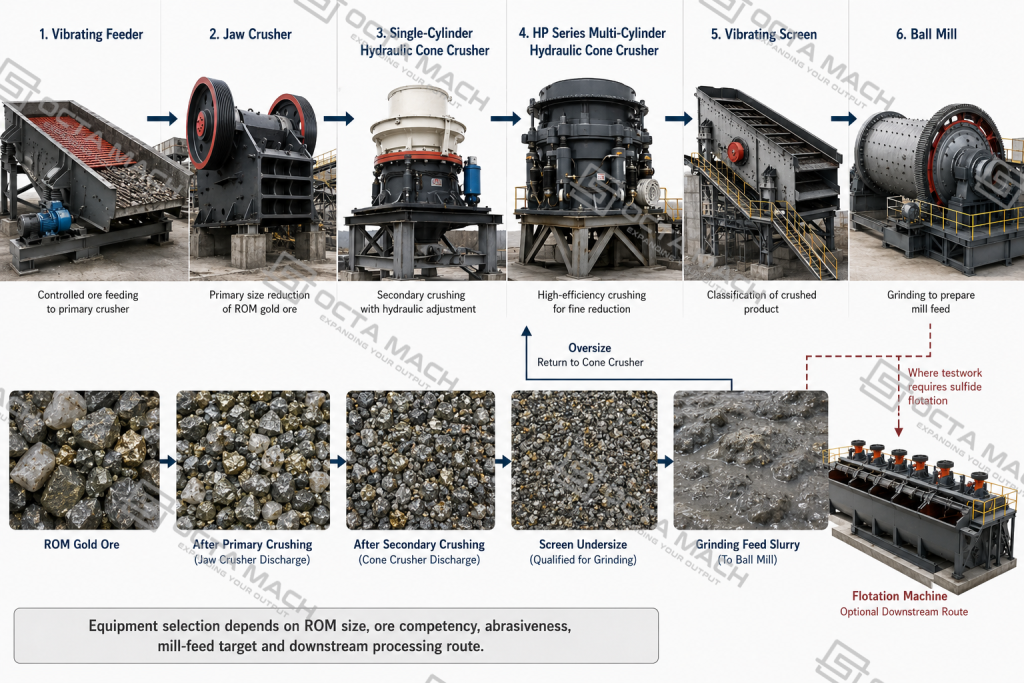
- Vibrating Feeder controls ROM delivery and can support pre-screening of fines.
- Jaw Crusher performs primary reduction of large hard-rock Gold Ore.
- Single-Cylinder Hydraulic Cone Crusher handles intermediate hard-rock crushing where controlled secondary reduction is required.
- HP Series Multi-Cylinder Hydraulic Cone Crusher supports higher-capacity secondary or tertiary crushing and closed-circuit duties.
- Vibrating Screen controls the crusher product cut and returns oversize for additional reduction.
- Ball Mill receives controlled crushed feed and reduces it to the liberation size required for beneficiation. OctaMach ball mills currently list feed sizes up to 25 mm and discharge ranges from 0.074 to 0.89 mm depending on the selected model and grinding circuit.
- Flotation Machine can be incorporated when testwork confirms that gold recovery depends on flotation of gold-bearing sulfide minerals. A complete flotation circuit normally also requires grinding, classification, conditioning and concentrate handling rather than the flotation cell alone.
OctaMach Gold Ore Processing Solutions
A practical Gold Ore Processing Plant should start with the ore, not with a predetermined crusher model.
For preliminary equipment selection, the following project data should be confirmed: maximum ROM lump size and feed-size distribution, required crushing capacity, mineralogical description, quartz and sulfide content, moisture and clay condition, abrasion or strength data where available, required mill-feed size, proposed beneficiation route, and metallurgical testwork results.
OctaMach can then coordinate primary crushing, secondary and tertiary crushing, closed-circuit screening and grinding preparation around the actual Gold Ore duty. Crusher model, cavity, feed opening, screen cut and Ball Mill configuration should only be finalized after these project inputs are established.
FAQ
Q: What is the hardness of Gold Ore?
A: Gold Ore does not have one fixed Mohs hardness. Native gold is about 2.5–3, but quartz is 7, pyrite is 6–6.5 and arsenopyrite is about 5.5–6. Quartz-rich hard-rock gold should therefore be treated as hard and potentially abrasive material when selecting crushing equipment.
Q: What size should Gold Ore be crushed to before a Ball Mill?
A: Many conventional circuits prepare Gold Ore to approximately 12–25 mm or smaller before ball milling, but the required feed depends on the mill and complete grinding circuit. OctaMach Ball Mills list a maximum feed of up to 25 mm depending on model.
Q: Which crusher is suitable for hard rock Gold Ore?
A: A Jaw Crusher is normally used for large ROM feed, followed by a Cone Crusher for harder and more abrasive secondary or tertiary crushing. The final combination depends on maximum feed size, capacity, abrasiveness and required grinding-feed size.
Q: Does every Gold Ore Processing Plant use the same beneficiation process?
A: No. Liberated free gold may favor gravity concentration, sulfide-associated gold may require flotation, free-milling ore may respond to cyanidation/CIL/CIP, and refractory ore may require pretreatment before leaching. Mineralogy and metallurgical testwork should determine the final flowsheet rather than a fixed Gold Ore process.