
Pebble used for aggregate and manufactured sand production is a naturally rounded stone formed by long-term transport, impact and abrasion in river channels and alluvial deposits. Its mineral composition varies with the source rock, while many deposits are silica-rich and have a dense, hard and wear-resistant structure. These properties make river pebble suitable for producing concrete aggregate, road-base material, pavement aggregate and manufactured sand, especially where controlled particle size and durable mineral aggregate are required.
Because river pebble is hard and abrasive, River Pebble Sand Making normally requires staged crushing rather than a single size-reduction step. A jaw crusher is used to reduce large raw pebbles at the primary stage, followed by one or more cone crushers for further compression crushing; when manufactured sand or improved particle shape is required, a VSI sand making machine is added for fine crushing and shaping. Screening then separates qualified sand and aggregate fractions and returns oversize material for further crushing, allowing the plant to produce manufactured sand together with graded aggregates according to the required capacity and final product sizes.
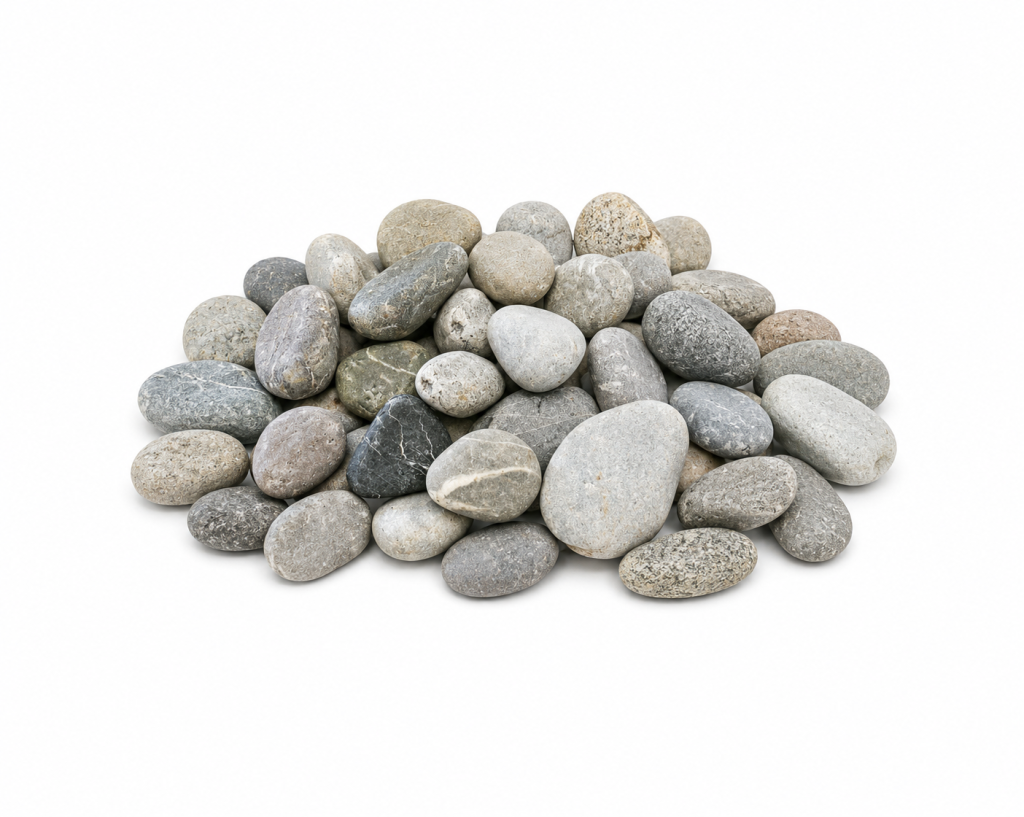
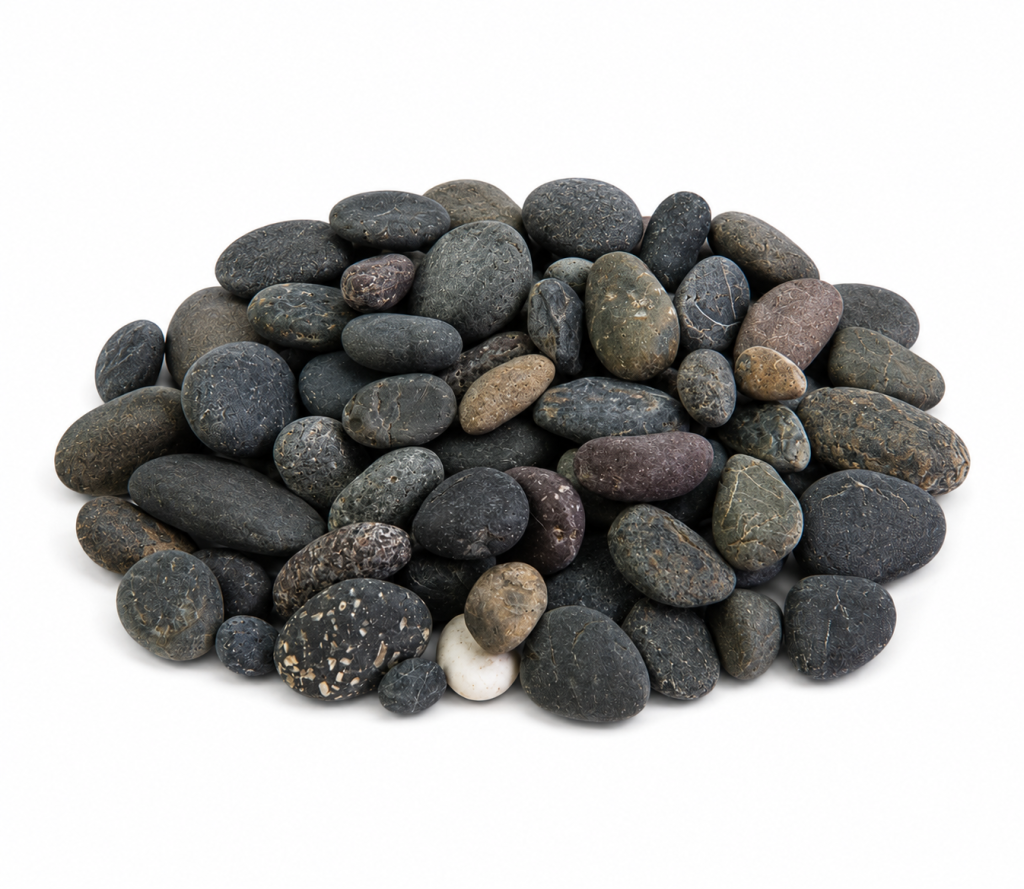
Pebble Characteristics
River pebble is a naturally rounded stone formed by long-term transport, collision and abrasion in river channels and alluvial deposits. Its composition depends on the original parent rock, although many deposits contain a high proportion of quartz and silica-bearing minerals. The surface is typically smooth and rounded, while the internal rock structure can remain dense, hard and resistant to weathering and abrasion.
| Property | Typical Characteristic |
|---|---|
| Geological Particle Size | Pebble: 4–64 mm; larger rounded particles from 64–256 mm are classified as cobbles |
| Mineral Composition | Source-rock dependent; commonly contains quartz and other silica-bearing minerals |
| Mohs Hardness | Variable by rock type; quartz-rich material can approach Mohs 7 |
| Quartz Density | Approximately 2.65 g/cm³ as a mineral reference |
| Particle Shape | Rounded to sub-rounded |
| Surface Texture | Generally smooth due to prolonged water transport and abrasion |
| Color | Commonly gray, white, brown, yellow or mixed, depending on mineral composition |
| Durability | Generally good resistance to weathering and surface abrasion in hard, silica-rich material |
Quartz-rich river pebbles are typically harder, while pebbles derived from softer parent rocks may show lower hardness and different physical properties. Their composition, hardness, density and color can therefore vary significantly between deposits.
River Pebble Sand Making Process
A river pebble sand production line normally separates coarse reduction, secondary and tertiary crushing, sand making, screening and washing into different processing stages. The exact route depends on raw feed size, required capacity, final product size and the proportion of manufactured sand required.
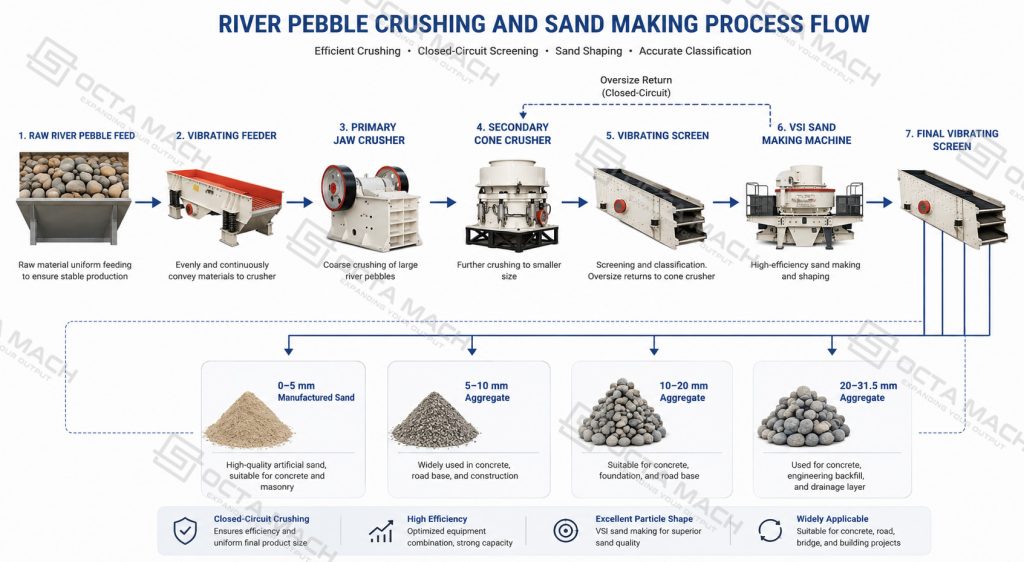
| Process Stage | Main Function | Typical Equipment |
|---|---|---|
| Feeding and Pre-screening | Controls feed rate and removes soil, natural fines or unsuitable undersize before crushing | Vibrating Feeder |
| Primary Crushing | Reduces large river pebbles to a size suitable for downstream crushing | Jaw Crusher |
| Secondary Crushing | Further reduces hard and abrasive material through compression crushing | Cone Crusher |
| Tertiary Crushing, When Required | Processes circulating oversize and reduces material further before sand making | Cone Crusher |
| Sand Making and Shaping | Produces fine material and improves particle shape for manufactured sand | VSI Sand Making Machine |
| Final Screening | Separates qualified sand and aggregate fractions and returns oversize to the crushing circuit | Vibrating Screen |
| Washing, When Required | Removes excessive fines, clay or surface contamination from the finished sand | Sand Washing Machine |
In the supplied hard-rock production configurations, oversized material can be returned to the cone-crushing or VSI circuit for further reduction rather than entering the finished stockpile directly. This closed-circuit arrangement helps control final particle size while allowing the same plant to produce manufactured sand and several graded aggregate fractions.
River Pebble Crusher Selection
River pebble crushing equipment should be selected from the material properties first, followed by the required reduction ratio and finished-product specification. Hardness alone does not determine the process. Abrasiveness, incoming size distribution, desired sand percentage and circulating load are equally important.
River Pebble Properties That Affect Crushing
River pebble is commonly treated as a hard and abrasive feed in aggregate production. Its rounded external shape does not mean the material breaks easily. Dense silica-rich pebbles can place substantial wear demand on crusher liners and sand-making components.
The main material factors affecting a river pebble crusher plant include:
- Hardness: affects the force required for size reduction and the suitability of compression crushing.
- Abrasiveness: directly influences liner wear, wear-part replacement intervals and operating cost.
- Mineral composition: silica-rich material generally requires closer attention to wear-part selection.
- Feed size: determines jaw crusher opening and the reduction required before secondary crushing.
- Feed gradation: affects chamber loading and the amount of material entering each downstream stage.
- Moisture and clay content: influence pre-screening, screen efficiency and whether washing is necessary.
- Required sand ratio: determines how much material must enter the VSI sand-making stage rather than leave the circuit as coarse aggregate.
For this reason, river pebble production lines normally favor compression crushing for the main reduction stages. Jaw crushers and cone crushers reduce the material without making high-speed impact crushing the primary method for all stages.
Crushing Stage Configuration for River Pebble
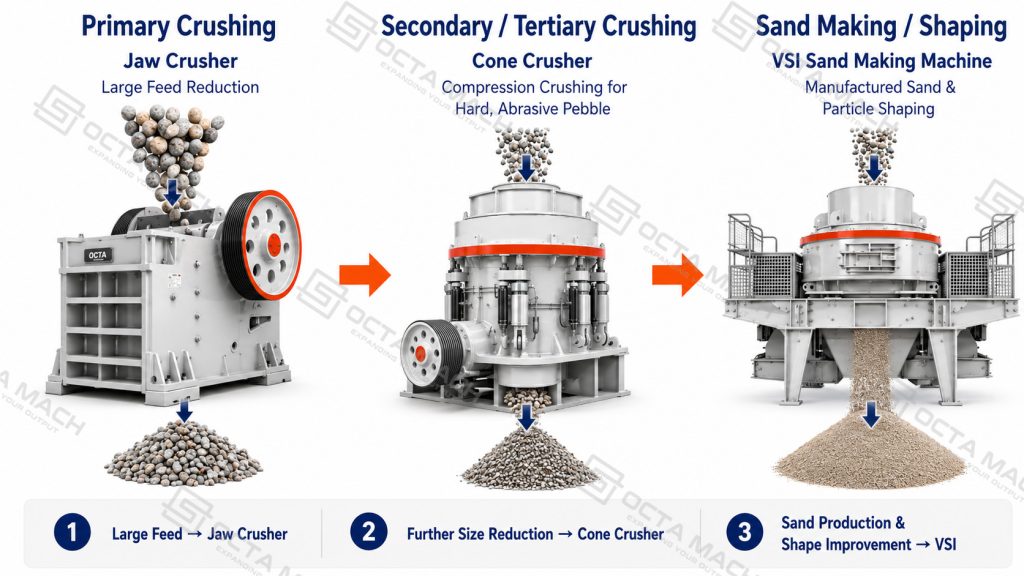
The crushing-stage configuration for river pebble should be determined from the required size-reduction duty rather than from material hardness alone. Key design inputs include maximum feed size, feed gradation, target product size, plant throughput, circulating load, and the proportion of manufactured sand required. For hard and abrasive river pebble, the main reduction stages normally rely on jaw and cone crushing, while VSI equipment is added when finer sand production or particle shaping is required.
| Configuration | Typical Crushing Route | Suitable Processing Condition | Main Purpose |
|---|---|---|---|
| Two-Stage Crushing | Jaw Crusher → Cone Crusher | Moderate reduction requirement; relatively coarse aggregate is the main product; one cone stage can control the required discharge | Primary size reduction followed by secondary compression crushing |
| Three-Stage Crushing | Jaw Crusher → Secondary Cone Crusher → Tertiary Cone Crusher | Larger feed, finer aggregate requirement, higher circulating load, or insufficient reduction from one cone stage | Distributes the reduction ratio across two cone stages and provides more controlled downstream feed |
| Crushing + VSI Sand Making | Jaw Crusher → Cone Crusher → Optional Tertiary Cone Crusher → VSI | Manufactured sand is required, or finished aggregate needs additional shaping | Produces fine material and improves particle shape after the main compression-crushing stages |
For two-stage crushing, the jaw crusher performs coarse reduction and the cone crusher completes the main secondary reduction, making this arrangement suitable when the required aggregate size can be achieved without an additional fine-crushing stage. When finer aggregate, larger feed, or higher circulating load requires further size control, a three-stage circuit adds a tertiary cone crusher to distribute the reduction duty and provide a more controlled feed for downstream processing.
For river pebble sand making, the VSI is positioned after the main compression-crushing stages. While cone crushers are responsible for size reduction, the VSI mainly increases the manufactured-sand fraction and improves particle shape before final screening. The final crushing route should therefore be selected according to feed size, plant capacity, target gradation, circulating load, and required manufactured-sand ratio, which together determine whether the plant uses two-stage crushing, three-stage crushing, or an additional VSI shaping stage.
Crusher Selection by Crushing Stage
River pebble crushing requires each machine to handle a specific reduction or classification duty within the overall circuit. Equipment selection should therefore follow the material flow from primary size reduction through secondary and tertiary crushing to final shaping, screening and, where required, sand washing.
| Position in the Line | Recommended Equipment | Engineering Role |
|---|---|---|
| Primary Crushing | Jaw Crusher | Accepts large feed and performs the first major size reduction |
| Secondary Crushing | Single-Cylinder Cone Crusher or suitable Cone Crusher | Reduces hard, abrasive river pebble through compression |
| Tertiary Crushing | Multi-Cylinder Cone Crusher | Controls finer aggregate size and processes circulating oversize |
| Sand Making / Shaping | VSI Sand Making Machine | Produces manufactured sand and improves aggregate particle shape |
| Size Classification | Vibrating Screen | Separates finished fractions and controls material recirculation |
| Fine Aggregate Cleaning | Sand Washer | Removes excessive fines or contamination when the final sand specification requires washing |
A jaw crusher for river pebble is selected mainly according to maximum feed size and the required primary discharge, while cone crusher selection depends on throughput, incoming particle size and target discharge. The VSI sand making machine should be sized according to the material that actually enters the shaping stage rather than the nominal capacity of the whole plant, because part of the crushed material may already leave as finished aggregate after intermediate screening and only selected fractions continue to VSI sand making and shaping.
River Pebble Sand Making Plant Configurations by Capacity
Higher-capacity river pebble sand making plants require the crushing duty to be distributed across more equipment rather than simply increasing the size of a single crusher. As throughput rises, the secondary and tertiary stages must handle greater circulating load, while the VSI stage must receive a controlled feed quantity suitable for sand making and shaping.
The following configurations are based on the supplied hard-rock sand production process plans and provide a reference for matching river pebble with different crushing stages.
| Reference Capacity | Primary Crushing | Secondary / Tertiary Crushing | Sand Making / Shaping | Typical Configuration Logic |
|---|---|---|---|---|
| 150–200 t/h | PE750×1060 Jaw Crusher | HP300 Multi-Cylinder Hydraulic Cone Crusher | 5X9532 VSI | Jaw crushing followed by cone reduction and VSI shaping |
| 200–300 t/h | PE900×1200 Jaw Crusher | CS440 Single-Cylinder Cone + HP300 Multi-Cylinder Cone | 5X1145 VSI | Separate secondary and tertiary cone stages before sand making |
| 400–500 t/h | CX125 European Jaw Crusher | CS440 Single-Cylinder Cone + 2 × HP300 Multi-Cylinder Cone | 2 × 5X1145 VSI | Parallel fine crushing and sand-making equipment for higher throughput |
These configurations illustrate typical river pebble sand-making layouts under the stated capacity ranges. Actual throughput should be verified against the specific feed and operating conditions, including:
- Raw feed size and gradation
- Pebble hardness and abrasiveness
- Crusher closed-side setting
- Screen aperture and screening efficiency
- Circulating load
- Required manufactured-sand proportion
- Moisture and clay content
- Equipment operating condition
As plant throughput increases, the required crushing duty must be redistributed across the intermediate and shaping stages. The secondary and tertiary crushing sections must provide sufficient reduction and stable feed before the material enters the VSI, rather than relying on VSI capacity alone to absorb the higher plant load.
Finished Sand Size, Screening and Washing
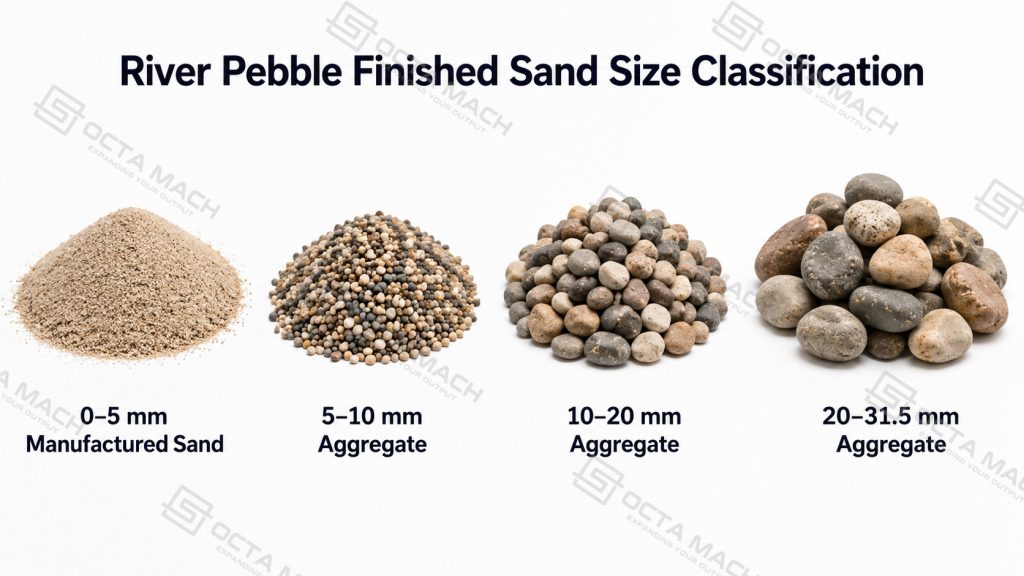
River pebble sand making can produce manufactured sand together with multiple graded aggregate fractions in the same production line. Final product size is controlled by the screen configuration and closed-circuit crushing arrangement rather than by crusher discharge alone, allowing oversize material to return for further reduction before it enters the finished-product stockpile.
| Product Size | Typical Product |
|---|---|
| 0–5 mm | Manufactured sand / fine aggregate |
| 5–10 mm | Small graded aggregate |
| 10–20 mm | Medium graded aggregate |
| 20–31.5 mm | Coarse graded aggregate |
Typical river pebble production can therefore be configured to produce 0–5 mm manufactured sand together with 5–10 mm, 10–20 mm and 20–31.5 mm aggregates. The final grading should be selected according to the required concrete aggregate specification, road construction requirement or manufactured-sand target, with screen apertures and crusher settings matched to the required product distribution.
Screening also controls the circulating load within the crushing circuit. In configurations using these product ranges, material above 40 mm can be returned to the cone-crushing stage for further reduction, while oversize material after VSI shaping is recirculated before final classification. This closed-circuit arrangement limits off-size material, stabilizes downstream feed and improves control of the final aggregate and sand grading.
Sand washing is selected according to the condition of the feed and the required quality of the 0–5 mm manufactured-sand fraction. When the feed contains adhered clay, excessive stone powder or other fine contamination, washing can improve sand cleanliness and grading before stockpiling. Where dry screening already achieves the specified fines content and particle-size distribution, the sand can proceed directly to the finished-product stage without an additional wet-washing circuit.
OctaMach River Pebble Sand Making Solutions
OctaMach configures river pebble sand making plants according to feed condition, required capacity, target manufactured-sand output and finished aggregate grading, integrating vibrating feeders, jaw crushers, cone crushers, VSI sand making machines, vibrating screens, sand washing equipment and belt conveyors into a coordinated production system. The supply scope can also include material-flow layout between crushing, screening, recirculation and finished-product handling, including intermediate transfer points, return conveyors and stockpile routing, so the complete line is matched to the required throughput and final product distribution.
FAQ
Q: Cone crusher or impact crusher for river pebble?
A: For hard and abrasive river pebble, a cone crusher is generally preferred for the main secondary and tertiary reduction because compression crushing limits the wear exposure associated with continuous high-speed impact. VSI equipment can then be used downstream when additional sand production or particle shaping is required.
Q: Should natural 0–5 mm material be crushed again?
A: Usually not if the natural fines already meet the required grading and cleanliness criteria. Pre-screening can bypass the 0–5 mm fraction from the main crushing circuit and direct it to classification or washing where appropriate, reducing unnecessary crusher load, wear and energy consumption.
Q: Does all river pebble need to pass through the VSI crusher?
A: No. Intermediate screening can remove aggregate fractions that already meet the required size, while only the material assigned to manufactured-sand production or additional shaping is sent to the VSI. Bypassing qualified aggregate reduces unnecessary VSI load, wear-part consumption and recirculation.
Q: Should VSI capacity match the total plant capacity?
A: Not necessarily. VSI capacity should be based on the actual material entering the sand-making and shaping stage, including the required manufactured-sand fraction and applicable recirculating load. Aggregate removed by intermediate screening should not be counted as VSI feed.