
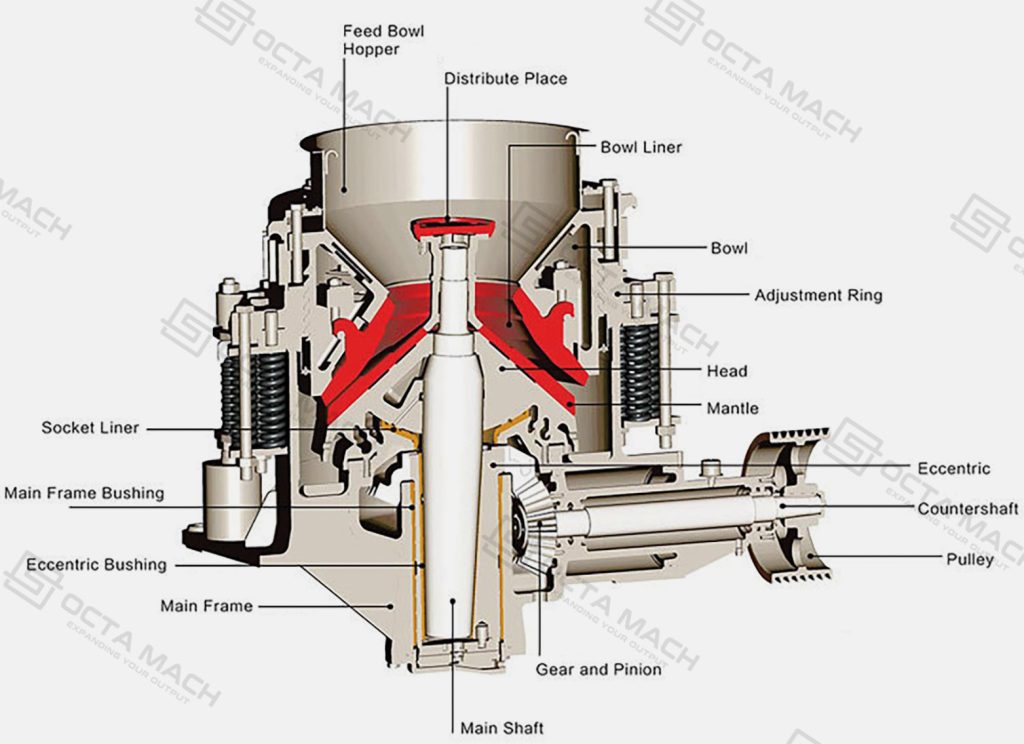
Cone crusher mantle and concave are the two main wear liners that form the crushing chamber. The mantle is fitted to the moving cone head, while the concave, also called the bowl liner, is installed inside the stationary bowl. Their profiles work together to compress rock as it moves through the chamber, directly affecting feed acceptance, discharge size, capacity and liner wear.
Octa Mach supplies high-manganese steel cone crusher mantles and concaves for HP multi-cylinder hydraulic and CS/CH single-cylinder hydraulic cone crushers, with Mn13, Mn18 and Mn22 material options. For replacement orders, the material grade, liner profile and mounting dimensions are matched to the specific crusher model and chamber configuration.
Cone Crusher Mantle and Concave Specifications
| Parameter | Cone Crusher Mantle | Cone Crusher Concave |
|---|---|---|
| Alternative Name | Head Liner | Bowl Liner |
| Material | High Manganese Steel | High Manganese Steel |
| Available Grades | Mn13, Mn18, Mn22 | Mn13, Mn18, Mn22 |
| Chamber Profiles | Extra Coarse, Coarse, Medium, Fine, Extra Fine | Matched chamber profiles |
| Construction | One-piece Cast Liner | One-piece Cast Liner |
| Installation Position | Moving Cone Head | Stationary Bowl |
| Mounting | Head Seating and Locking Assembly | Bowl Seating and Retention System |
| Reference Equipment | HP and CS/CH Series | HP and CS/CH Series |
Reference Equipment Models
| Crusher Series | Reference Models |
|---|---|
| HP Multi-Cylinder Hydraulic Cone Crusher | HP100, HP200, HP300, HP400, HP500, HP800 |
| CS/CH Single-Cylinder Hydraulic Cone Crusher | CS420, CS430, CS440, CH430, CH440, CS660, CH660, CH870, CH890 |
The listed models are equipment references, not interchangeable liner specifications. Exact dimensions, part numbers, chamber codes and mounting arrangements must be checked against the corresponding crusher configuration.
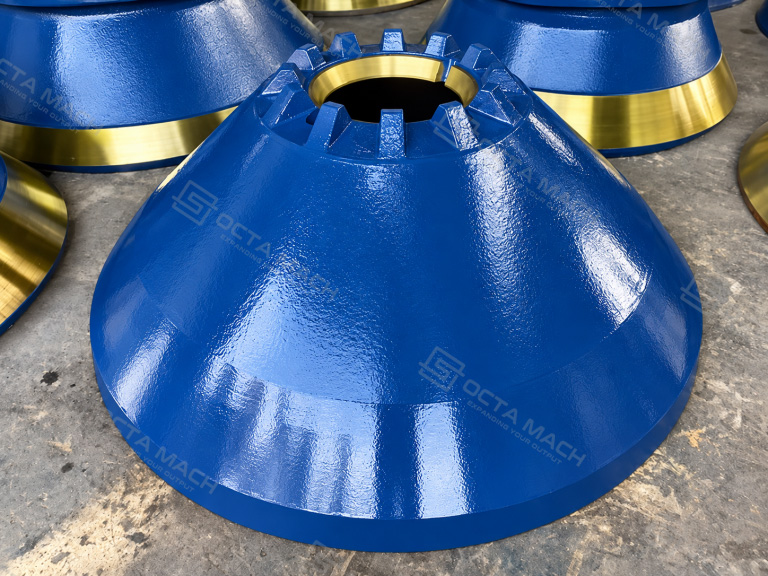
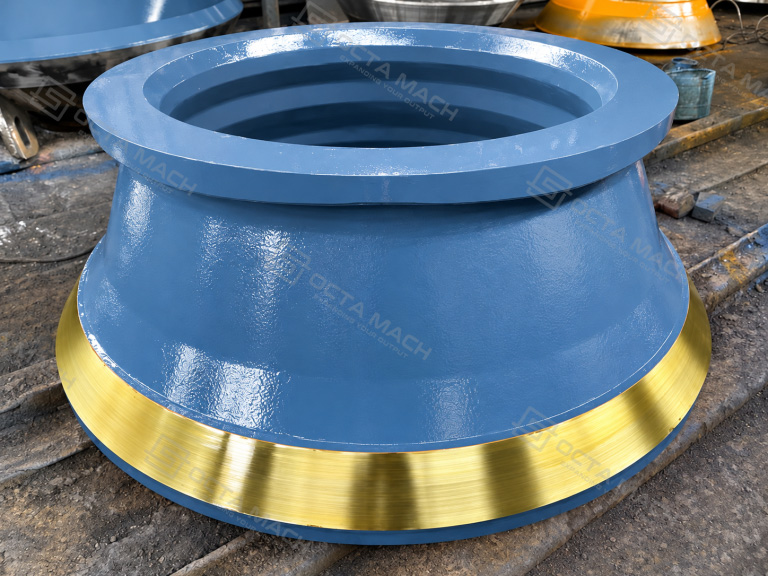
Mantle and Concave Structure and Function
Cone Crusher Mantle
The cone crusher mantle is mounted on the moving cone head and forms the inner crushing surface. Its conical profile follows the contour of the head, with the upper and lower sections designed to work against the corresponding concave.
As the eccentric mechanism moves the cone head, the mantle approaches and moves away from the concave during each crushing cycle. Rock entering the chamber is compressed between the two surfaces. Repeated loading gradually wears the mantle, particularly in areas where material contact and compression are concentrated.
The mantle profile also determines how material enters the crushing zone and moves toward the discharge opening. A coarse profile accommodates larger feed particles, while finer profiles are intended for smaller feed sizes and more restricted crushing chambers.
Cone Crusher Concave / Bowl Liner
The cone crusher concave, commonly called the bowl liner, is fitted inside the stationary bowl. Its curved inner surface forms the outer boundary of the crushing chamber and receives the reaction forces generated during compression.
The concave must match the mantle profile. Differences in their contours can change the width of the crushing space along the chamber, affecting material flow and the distribution of crushing forces.
During operation, abrasive contact gradually removes material from the concave’s inner surface. As the liner wears, the original chamber profile changes. Even if the crusher continues running, the altered geometry can affect product gradation, capacity and adjustment requirements.
Both components should therefore be specified as a matched liner configuration, rather than selected independently by weight or general model designation.
Manganese Steel Grades and Material Selection
A key feature of manganese steel is its response to impact during crushing. When the liner experiences sufficient impact and plastic deformation, its working surface gradually hardens through work hardening, while the material beneath retains the toughness needed to withstand continued loading.
Mn13, Mn18 and Mn22 are three available material grades for cone crusher mantles and concaves. They differ in manganese content and material response under impact and abrasive conditions. The following comparison outlines their main characteristics and typical selection factors.
| Material Grade | Approximate Mn Content | Material Characteristics | Selection Considerations |
|---|---|---|---|
| Mn13 | 11–14% | High toughness with work-hardening capability under impact | Feed size, impact intensity and rock characteristics |
| Mn18 | 17–19% | Higher manganese content, suitable for evaluating combined impact and abrasive wear | Abrasiveness, feed gradation and operating conditions |
| Mn22 | 20–23% | Higher-manganese option for applications requiring specific wear resistance | Sufficient impact to develop work hardening and actual liner wear patterns |
The manganese content ranges shown above are indicative. Actual chemical composition should be verified against the agreed material specification and mill test certificate.
Work hardening plays an important role in the performance of manganese steel liners. Under sufficient impact, the working surface becomes harder while the underlying material retains its toughness. If the feed material is relatively soft or produces limited impact, this hardening effect may be less pronounced. As a result, a higher manganese grade does not automatically translate into longer liner life.
When selecting a material grade, the following operating conditions should be considered:
- Rock properties: Hardness, mineral composition and silica content.
- Feed conditions: Maximum feed size, particle distribution and impact intensity.
- Wear characteristics: Abrasiveness and the wear pattern of previously installed liners.
- Crushing chamber: Mantle and concave profiles, chamber configuration and operating setting.
- Material quality: Chemical composition, heat treatment and quenching condition.
Previous liner replacement records from the same crusher can also help identify which material grade performs better under actual operating conditions.
Cone Crusher Mantle and Concave Profiles
The mantle and concave profiles form the working geometry of the crushing chamber. Their contours determine the space available for material to enter, move through and be compressed inside the crusher. A change in liner profile can affect the maximum feed size, material flow, reduction ratio and final product gradation.
Cone crushers are available with different chamber configurations to handle different feed conditions. The main options generally range from extra coarse to extra fine, with each profile designed for a particular combination of feed size and crushing requirements.
| Chamber Profile | Typical Application | Main Selection Factors |
|---|---|---|
| Extra Coarse | Crushing larger feed material | Maximum feed size and feed opening |
| Coarse | Secondary crushing with relatively large feed | Feed gradation and required reduction |
| Medium | General secondary and tertiary crushing | Feed distribution and target product size |
| Fine | Tertiary crushing with smaller feed | CSS and required product gradation |
| Extra Fine | Fine crushing with well-controlled feed | Feed size, fines content and discharge requirements |
The available chamber profiles and their designations vary between crusher models. HP and CS/CH series also have different liner configurations, so a chamber code from one series should not be used to identify a replacement liner for another.
Feed size and CSS should be checked together when selecting a replacement chamber. A fine profile is not suitable simply because a smaller final product is required; the incoming material must also fall within the specified feed limits. If the feed is too large or poorly distributed, the chamber may not operate as intended, and liner wear can become uneven.
For replacement orders, the crusher model, chamber designation, existing part number and actual feed conditions are useful references for confirming the correct mantle and concave profiles.
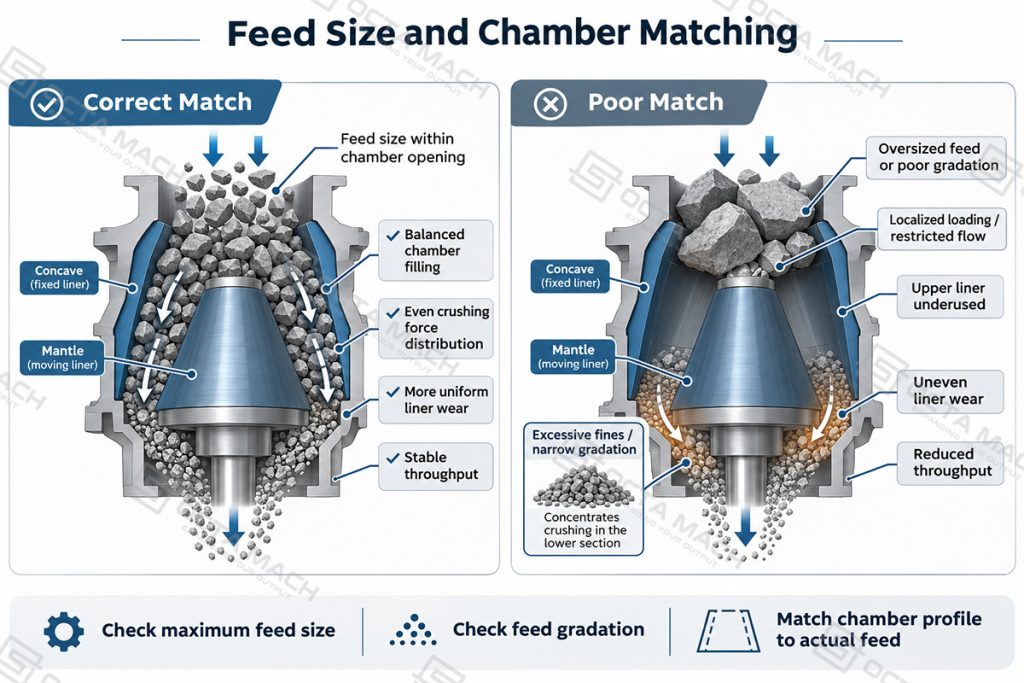
Feed Size and Chamber Matching
The maximum feed size must remain within the selected chamber’s specified opening. Oversized particles can create localized loading or prevent material from moving properly through the chamber.
Feed gradation is equally important. A feed containing excessive fines or a narrow particle-size distribution may change how the chamber fills and how crushing forces are distributed. This can lead to uneven liner wear and reduced throughput.
For example, installing a coarse chamber while supplying predominantly fine material can concentrate crushing in the lower section of the liners. The upper working surface may remain underused, resulting in an uneven wear profile.
Closed Side Setting (CSS)
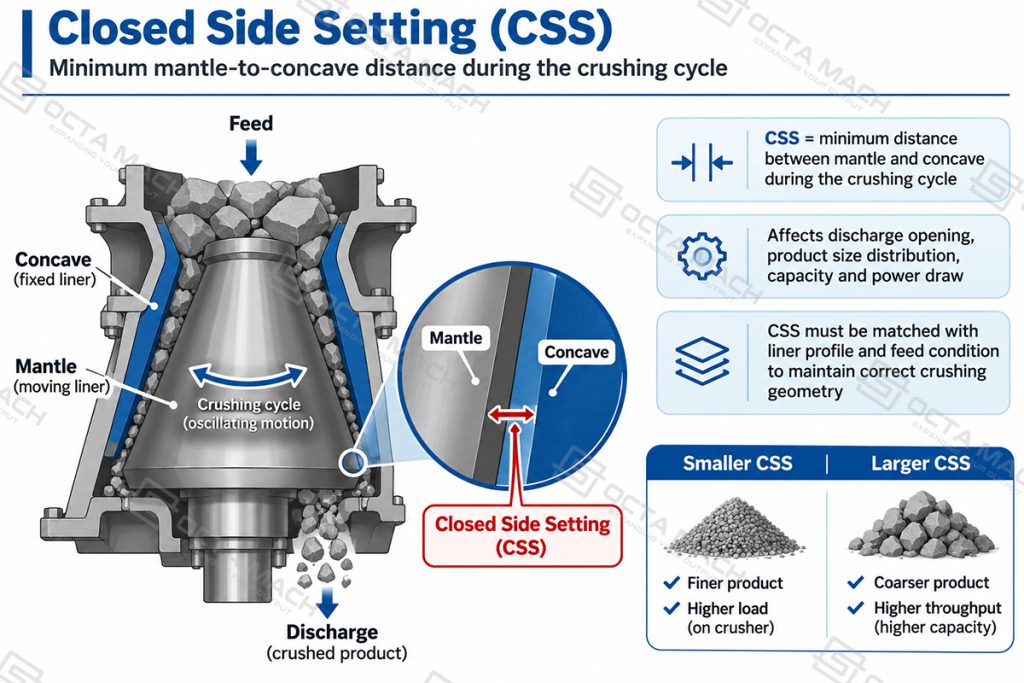
CSS (Closed Side Setting) is the minimum distance between the mantle and concave during the crushing cycle. It influences the discharge opening, product size distribution, capacity and power draw.
CSS should be considered together with the liner profile. Reducing the setting without checking the feed condition and chamber capacity may increase operating load without delivering the expected improvement in product size.
When replacing mantles and concaves, the selected profiles must maintain the intended crushing geometry at the specified operating setting.
Mantle and Concave Manufacturing
Cone crusher mantles and concaves are large cast wear components. Their service performance depends on more than the nominal steel grade. Casting integrity, chemical composition, heat treatment and dimensional accuracy all affect the finished liner.
The main manufacturing and inspection stages include the following.
1. Pattern and Mold Preparation
The casting pattern is prepared according to the component drawing. Shrinkage allowance, wall thickness and the shape of the working surface must be considered to achieve the required finished dimensions.
2. Melting and Casting
The steel charge is melted and adjusted to meet the specified chemical composition. Pouring conditions and mold design affect solidification and the risk of casting defects, particularly in thick sections and complex transitions.
3. Solution Heat Treatment
High manganese steel castings require suitable heat treatment to obtain the required toughness and ductility. The treatment generally involves heating to the specified solution-treatment temperature, holding as required by the casting section and alloy composition, followed by rapid quenching.
The actual temperature and treatment cycle should follow the applicable material specification and approved manufacturing procedure.
4. Finishing and Machining
After heat treatment, excess casting material is removed and the liner is cleaned. Critical seating surfaces, locking interfaces and other specified dimensions are checked or machined according to the component drawing.
5. Final Inspection
The finished mantle and concave are checked against the agreed technical requirements before packing. Inspection should cover material identity, heat-treatment condition, critical dimensions and visible casting condition.
Mantle and Concave Wear and Replacement
The mantle and concave are exposed to repeated impact, compression and abrasion during crushing. As the working surfaces wear down, the shape of the crushing chamber gradually changes. Wear is not always uniform: feed distribution, rock properties, chamber profile and operating conditions can cause certain areas to wear faster than others.
Uneven Wear Patterns
Uneven wear can often be seen when one side of the mantle or concave has lost more material than the opposite side. This may occur when feed enters the chamber off-center or is distributed unevenly across the crushing cavity.
The wear pattern should be checked together with the feed arrangement and chamber filling condition. Replacing the liners without addressing the cause of uneven loading may result in the same wear pattern appearing on the new set.
Changes in Crushing Chamber Geometry
As the mantle and concave wear, their original profiles become flatter or change shape, altering the space available for material compression. This can affect the reduction ratio, product gradation and throughput.
Operators may need to adjust the Closed Side Setting (CSS) to maintain the required discharge size. However, CSS adjustment cannot restore the original chamber profile once significant liner material has been lost. The remaining liner profile should therefore be considered alongside the operating setting.
Localized Wear and Surface Damage
Deep grooves, concentrated material loss and visible cracks require closer inspection. Localized wear can reduce the effective thickness of the liner in specific areas, while cracks or casting damage may affect its continued serviceability.
During inspection, attention should also be given to the seating surfaces, contact areas and supporting components. Damage or poor contact at these locations can affect how the replacement liner is fitted and supported.
When to Replace Cone Crusher Liners
Liner replacement should be based on the manufacturer’s allowable wear limits, measured profile changes and actual crusher performance rather than operating hours alone. A significant reduction in liner thickness, loss of the intended chamber profile or damage affecting structural integrity may indicate that replacement is necessary.
The mantle and concave should be checked together when ordering replacement parts. If only one liner is being replaced, the remaining liner’s wear condition and profile compatibility should be assessed first. During installation, seating surfaces, locking components and backing arrangements, where applicable, should be checked to ensure proper fitting and support.
Applications of Cone Crusher Mantle and Concave
Granite and Basalt Aggregate Production
In a quarry processing granite or basalt, a cone crusher commonly receives material from a primary jaw crusher. The incoming feed may contain a wide range of particle sizes, and the liner must handle repeated compression and abrasive contact.
The selected chamber should accommodate the actual feed opening and produce the required intermediate aggregate size before screening. Consistent feed distribution helps prevent excessive wear on one side of the mantle and concave.
Iron Ore and Copper Ore Crushing
In mineral-processing plants, cone crushers are often installed between primary crushing and downstream screening or grinding. Ore characteristics can vary between production areas, creating changes in feed hardness and abrasiveness.
The manganese steel grade and chamber profile should be assessed against the actual ore properties. A liner selected only by its manganese percentage may not perform as expected if the impact conditions are insufficient for work hardening.
Tertiary Crushing and Manufactured Sand
When a cone crusher operates after secondary crushing, the incoming material is generally smaller and the required product gradation is more restricted. Fine or extra-fine chamber profiles may be considered, provided the feed size remains within the manufacturer’s limits.
The mantle and concave must maintain the intended compression profile. Their condition, together with CSS and feed distribution, influences the material delivered to the vibrating screen or subsequent sand-making equipment.
Why Choose Octa Mach
Octa Mach supplies cone crusher wear parts for HP multi-cylinder hydraulic and CS/CH single-cylinder hydraulic cone crusher series. The range includes mantles and bowl liners, with Mn13, Mn18 and Mn22 material options.
For replacement requirements, we work from the equipment model, component drawings and technical specifications to identify the required liner configuration. This is particularly important when the same crusher model has multiple chamber options or when an older machine needs a replacement component.
Beyond cone crusher mantles and bowl liners, Octa Mach’s crusher parts range also includes fixed and swing jaw plates, cheek plates and cone crusher feed plates. For replacement orders, component dimensions, working profiles, material grades and mounting arrangements are checked against the relevant crusher model and technical drawings.
For customers replacing worn liners, the existing component drawing, part number or clear photographs of the installed parts provide useful reference information. Feed material and operating conditions can also help clarify whether the existing liner specification remains suitable.
FAQuestions
Q1:Can I replace the cone crusher mantle without replacing the concave?
A1:Yes, but the remaining concave must be checked for wear and profile compatibility. If the two liners no longer form the specified crushing chamber, replacing them as a matched set is generally preferable.
Q2:Are cone crusher mantles interchangeable between different manufacturers?
A2:Not necessarily. Similar-looking liners may have different seating dimensions, locking arrangements and chamber profiles. Verify the part number and original technical drawing before ordering.
Q3:Does a heavier mantle or bowl liner provide a longer service life?
A3:Not by itself. Service life depends on usable wear material, liner geometry, alloy composition, heat treatment and operating conditions. Weight alone is not a reliable comparison.
Q4:Can I use Mn22 instead of Mn18 for every cone crusher application?
A4:No. Mn22 should be selected according to impact intensity, abrasiveness and work-hardening conditions. Higher manganese content does not guarantee better wear performance in every application.
Q5:What information is needed to identify an old or unmarked cone crusher liner?
A5:Provide the crusher model, equipment serial number, component dimensions, photographs and any available drawings. The liner profile and mounting interfaces should be verified before confirming a replacement.