
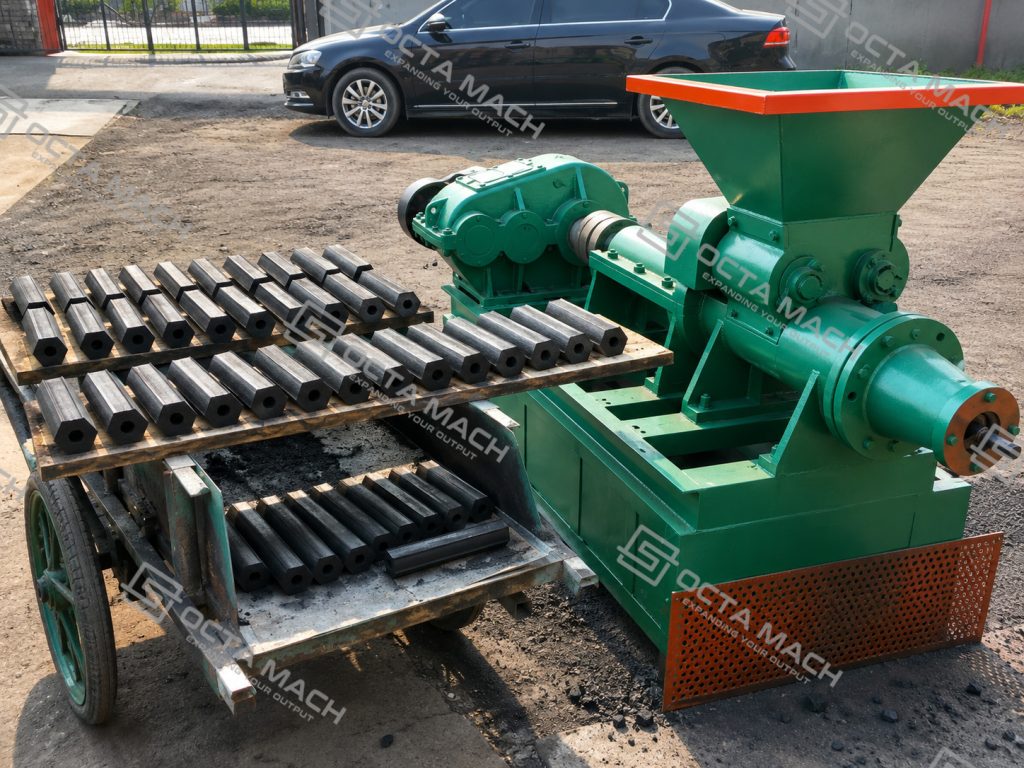
coal rod extrusion machine converts prepared coal fines, coke powder or carbonized charcoal powder into continuous fuel rods by forcing a conditioned powder mixture through a forming die. The material is conveyed and compressed by a rotating screw rather than by two pocketed rollers, allowing the machine to produce round, hollow, hexagonal, square or other continuous bar sections that can be cut to the required length.
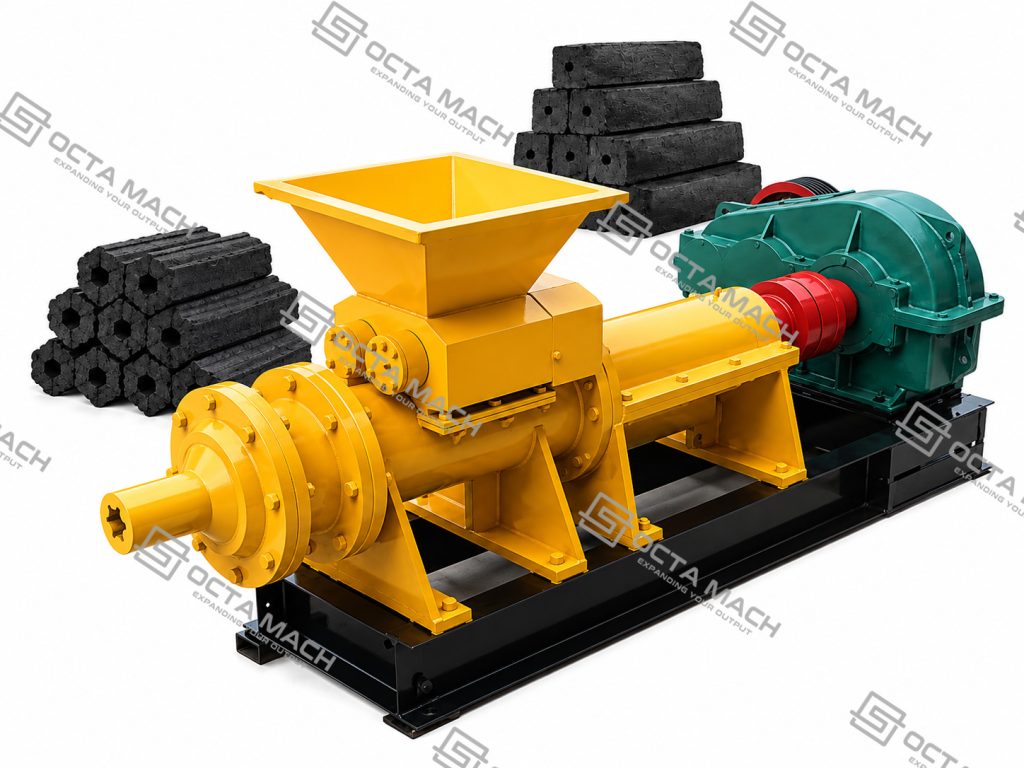
The MBJ-series coal rod machine covers nominal capacities from 1 to 12 t/h. Its main structure includes a feed hopper, drive motor, transmission system, propulsion shaft, spiral impeller, compression barrel and replaceable forming die. Depending on regional terminology, the same equipment may also be described as a coal rod extruder, coal stick extruder machine, coal bar extruder machine or screw extrusion coal briquette machine. Manufacturer descriptions consistently identify screw conveying, progressive compression and die forming as the central operating principle.
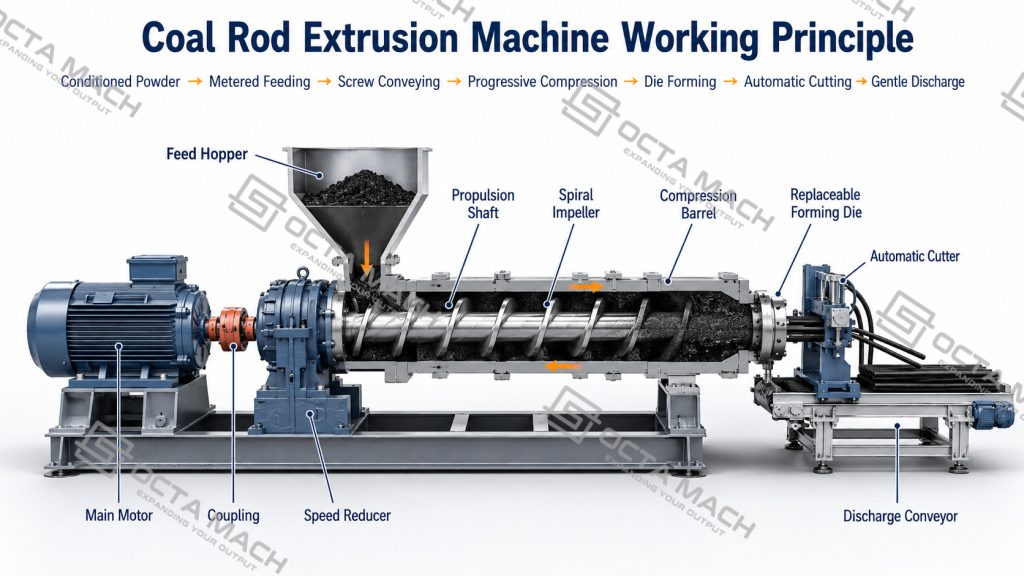
Coal Rod Extrusion Machine Working Principle
Power from the main motor is transmitted through the drive and reduction system to the propulsion shaft. Spiral vanes mounted on the shaft draw the conditioned material from the feed zone and move it toward the forming head.
As the available flow area becomes more restricted, the powder particles are rearranged and progressively compacted. Friction between the material, screw, barrel and die generates resistance, while the forming die provides the back pressure required to consolidate the mixture. The compacted feed then leaves the die as a continuous coal rod.
A cutter can be installed after the discharge head to divide the extruded product into controlled lengths. The fresh rods are then transferred carefully to drying, curing or cooling equipment according to the binder system and final application. Similar commercial machines use a motor, transmission, coupling, propulsion shaft and forming head in this sequence, while complete production lines commonly add a crusher, mixer, feeder, conveyor and dryer.
The operating sequence can be summarized as:
Conditioned powder → Metered feeding → Screw conveying → Progressive compression → Die forming → Cutting → Drying or curing.
MBJ Coal Rod Extrusion Machine Technical Parameters
The following data are taken from the supplied MBJ-series catalogue. Capacity represents nominal production with correctly prepared feed and should be confirmed against the actual raw material.
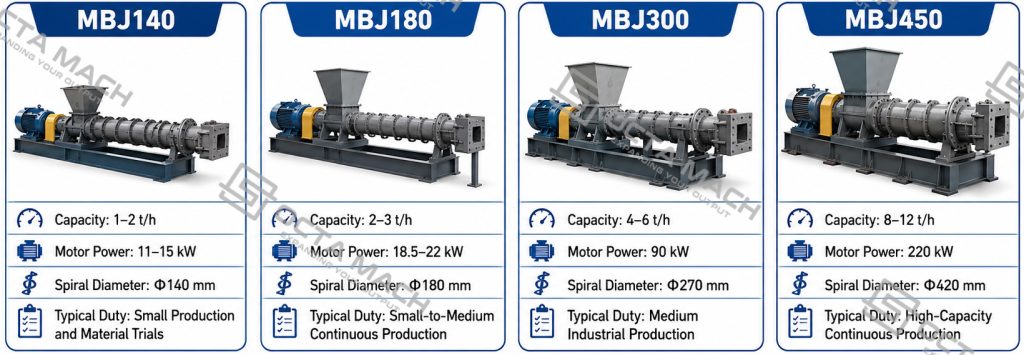
| Parameter | MBJ140 | MBJ180 | MBJ300 | MBJ450 |
| Nominal capacity | 1–2 t/h | 2–3 t/h | 4–6 t/h | 8–12 t/h |
| Motor power | 11–15 kW | 18.5–22 kW | 90 kW | 220 kW |
| Main-shaft speed | 46–60 r/min | 39–60 r/min | 132 r/min | 118 r/min |
| Nominal round-rod size | Φ20–30 mm | Φ20–30 mm | Φ18–30 mm | Φ20–30 mm |
| Number of spiral vanes | 5 | 5 | 4 | 4 |
| Spiral impeller diameter | Φ140 mm | Φ180 mm | Φ270 mm | Φ420 mm |
| Overall dimensions | 1900 × 1100 × 1170 mm | 2210 × 1370 × 1440 mm | 3605 × 1025 × 955 mm | 5130 × 520 × 1480 mm* |
| Working current | Not listed | Not listed | 130–160 A | 320–360 A |
| Maximum catalogue feed size | <5 mm | <5 mm | <5 mm | <5 mm |
| Catalogue reference moisture | 12–14% | 12–14% | 12–14% | 12–14% |
*The MBJ450 width shown in the supplied table should be reconfirmed before the value is used for foundation or layout design.
The catalogue also gives a green-rod reference in which at least 75% of newly formed rods remain unbroken after a two-metre free fall. This should be treated as a supplier reference test. The feed formulation, rod diameter, sample count, drop surface and conditioning time must be agreed before it is used as a contractual acceptance criterion.
MBJ140, MBJ180, MBJ300 and MBJ450 Model Selection
MBJ140 Coal Rod Extrusion Machine
With a nominal capacity of 1–2 t/h, the MBJ140 is suited to smaller production lines, new material trials and operations with moderate daily output. Its 140 mm spiral impeller and 11–15 kW power range make it the smallest confirmed model in the series.
MBJ180 Coal Rod Extruder
The MBJ180 increases nominal capacity to 2–3 t/h and uses a 180 mm spiral impeller. It is appropriate where the MBJ140 cannot meet the required hourly output but the project does not justify a large industrial line.
MBJ300 Coal Powder Rod Making Machine
The MBJ300 is rated at 4–6 t/h and uses a 270 mm impeller with a 90 kW motor. Feed preparation and stable metering become increasingly important at this output because short-term flow variation can create higher load fluctuations and greater downstream handling demand.
MBJ450 High-Capacity Coal Rod Machine
The MBJ450 covers a nominal 8–12 t/h and is intended for continuous industrial production. Its 420 mm impeller, 220 kW power and 320–360 A catalogue working-current range require appropriate electrical capacity, foundation planning and coordinated upstream feeding.
When comparing a coal rod extrusion machine for sale, capacity should not be selected from the motor rating alone. The following project inputs must be reviewed together:
- Raw-material type and source
- Feed particle-size distribution
- Moisture variation
- Binder type and dosage
- Target rod shape and cross section
- Required green and dry strength
- Operating hours per day
- Drying or curing method
- Site voltage and frequency
- Upstream and downstream equipment
A feed sample trial is the most reliable way to confirm whether the selected machine can achieve the required capacity without excessive motor load, die blockage or product breakage.
Factors Controlling Coal Rod Quality
Coal-rod strength is not produced by machine pressure alone. Research on briquetting shows that particle-size distribution, binder selection, moisture condition and compaction load all influence density, durability and mechanical strength. Smaller particles can improve contact area, but an excessively narrow or unsuitable size distribution may increase preparation energy or change flow behavior.
Particle-Size Distribution
Oversize particles may obstruct the die or create local weak points. Extremely fine material can also become difficult to feed uniformly. The catalogue limit of less than 5 mm is a maximum reference, not a complete particle-size specification.
Moisture Stability
Moisture affects plasticity, screw load, die release and green-rod strength. Dry material may not consolidate properly, while excessive water can produce soft rods that deform during cutting or transfer.
Binder Compatibility
Binder selection must reflect the raw material and the final use of the rod. The binder affects green strength, dry strength, ash contribution, combustion behavior, drying demand and storage stability.
Uniform Mixing and Feeding
Water and binder must be distributed throughout the powder before extrusion. Unmixed lumps or intermittent feeding can cause unstable extrusion pressure and inconsistent rod density. Coal-briquette equipment patents similarly use mixing, kneading and controlled transfer before the final molding stage to prevent feed irregularities from reducing product quality.
Screw, Barrel and Die Condition
Wear increases internal clearance and changes compression behavior. Inspection should focus on vane profile, screw-to-barrel clearance, die wear, fastener condition and abnormal increases in operating current.
Gentle Product Handling
Fresh rods should be supported immediately after discharge. Excessive drop height, sharp conveyor transitions or premature stacking can cause bending, surface cracking and breakage before the binder has cured.
Main Machine Components
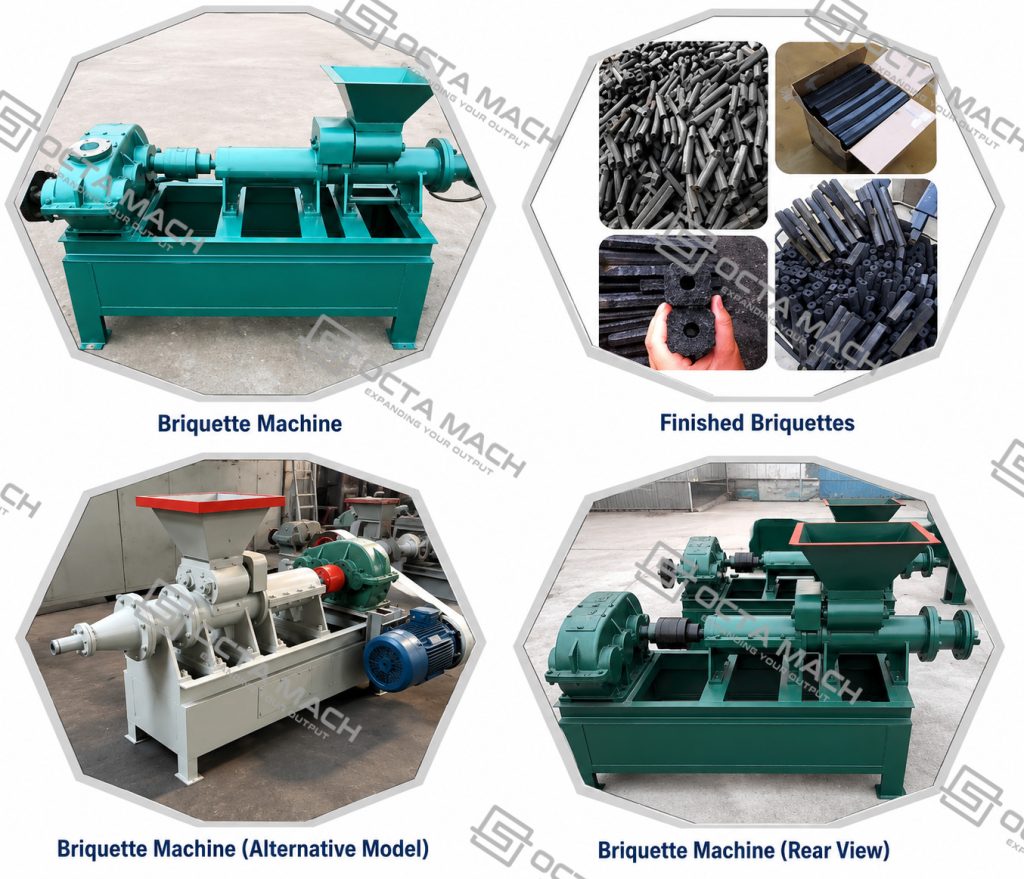
Feed Hopper: Receives the prepared coal or carbon mixture and feeds it steadily into the screw chamber. Stable feeding helps maintain consistent forming pressure.
Drive Motor and Transmission: Supplies torque to the screw system. The reducer controls shaft speed and increases available torque.
Propulsion Shaft and Spiral Impeller: Conveys and compresses the feed toward the die. Screw size, vane condition and rotational speed affect output and motor load.
Compression Barrel and Liner: Contains the material during compression. Internal wear influences friction, pressure buildup and rod consistency.
Forming Die: Determines the rod cross section. Round, hollow, hexagonal and other profiles can be produced by changing the die.
Automatic Cutter and Discharge Conveyor: Cuts rods to the required length and transfers them with limited drop height to reduce cracking or deformation.
Suitable Raw Materials and Feed Boundaries
For stable extrusion, coal fines or carbonized powder should be screened to the required size and mixed uniformly with controlled moisture and binder when needed. Poor feed preparation may cause unstable output, excessive motor load, die blockage or weak coal rods.
The equipment is primarily designed as a coal powder rod making machine or carbon-powder extruder. Material suitability depends on particle-size distribution, moisture, binder response, abrasiveness and the required green strength.
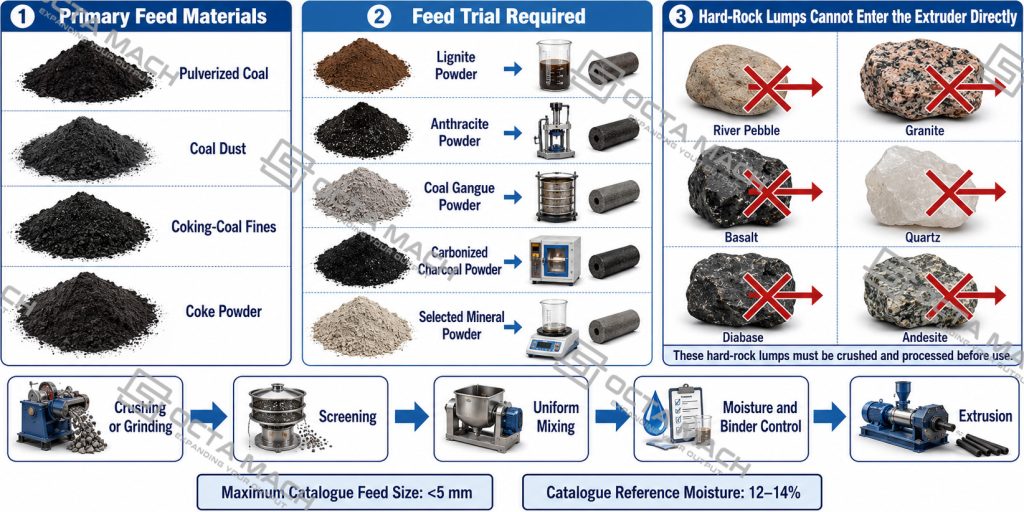
| Feed category | Typical materials | Preparation requirement | Suitability |
| Coal fines | Pulverized coal, coal dust, coking-coal fines | Grinding, screening and conditioning | Primary application |
| Coke materials | Coke powder and coke fines | Controlled particle size and binder trial | Generally suitable after testing |
| Low-rank coal | Lignite or brown-coal powder | Moisture and binder control | Requires formulation testing |
| High-rank coal | Anthracite powder | Fine grinding and suitable binder | Requires strength verification |
| Coal-processing residue | Coal gangue powder and selected coal waste | Crushing, removal of tramp material and abrasion assessment | Trial required |
| Carbonized charcoal | Wood charcoal, coconut-shell charcoal, rice-husk charcoal and bamboo charcoal powder | Feedstock must first be carbonized and ground | Suitable after formulation testing |
| Selected mineral powder | Iron ore powder, manganese ore powder, limestone, calcite, bauxite fines or copper concentrate | Grinding, screening and extrusion trial | Not a default application |
| Hard-rock lumps | River pebbles, granite, basalt, quartz, diabase and andesite | Cannot be fed directly | Not suitable for direct feeding |
Carbonized biomass powders should not be confused with raw sawdust, straw, coconut shells or wood chips. In the coal-stick route, biomass material is normally carbonized before the resulting charcoal powder is ground, mixed and extruded.
Some equipment suppliers list iron powder, aluminum powder, gypsum and other mineral powders as possible feedstocks. These claims should not be treated as universal suitability. Abrasive mineral powder may sharply increase screw, barrel and die wear, and its binder response can differ from coal. An extrusion trial is therefore necessary before describing the machine as an iron ore, limestone or bauxite rod-making machine.
Factors Controlling Coal Rod Quality
Coal-rod strength is not produced by machine pressure alone. Research on briquetting shows that particle-size distribution, binder selection, moisture condition and compaction load all influence density, durability and mechanical strength. Smaller particles can improve contact area, but an excessively narrow or unsuitable size distribution may increase preparation energy or change flow behavior.
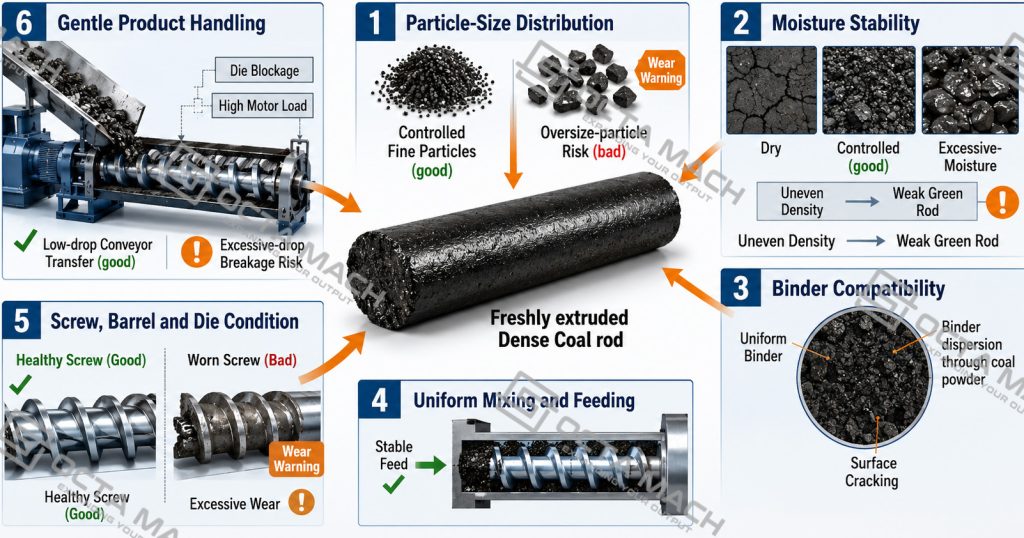
Particle-Size Distribution
Oversize particles may obstruct the die or create local weak points. Extremely fine material can also become difficult to feed uniformly. The catalogue limit of less than 5 mm is a maximum reference, not a complete particle-size specification.
Moisture Stability
Moisture affects plasticity, screw load, die release and green-rod strength. Dry material may not consolidate properly, while excessive water can produce soft rods that deform during cutting or transfer.
Binder Compatibility
Binder selection must reflect the raw material and the final use of the rod. The binder affects green strength, dry strength, ash contribution, combustion behavior, drying demand and storage stability.
Uniform Mixing and Feeding
Water and binder must be distributed throughout the powder before extrusion. Unmixed lumps or intermittent feeding can cause unstable extrusion pressure and inconsistent rod density. Coal-briquette equipment patents similarly use mixing, kneading and controlled transfer before the final molding stage to prevent feed irregularities from reducing product quality.
Screw, Barrel and Die Condition
Wear increases internal clearance and changes compression behavior. Inspection should focus on vane profile, screw-to-barrel clearance, die wear, fastener condition and abnormal increases in operating current.
Gentle Product Handling
Fresh rods should be supported immediately after discharge. Excessive drop height, sharp conveyor transitions or premature stacking can cause bending, surface cracking and breakage before the binder has cured.
Coal Rod Briquette Production Line
A complete coal rod briquette production line can be configured as:
Raw material → Crushing or grinding → Screening → Binder preparation → Mixing and conditioning → Metered feeding → Screw extrusion → Automatic cutting → Drying or curing → Final screening and storage.
The crusher reduces oversize feed, while screening protects the extruder from unacceptable particles and tramp material. A wheel mixer or double-shaft mixer distributes water and binder. The feeder then supplies the conditioned mixture to the coal rod machine at a stable rate.
After extrusion, an automatic cutter controls rod length. Drying equipment may be required when the selected binder or moisture level does not allow the rods to reach handling and storage strength naturally. Commercial coal-rod lines commonly combine crushers, binder mixers, mixers, automatic feeders, conveyors and dryers around the central extruder.
Finished Coal Rod Shapes and Die Options
Changing the forming die allows the coal rod extrusion machine to produce solid round rods, hollow rods, hexagonal sticks, square bars, plum-flower sections and other customized profiles.
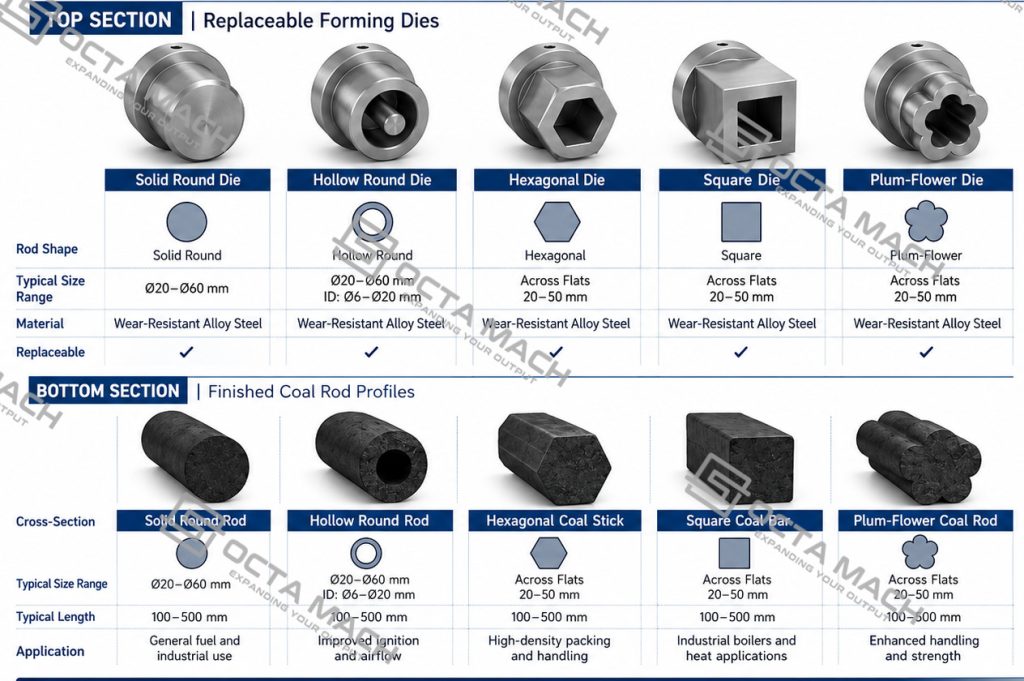
The die opening controls the rod cross section and also affects extrusion resistance, motor load, output and green-rod strength. A smaller die opening does not necessarily produce a stronger rod. If the opening is too restrictive, extrusion pressure may rise, capacity may decrease and wear on the screw and die may increase. Die selection should therefore be matched to the feed formulation, required rod size and target capacity.
Typical products include industrial fuel rods made from coal fines, coke powder, anthracite, lignite or carbonized charcoal powder. For use in boilers, furnaces or gasifiers, the finished rods should also be checked for size, calorific value, ash content, volatile matter, mechanical strength and combustion behavior.
OctaMach Production, Assembly and Complete-Line Supply
OctaMach supplies MBJ-series coal rod extrusion machines through its domestic manufacturing base in China. Our production facilities cover steel fabrication, component machining, screw and die manufacturing, machine assembly, electrical integration and pre-shipment testing, allowing the main equipment and matching production-line units to be coordinated under one supply system.
With dedicated equipment-production lines and experienced manufacturing teams, OctaMach can configure the machine according to the required raw material, rod diameter, die shape, output target and downstream handling method. Key components such as the extrusion screw, forming die, transmission system, machine frame and discharge section are inspected during production and assembly to reduce dimensional mismatch and unstable operation after installation.
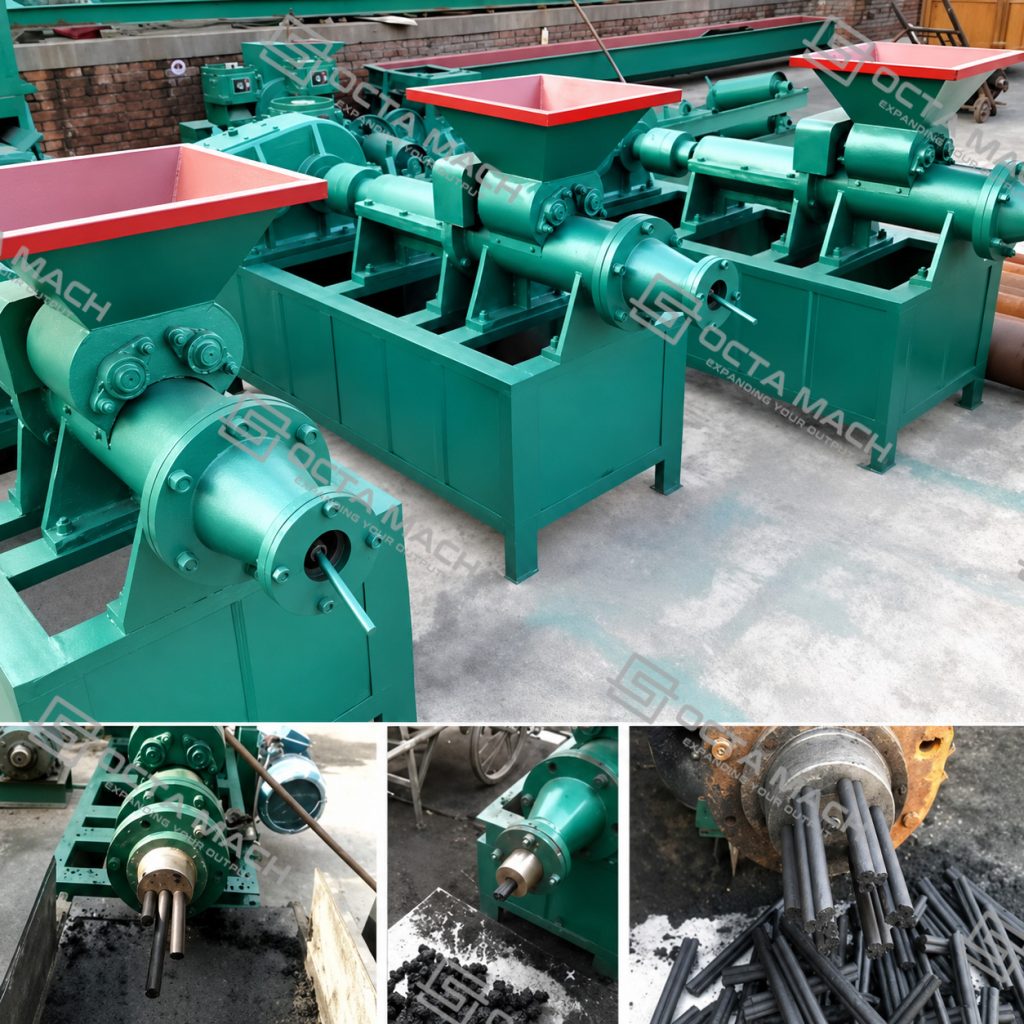
Our manufacturing and supply scope can include:
- MBJ-series coal rod extrusion machines
- Replaceable forming dies for different rod shapes and diameters
- Heavy-duty screws and wear-resistant internal components
- Motors, reducers, couplings and transmission systems
- Automatic feeding and cutting equipment
- Crushers, screens, mixers and binder-preparation systems
- Conveyors, dryers and complete coal-rod production lines
- Spare parts and wearing parts for routine maintenance
Before shipment, each machine can be checked for assembly condition, rotation stability, transmission alignment, electrical operation and extrusion performance. Representative-material testing can also be arranged when the customer provides sufficient raw-material information or samples.
By combining equipment manufacturing, process configuration and production-line integration, OctaMach helps customers reduce coordination between multiple suppliers and obtain a coal rod production system matched to the actual material and finished-product requirements.
FAQ
Q: What is the difference between a coal rod extruder and a roller briquette machine?
A: A coal rod extruder uses a rotating screw and forming die to produce a continuous rod. A roller briquette machine uses two synchronized pocketed rollers to form separate balls, pillows or blocks. The correct machine depends on the feed condition and required product shape.
Q: Can a coal rod machine process granite, basalt or river pebbles?
A: No. Hard-rock lumps cannot be fed directly. Selected mineral powders may be tested after crushing, grinding and screening, but many mineral materials are better suited to roller briquetting.
Q: How is the correct MBJ model selected?
A: Start with the required hourly output, then verify raw-material type, particle-size distribution, moisture, binder, rod diameter, drying route and operating schedule. The nominal range is MBJ140 at 1–2 t/h, MBJ180 at 2–3 t/h, MBJ300 at 4–6 t/h and MBJ450 at 8–12 t/h.
Q: What determines the coal rod machine price?
A: Price depends on the selected model, motor and voltage configuration, die quantity, automatic cutter, wear-part specification and whether the project includes crushers, mixers, feeders, conveyors or drying equipment. A complete quotation requires both feed data and the required finished-rod specification.