
The HY high pressure dry powder briquette machine converts loose industrial powders into dense, uniform briquettes for controlled handling and downstream furnace processing. An adjustable screw feeder meters and pre-compacts the feed before synchronized counter-rotating rollers press it continuously without adding process water during forming.
Typical feed materials include quicklime powder, magnesium oxide powder, copper concentrate, chrome ore powder, lead-zinc powder, prepared bauxite fines, refractory powders and ceramic powder blends. The machine is intended for screened, flowable dry powders with stable composition and residual moisture. Untreated ore lumps, oversize particles and contaminated feed must be crushed, screened or cleaned before briquetting.
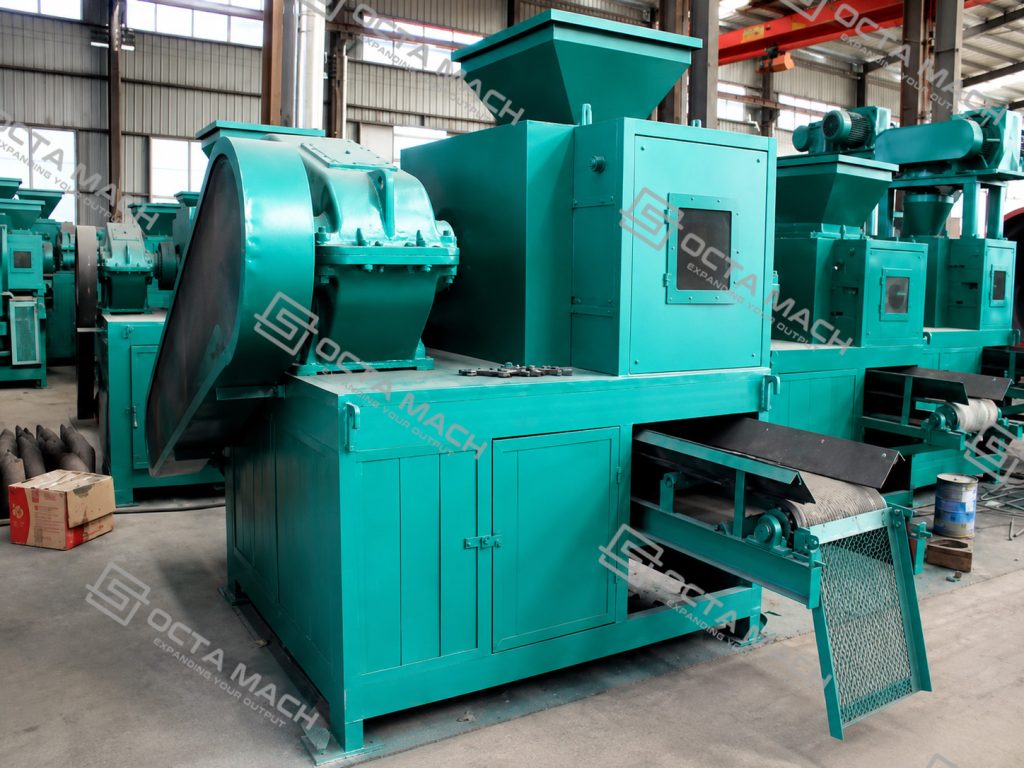
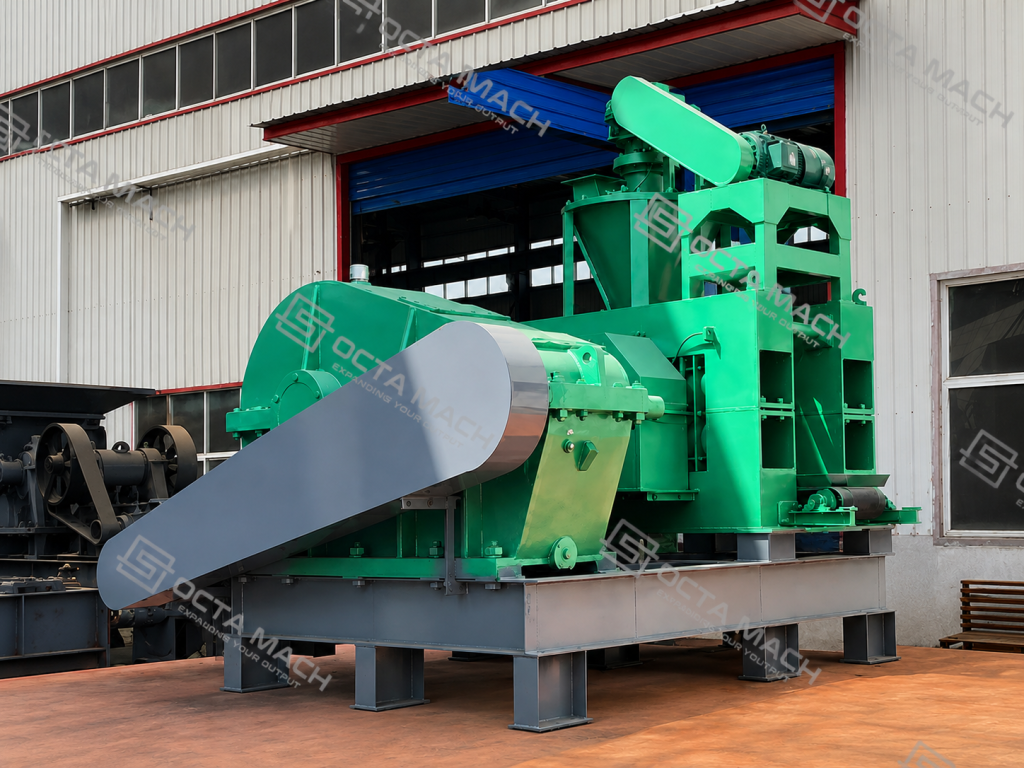
During pressing, the prepared powder fills matched pockets on the surfaces of the two forming rollers. As the pockets approach the roll nip, the available volume decreases and the material is progressively compacted into a defined briquette shape. The finished briquettes are released as the rollers separate, while product consistency depends on stable feeding, pocket geometry and accurate roller synchronization.
Main Operating Range
| Parameter | Available Range |
| Product series | HY0.5 to HY10 |
| Design capacity | 0.5–10 t/h |
| Roller diameter | Φ299–Φ858 mm |
| Roller width | 180–300 mm |
| Main motor power | 18.5–110 kW |
| Auxiliary motor power | 11–22 kW |
| Feeding arrangement | Adjustable screw feeding and pre-compaction |
| Pressing method | Double counter-rotating forming rollers |
| Typical feed | Prepared dry mineral, metallurgical, refractory and chemical powders |
| Product form | Pocket-shaped briquettes determined by roller design |
The published capacity is suitable for preliminary model comparison. Actual output depends on material bulk density, particle-size distribution, feeding stability, powder compressibility, roller-pocket dimensions and the amount of recycle fines.
High Pressure Dry Powder Briquette Machine Technical Parameters
| Model | Roller Diameter | Roller Width | Design Capacity | Main Motor Model | Main Motor Power | Auxiliary Motor Model | Auxiliary Motor Power |
| HY0.5 | Φ299 mm | 180 mm | 0.5 t/h | Y180M-4 | 18.5 kW | YCT225-4A | 11 kW |
| HY1.0 | Φ367 mm | 183 mm | 1 t/h | YCT315-4A | 37 kW | YCT225-4A | 11 kW |
| HY1.5 | Φ368 mm | 183 mm | 1.5 t/h | Y250M-6 | 37 kW | YCT225-4A | 11 kW |
| HY2.0 | Φ399 mm | 232 mm | 2 t/h | BYQ7315-4-13 | 45 kW | YCT225-4A | 15 kW |
| HY3.0 | Φ522 mm | 196 mm | 3 t/h | Y280S-6 | 55 kW | YCT225-4B | 15 kW |
| HY5.0 | Φ700 mm | 210 mm | 5 t/h | Y315M-6 | 90 kW | YCT250-4A | 18.5 kW |
| HY6.0 | Φ738 mm | 225 mm | 6 t/h | Y280S-4 | 90 kW | YCT250-4A | 18.5 kW |
| HY8.0 | Φ758 mm | 225 mm | 8 t/h | Y315S-4 | 110 kW | YCT250-4A | 18.5 kW |
| HY10 | Φ858 mm | 300 mm | 10 t/h | Y315M2-6 | 110 kW | YCT250-4B | 22 kW |
Technical note: Catalogue values are used for model comparison. Final motor configuration, roller-pocket design, feed-screw speed, installation dimensions and electrical requirements should be confirmed in the project-specific technical agreement.
How the High Pressure Briquetting Machine Works
The high pressure briquetting machine combines controlled feeding with roll-nip compression. The forming process can be divided into five functional stages.
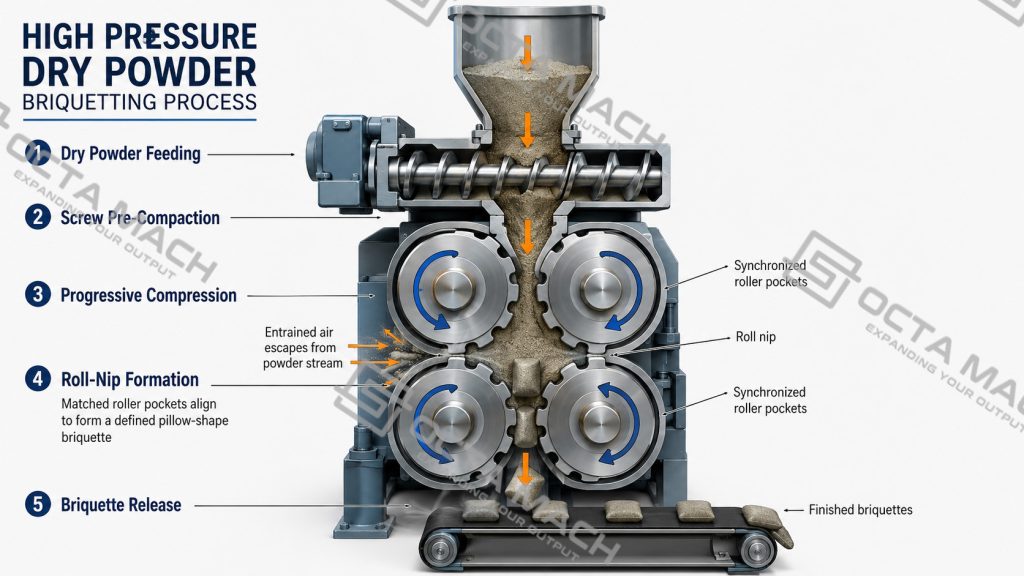
1. Dry Powder Feeding
Prepared powder enters the feed hopper. Oversize particles, metal contamination and foreign materials should be removed before the powder reaches the machine.
Dry powder does not necessarily mean absolutely moisture-free material. It means that the process is designed without adding water as a normal pressing medium. Residual moisture still needs to remain stable because changes in moisture can alter powder flow, compaction behaviour and briquette release.
2. Screw Pre-Compaction
An adjustable screw-feeding device meters the material and pushes it into the space above the forming rollers. This is particularly important for low-bulk-density or poorly flowing powders that may not enter the roll nip consistently under gravity alone.
The feeding rate must match the available roller-pocket volume and roller speed. Underfeeding can leave pockets incompletely filled, while overfeeding can create unstable loading, excessive edge material or irregular briquette release. Forced feeding and pre-compaction are also highlighted in other industrial high-pressure roller-press designs.
3. Progressive Compression
The two forming rollers rotate in opposite directions. Powder entering the narrowing gap is first redistributed, then gradually compressed as it moves toward the minimum roll gap.
Pressure increases progressively rather than being applied in one sudden impact. This gives entrained air time to escape and helps the powder fill the roller pockets more evenly.
4. Briquette Formation
Maximum compaction occurs near the roll nip, where the matched upper and lower pockets align. The powder is compressed into the selected pillow, oval, round, rectangular or project-specific briquette geometry.
The roller-pocket profile affects more than appearance. It influences pocket filling, compaction uniformity, briquette thickness, release behaviour, edge formation and the risk of breakage after pressing.
5. Briquette Release
After passing through the roll nip, the two pocket halves separate. The newly formed briquette is released by roller movement and gravity, then falls onto the discharge conveyor.
Freshly pressed briquettes should be handled gently. Depending on the recipe and downstream requirement, they may pass directly to screening or may require curing, drying, cooling or temporary storage.
Main Machine Structure
A complete roller press briquette machine contains several coordinated assemblies.
Feed Hopper
The hopper provides temporary storage and directs material into the screw feeder. Its design should prevent bridging, segregation and uncontrolled surging.
Adjustable Screw Feeder
The screw feeder meters and pre-compacts the dry powder before it reaches the forming rollers. The auxiliary motor listed in the catalogue drives this feeding system.
A stable relationship between screw speed and roller speed is essential. Adjusting only the main roller drive without correcting the feed rate can cause underfilled pockets or excessive material accumulation.
Double Forming Rollers
The roller surfaces contain matched pockets. Their diameter, working width and pocket geometry determine available forming volume and influence the nominal machine capacity.
The supplied HY range uses roller diameters from Φ299 to Φ858 mm and roller widths from 180 to 300 mm.
Main Drive and Transmission
The main motor supplies the torque required to rotate the forming rollers under load. The transmission system maintains synchronized roller movement so that opposing pockets meet accurately at the roll nip.
Heavy-Duty Frame
The frame supports the rollers, bearings, drive and feeding system. Structural rigidity is important because excessive movement or misalignment can affect pocket matching, roll-gap stability and briquette consistency.
Discharge Arrangement
The discharge section transfers newly formed briquettes away from the pressing zone. A downstream screen can separate qualified briquettes from loose fines and edge material.
Suitable Materials for Dry Powder Briquetting
The HY series is positioned as a mineral powder briquette machine, ore fines briquetting machine and industrial dry-powder press. Suitable feed must already be reduced to a controlled powder or fine-particle form.
| Material Group | Typical Feed Materials | Main Process Consideration |
| Lime and magnesium materials | Quicklime powder, magnesium oxide powder | Reactivity, moisture sensitivity and downstream chemistry |
| Metal concentrates | Copper concentrate powder, lead-zinc powder | Mineral composition, density and furnace requirements |
| Ferroalloy and ore fines | Chrome ore powder, prepared bauxite fines | Abrasiveness, particle-size distribution and binder compatibility |
| Non-ferrous powders | Selected non-ferrous mineral or metallurgical powders | Oxidation, contamination and product chemistry |
| Refractory materials | Refractory powder and selected oxide fines | Briquette density, handling strength and thermal process requirements |
| Ceramic materials | Prepared ceramic powder blends | Uniform feeding, fine-powder aeration and pocket release |
Roll-press briquetting is widely applied to ores, mineral fines, metal fines and industrial by-products, but each material requires its own feed preparation and operating window.
Application Boundary
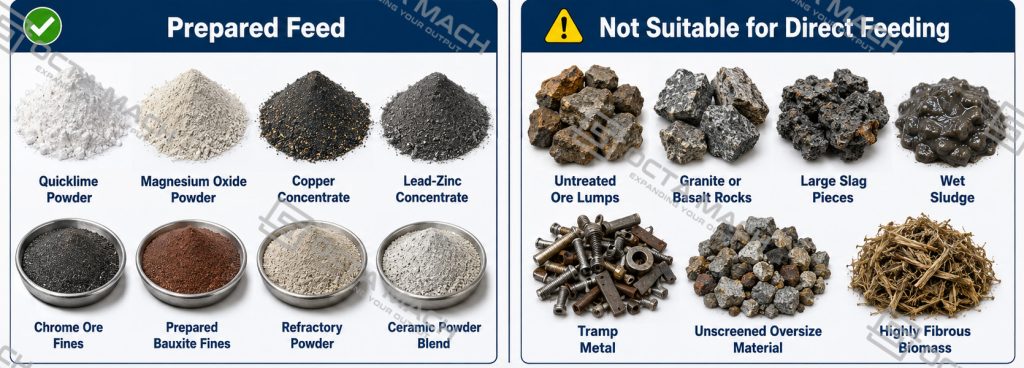
Suitable as prepared feed:
- Dry mineral powders
- Ore concentrates
- Fine metallurgical materials
- Refractory powders
- Ceramic powder blends
- Controlled mixtures of compatible powders
Not suitable as direct feed:
- Untreated ore lumps
- Granite, basalt or quartzite rocks
- River pebbles
- Large pieces of slag
- Wet sludge with unstable moisture
- Feed containing tramp metal
- Highly fibrous biomass materials
Large or untreated material must first be crushed, ground, screened and conditioned before it enters the briquette press.
Binder Requirements for Dry Powder Briquetting
A dry powder briquette machine does not automatically mean that every material can be pressed without a binder.
- Binder-Free Briquetting
Binder-free operation is possible only when the powder develops sufficient particle bonding under pressure. The feed must maintain stable composition, particle size, moisture and compressibility.
Some reactive or plastically deformable powders may form acceptable briquettes without an external binder, but this must be confirmed through material tests.
- Binder-Assisted Briquetting
Where natural particle bonding is insufficient, a binder may be added before pressing. Binder dosage must be controlled and distributed uniformly through the feed.
The binder must also be compatible with the downstream process. A binder that improves green handling strength may still be unacceptable if it introduces unwanted ash, sulphur, alkalis, phosphorus or other process contaminants.
Industrial cold-briquetting practice therefore selects the recipe from material type, grain size, moisture and binder content, normally supported by pilot or laboratory testing.
Factors That Control Briquette Quality
High pressing force alone does not guarantee an acceptable product. Briquette quality is determined by the complete material-and-machine relationship.
Feed Particle Size
The powder should have a controlled size distribution. Excessively coarse particles can interfere with pocket filling, while extremely fine cohesive powder may trap air or feed inconsistently.
Feed Moisture
Moisture variation changes flowability and compaction response. Even when no water is added, the existing moisture level should remain stable during production.
Screw-Feed Stability
The screw feeder should supply each section of the roller width consistently. Uneven material distribution can produce denser briquettes in one area and weaker products in another.
Roller-Pocket Geometry
Pocket volume, depth, edge angle and release profile must suit the powder and required product dimensions. The finished briquette shape is determined by the matched roller molds.
Roller Synchronization
The two rollers must remain synchronized so that opposing pockets meet accurately. Poor timing can create malformed briquettes, excessive flash or local roller loading.
Product Handling
Fresh briquettes may have lower handling strength than cured or dried products. Conveyor drop height, transfer points and screening intensity should therefore be matched to the green briquette strength.
Complete Dry Powder Briquetting Process
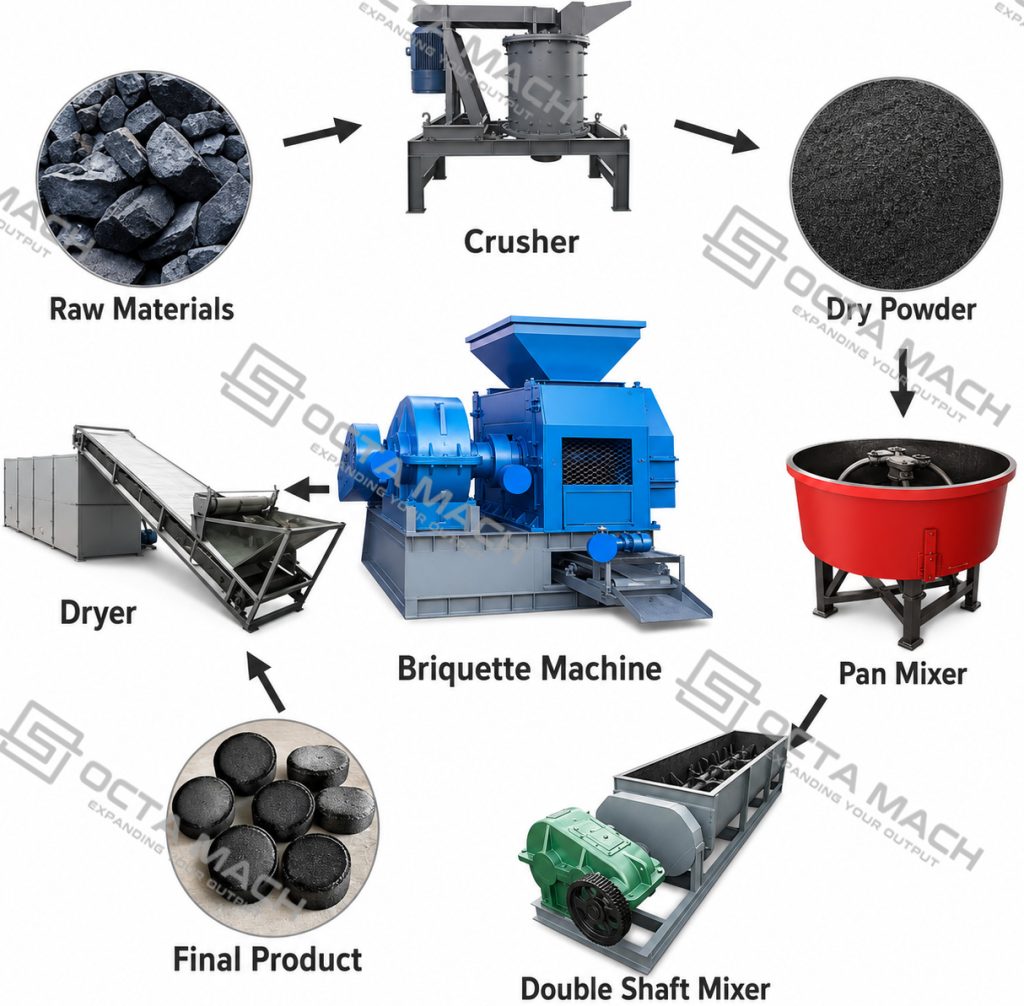
A typical production line can be arranged as:
Raw powder storage → screening → controlled dosing → binder addition when required → mixing → screw pre-compaction → high-pressure roller briquetting → product screening → qualified briquettes.
Screen undersize and loose fines can be returned to the feeding or mixing stage after the recycle ratio has been checked.
Drying, curing or cooling equipment is included only when required by the material recipe and downstream process. In established cold-briquetting practice, mixing, pressing, screening, fines return and optional post-treatment are treated as one integrated system rather than isolated machines.
Typical Materials for Dry Powder Briquetting
The high pressure dry powder briquette machine is designed for prepared industrial powders rather than untreated rocks or ore lumps.
| Material | Required Feed Condition | Main Purpose |
| Quicklime Powder | Screened powder with stable moisture | Form briquettes for easier handling and downstream thermal processing |
| Magnesium Oxide Powder | Uniform fine powder without contamination | Improve feeding stability and reduce loose-powder handling |
| Copper Concentrate | Controlled particle size and consistent composition | Form concentrate briquettes for transport or furnace feeding |
| Lead-Zinc Concentrate | Prepared fine concentrate with stable bulk density | Reduce dust and improve material handling |
| Chrome Ore Powder | Crushed, ground and screened fines | Produce shaped briquettes for downstream metallurgical use |
| Bauxite Fines | Prepared fines with confirmed briquetting recipe | Improve handling and controlled furnace charging |
| Refractory Powder | Uniform dry powder blend | Form dense, consistent products before further processing |
| Ceramic Powder | Fine mixed powder with stable feeding properties | Produce repeatable shapes for later treatment or firing |
Feed Boundary
Suitable feed
- Prepared mineral powder
- Ore concentrate
- Metallurgical fines
- Refractory powder
- Ceramic powder blends
Not suitable for direct feeding
- Untreated ore lumps
- Large rocks
- Wet sludge
- Material containing metal pieces
- Unscreened feed with oversize particles
Large material must be crushed, ground and screened before entering the briquette press.
Our Advantages in Briquetting Equipment Supply
Octa Mach is a China-based manufacturer and supplier of industrial briquetting equipment, providing HY series high pressure dry powder briquette machines for mineral powders, metallurgical fines, refractory materials and ceramic powder blends. Our equipment selection is based on actual feed properties, required capacity, briquette dimensions and downstream process conditions rather than motor power alone.
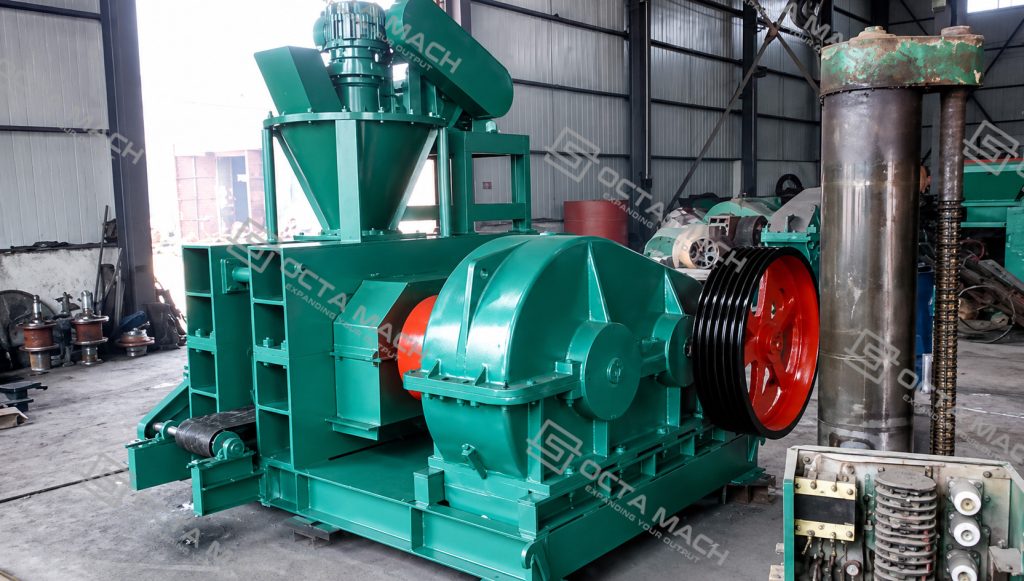
The machine configuration can be matched to the project requirements, including screw-feeding capacity, roller diameter, roller-pocket shape, wear-part material, motor voltage, discharge arrangement and connections with upstream mixing or downstream screening equipment. Pillow, oval, round and rectangular briquettes can be produced with corresponding forming-roller designs.
Before shipment, the feeder, forming rollers, bearings, coupling, reducer and drive system are checked for assembly condition, alignment, synchronized rotation and no-load operation. Installation drawings, equipment lists, operating documents, packing records and export coordination are prepared according to the confirmed technical agreement.
FAQ
Q: Can the high pressure dry powder briquette machine operate without a binder?
A: Only when the material develops sufficient bonding under pressure. Binder-free operation must be confirmed through feed and briquette testing.
Q: Does dry powder mean the feed must contain zero moisture?
A: No. It means no process water is normally added during pressing. Residual moisture may still be present, but it must remain within a stable material-specific range.
Q: Can the catalogue capacity be used as guaranteed output?
A: No. The 0.5–10 t/h values are design capacities for preliminary comparison. Actual production depends on powder density, feeding stability, roller-pocket size, recycle fines and briquette quality requirements.
Q: Can the same roller pockets be used for every powder?
A: Not necessarily. Pocket geometry should be matched to material compressibility, required briquette dimensions, release behaviour and downstream handling conditions.