
Mesh Belt Dryer (Net Belt Dryer) carries briquettes, pellets, blocks, strips and other air-permeable materials through controlled drying chambers on a moving mesh conveyor. Circulating hot air passes through the material bed to remove moisture evenly, while conveyor speed, bed depth, airflow and the number of drying layers determine residence time and final moisture content.
OctaMach supplies single-layer and Multi-Layer Mesh Belt Dryer configurations with belt widths from 600 to 3000 mm, effective drying areas from 3.6 to 600 m², one to five conveyor layers and adjustable belt speeds from 0.06 to 1 m/min. The final configuration is selected according to the required water evaporation, inlet and outlet moisture, product dimensions, bed permeability, handling strength, available heat source and installation space.
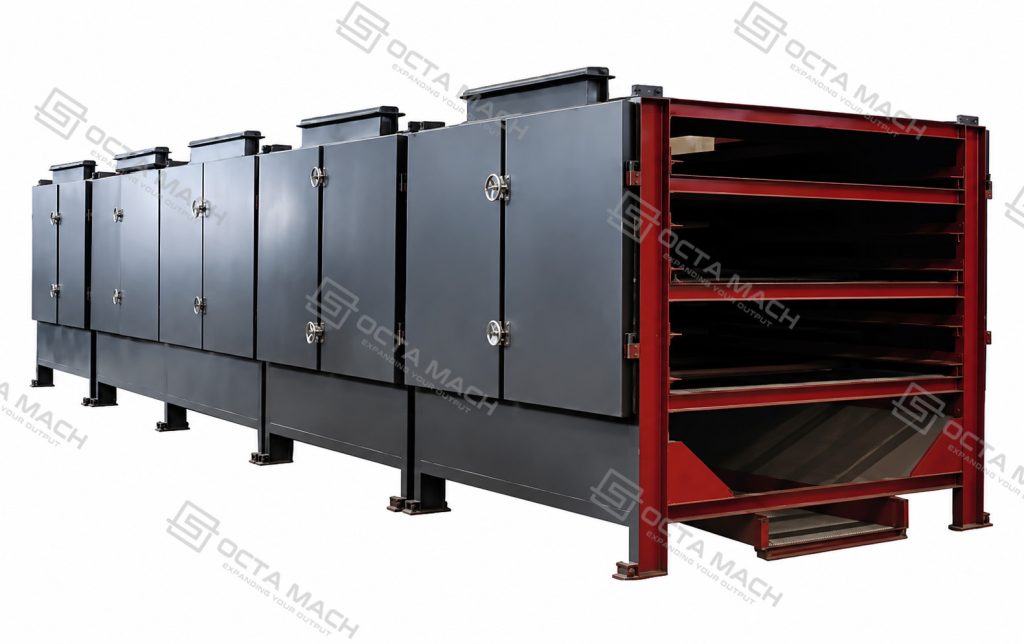
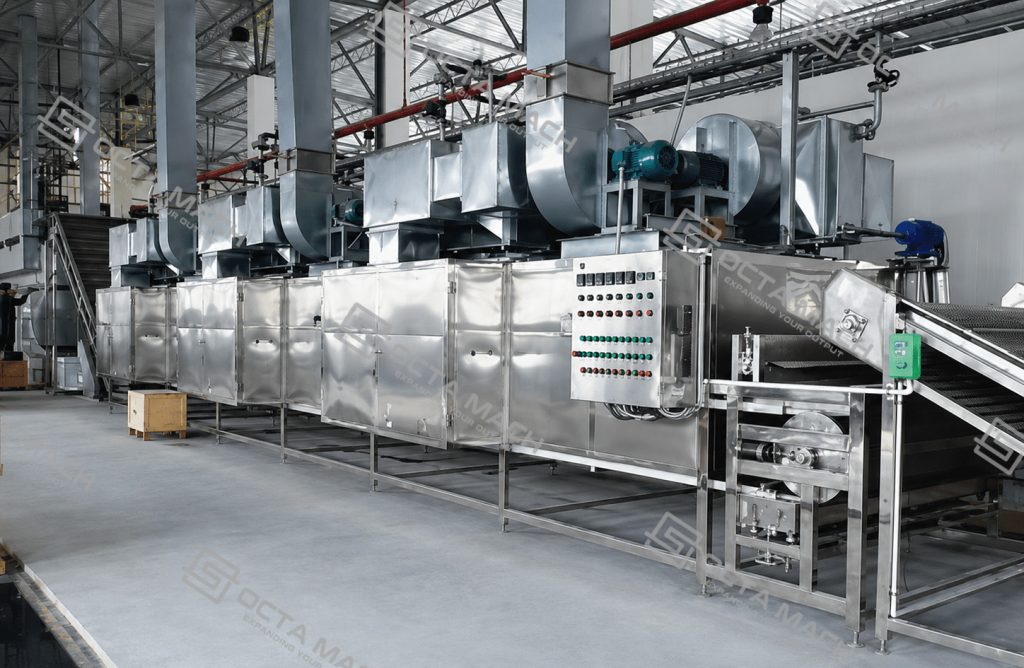
Mesh Belt Dryer Specifications and Model Range
The HJWD series is configured by belt width, drying-section length and the number of conveyor layers. Increasing the belt width, section length or layer count increases the available drying area, but final capacity still depends on the evaporation duty and product permeability.
| Model | Belt Width (mm) | Drying-Section Length (m) | Feed-Section Length (m) | Drive-Section Length (m) | Effective Drying Area (m²) | Drive Power (kW) |
|---|---|---|---|---|---|---|
| HJWD6 | 600 | 6–12 | 1 | 1 | 3.6–36 | 1.1–2.2 |
| HJWD8 | 800 | 6–12 | 1 | 1 | 4.8–48 | 1.1–2.2 |
| HJWD10 | 1000 | 6–16 | 1 | 1 | 6–80 | 1.1–2.2 |
| HJWD12 | 1200 | 8–16 | 1 | 1 | 7.2–96 | 1.1–3 |
| HJWD16 | 1600 | 8–22 | 1 | 1 | 13–106 | 1.5–3 |
| HJWD20 | 2000 | 10–26 | 1.5 | 1.5 | 20–260 | 1.5–4 |
| HJWD24 | 2400 | 12–30 | 1.5 | 1.5 | 28.8–360 | 3–7.5 |
| HJWD30 | 3000 | 12–40 | 2 | 2 | 36–600 | 5–11 |
| Operating Parameter | Published Range or Option |
|---|---|
| Number of Belt Layers | 1–5 |
| Layer Spacing | 400–600 mm |
| Belt Loading Capacity | 90–200 kg/m² |
| Evaporation Intensity | 5–20 kg water/m²·h |
| Belt Speed | 0.06–1 m/min |
| Available Heat Sources | Hot air, electricity or steam |
| Auxiliary Equipment | Feeding conveyor, heat source, dust-removal equipment and induced-draft fan |
The listed drive power covers the mesh-belt transmission only; circulation fans, exhaust fans and the heat-source system are rated separately. Published drying area and evaporation intensity should be used together: the estimated water-removal capacity is based on effective drying area × evaporation intensity, then checked against actual inlet moisture, target outlet moisture, bed loading and material permeability. Dense briquettes, excessive fines or uneven bed depth can reduce airflow through the product and lower the achievable evaporation rate, even when the belt area remains unchanged.
Working Principle
Wet briquettes, pellets or granular material enter through a controlled feeder and are spread across the full mesh-belt width at a uniform bed depth. The conveyor carries the material through enclosed drying zones while heated air is circulated upward or downward through the belt openings and the voids between individual pieces. This through-flow air transfers heat directly into the material bed, evaporates moisture and carries the resulting water vapor toward the exhaust system. Stable drying depends on consistent feed distribution, sufficient bed permeability and balanced airflow across the belt width.
Belt speed and total conveyor length determine the material residence time inside the dryer. In a multi-layer configuration, the product transfers from one belt level to the next, increasing the effective drying area without requiring the same floor length as a single-layer unit. Transfer height, product strength and fines generation must be controlled so that the material remains evenly distributed after each transfer and reaches the specified outlet moisture without excessive breakage or over-drying.
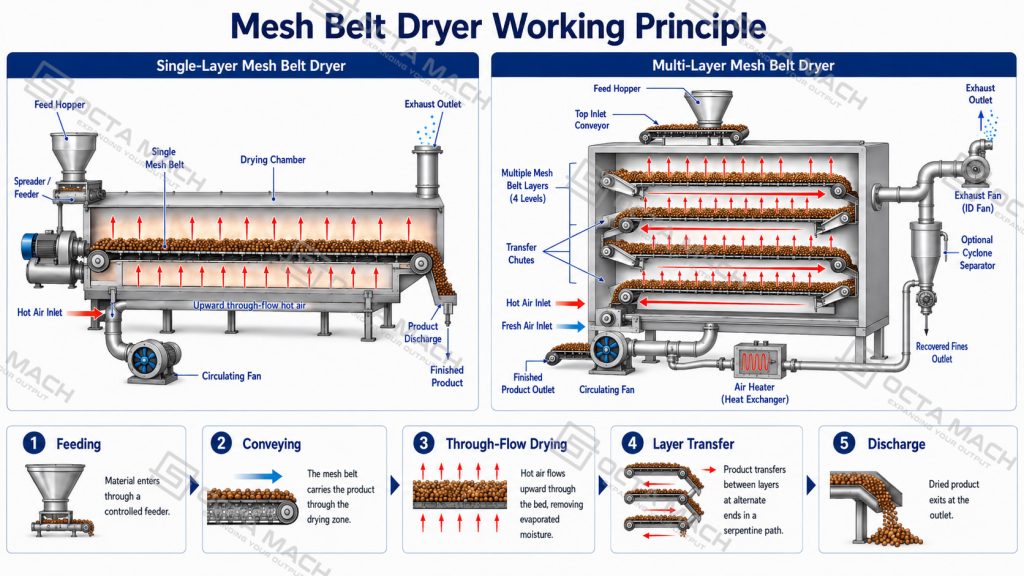
Main Components and Process Functions
A Mesh Belt Dryer Machine is a coordinated conveying, heating and airflow system. Stable drying requires more than a long chamber and a moving belt.
| Component | Process Function | Main Operating Concern |
|---|---|---|
| Feed Conveyor | Transfers wet product into the dryer | Feed surging and mechanical damage |
| Distribution Device | Forms a uniform material bed | Bed-depth variation across the belt |
| Mesh Conveyor Belt | Supports and transports the product | Aperture size, blockage, tracking and wear |
| Drive System | Controls conveyor movement | Belt-speed stability and alignment |
| Drying Chamber | Contains the heated process zones | Air leakage, insulation and access |
| Air Distributor | Directs air through the material bed | Uneven pressure and airflow distribution |
| Circulation Fan | Moves process air through the chamber | Air volume, pressure and vibration |
| Heat-Source Interface | Supplies controlled thermal energy | Temperature response and contamination limits |
| Exhaust System | Removes moisture-laden air | Insufficient exhaust or excessive heat loss |
| Layer Transfer Device | Moves product between conveyor levels | Drop height, breakage and bed redistribution |
| Discharge Conveyor | Transfers the dried product | Product temperature and handling strength |
The mesh opening must retain the product while allowing sufficient airflow. Excessive fines can block the openings or pass through the belt, increasing pressure loss, dust loading and product loss.
Drying Area, Evaporation Duty and Actual Capacity
A Mesh Belt Dryer is sized according to the amount of water that must be removed each hour. Belt width affects the available drying area, but it does not determine capacity on its own. The calculation starts with the wet feed rate, inlet moisture and required outlet moisture.
| Calculation Item | Relationship |
|---|---|
| Dry Solids Rate | Wet Feed Rate × (1 − Inlet Moisture Fraction) |
| Final Product Rate | Dry Solids Rate ÷ (1 − Outlet Moisture Fraction) |
| Required Water Evaporation | Wet Feed Rate − Final Product Rate |
| Preliminary Evaporation Capacity | Effective Drying Area × Evaporation Intensity |
The published evaporation intensity of 5–20 kg water/m²·h can be used for initial model comparison. The actual value depends on how easily hot air passes through the product bed. Dense briquettes, excessive fines or uneven loading increase airflow resistance and reduce the usable evaporation rate. Porous pellets with stable spacing generally allow better through-flow drying under the same belt area.
Final drying-area selection should therefore consider:
- Inlet and target outlet moisture
- Product size and porosity
- Bed depth and belt loading
- Air temperature, velocity and humidity
- Belt speed and residence time
- Exhaust-air volume
A practical model should provide enough drying area to handle normal feed-moisture variation without increasing product temperature, airflow or belt loading beyond stable operating conditions.
Material-Bed Depth and Air Permeability
Drying performance depends on whether heated air can pass evenly through the material bed. Bed depth must therefore be matched to the size, shape, porosity and fines content of the briquettes or pellets. When the bed is too deep or densely packed, airflow resistance increases and less air reaches the lower product layers, leading to uneven moisture and longer drying time. Increasing the air temperature does not correct poor permeability and may overheat the upper layer before the lower layer reaches the required moisture.
An excessively shallow or uneven bed also reduces effective use of the drying area. Air can bypass lightly loaded sections, while locally thick sections remain wet. Fine particles may fill the voids between larger products or block the mesh openings, further increasing pressure loss and reducing airflow through the bed.
The operating bed depth should provide stable belt loading while maintaining uniform airflow across the full belt width. It is confirmed according to product dimensions, bulk arrangement, fines content, fan pressure and the allowable outlet-moisture variation.
Single-Layer and Multi-Layer Configurations
The HJWD series can be configured with one to five conveyor layers. Layer count is selected according to the required effective drying area, available floor space, target residence time and the product’s ability to withstand transfer between belts. A single-layer dryer provides the simplest material path, while a multi-layer arrangement increases conveyor length within a shorter installation footprint.
| Configuration | Process Characteristic | Suitable Application | Main Design Consideration |
|---|---|---|---|
| Single-Layer Dryer | Material remains on one conveyor throughout the drying process | Fragile briquettes, pellets with low green strength, or processes requiring easy cleaning and inspection | Requires more floor length to provide the same effective drying area |
| Multi-Layer Dryer | Material transfers through several vertically arranged conveyors | Products with sufficient handling strength and projects with limited installation space | Transfer points must control drop height, breakage, fines generation and bed redistribution |
| Multi-Zone Dryer | Drying sections operate with different airflow or temperature settings | Products requiring staged moisture removal or controlled final drying | Fan capacity, exhaust rate and temperature control must be coordinated between zones |
A Multi-Layer Mesh Belt Dryer increases effective drying area and residence time by extending the material path vertically. Its performance depends on more than the number of conveyor layers. At each transfer point, the product must fall onto the next belt without excessive cracking, sticking or segregation. Transfer design should therefore be matched to briquette dimensions, green strength, binder condition, drying shrinkage and acceptable fines generation. When shape retention and gentle handling are more important than floor-space reduction, a single-layer Belt Dryer Machine is usually the more practical configuration.
How to Select a Mesh Belt Dryer
Mesh belt dryer selection starts with the required hourly water evaporation, then checks whether the product can maintain stable airflow and withstand conveyor transfer. The final configuration should match the drying duty, material condition, installation space and available utilities.
| Selection Input | Effect on Dryer Configuration |
|---|---|
| Product Form and Size | Determines mesh opening, feeding method and allowable bed depth |
| Required Water Evaporation | Determines the minimum effective drying area |
| Air Permeability and Fines Content | Determines bed loading, fan pressure and airflow distribution |
| Product Temperature Limit | Determines the allowable drying-air temperature |
| Handling Strength | Determines whether a single-layer or multi-layer arrangement is suitable |
| Heat Source and Installation Space | Determines the thermal system, belt width, drying length and number of layers |
The selected Mesh Belt Dryer should provide sufficient drying area and residence time without exceeding the allowable bed loading, product temperature or airflow resistance.
OctaMach Supply Scope
OctaMach configures each Industrial Belt Dryer according to the required evaporation duty, product form, bed permeability, handling strength, heat source and installation space. The final supply scope is confirmed around the complete drying process rather than the dryer chamber alone.
| System Area | Available Supply Scope |
|---|---|
| Drying Section | Insulated chamber, single-layer or multi-layer mesh conveyor and internal air-distribution sections |
| Feeding and Discharge | Feed conveyor, material distributor, layer-transfer arrangement and discharge conveyor |
| Air and Heat System | Circulation fans, heat-source interface, air ducts and moisture-exhaust system |
| Drive and Control | Conveyor drive, adjustable belt-speed system and electrical control cabinet |
| Technical Deliverables | General arrangement drawing, foundation information, operating instructions and recommended spare-parts list |
| Export Delivery | Equipment dismantling plan, protective packing and shipment documentation |
OctaMach Advantages
- Duty-based sizing: Configured from evaporation duty and material conditions.
- Flexible model range: Belt widths of 600–3000 mm with 1–5 layers.
- Integrated drying system: Feeding, heating, exhaust and conveying can be coordinated.
- Technical support: Drawings, operating documents, spare-parts guidance and export packing.
FAQ
Q1:How is the mesh opening selected for briquettes or pellets?
A1:The opening must retain the smallest product and loose fines while allowing sufficient airflow. An opening that is too small increases blockage and pressure loss; an oversized opening increases product loss.
Q2:Is the published evaporation intensity a guaranteed dryer capacity?
A2:No. Evaporation intensity is a preliminary area-based value. Actual water removal depends on bed depth, product permeability, inlet moisture, air temperature, airflow and exhaust conditions.
Q3:Can wet powder or filter cake enter a Mesh Belt Dryer directly?
A3:Usually not. Loose powder, slurry or cohesive filter cake normally requires briquetting, granulation or extrusion first so that it forms a stable, air-permeable bed on the conveyor.
Q4:When is a single-layer dryer better than a multi-layer dryer?
A4:A single-layer dryer is preferable when wet briquettes have low green strength or must retain their shape. Multi-layer drying is suitable only when the product can tolerate transfer drops without excessive cracking or fines generation.