
Briquette Press Ball Machine is an industrial double-roller compaction machine used to convert prepared coal fines, coke fines, mineral powders, iron-bearing fines and selected metallurgical residues into uniform, transportable briquettes. The machine combines a metered feeding system, two counter-rotating forming rollers, a reduction gearbox, an electric motor, bearing assemblies, a rigid frame and a discharge unit. As conditioned material enters the roll gap, pressure increases toward the centerline of the rollers, compacting the feed into pillow, oval, round or other pocket-defined shapes. The available YHQ and YHY models cover catalogue capacities from 2 to 45 t/h, motor powers from 5.5 to 132 kW, and roller sizes from Φ290 × 220 mm to Φ1000 × 530 mm.
Also called a ball briquette machine, ball press machine or roller briquette press machine, this equipment is intended for continuous industrial powder agglomeration. It is different from a screw-extrusion biomass briquetter, a hydraulic metal-chip press and a hot briquetting press for direct-reduced iron. Industrial roll briquetting uses synchronized cavities in two counter-rotating rollers to form fine material into briquettes of controlled size and shape.
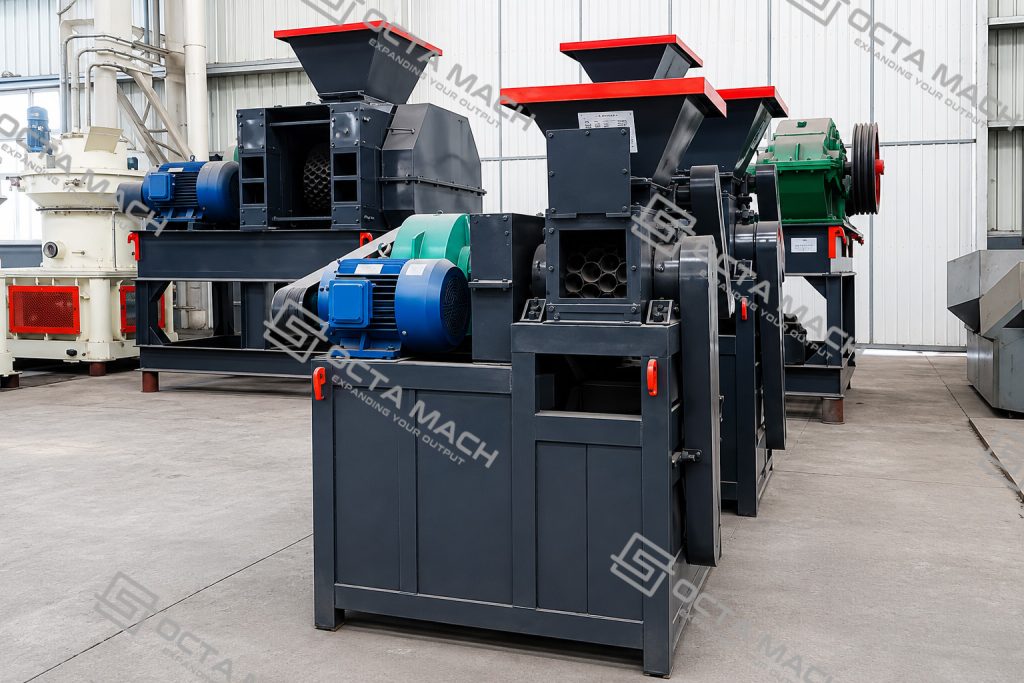
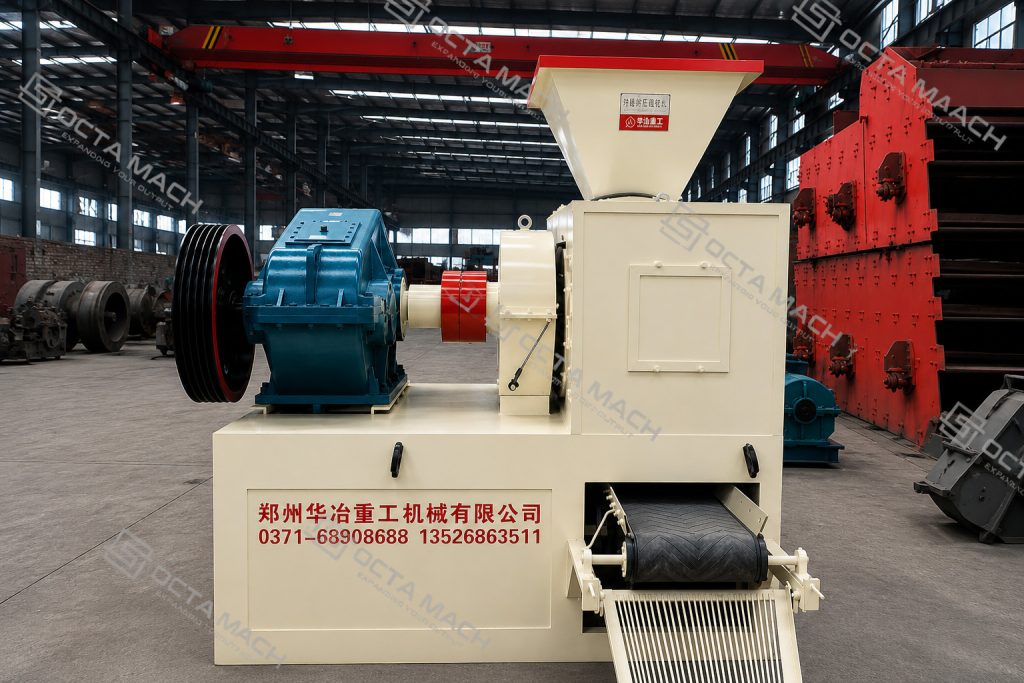
Octa Mach supplies the YHQ and YHY Briquette Press Ball Machine range with model matching based on actual feed properties, required capacity, moisture, binder system and target briquette shape. Rather than selecting equipment from motor power alone, we review roller diameter, pocket geometry, feeding method, reducer configuration and wear conditions for each application. The machine can also be coordinated with dosing, mixing, conveying, screening, fines-return and drying or curing equipment, allowing the press and surrounding process interfaces to be confirmed as one integrated briquetting system.
Product Range at a Glance
| Parameter | Available Range |
|---|---|
| Product type | Industrial double roller briquette press machine |
| Models | YHQ290 to YHY1000 |
| Published capacity | 2–45 t/h |
| Forming roller size | Φ290 × 220 to Φ1000 × 530 mm |
| Roller speed | 10–25 r/min, depending on model |
| Main motor power | 5.5–132 kW |
| Speed reducer | ZQ350 to ZQ1000 |
| Briquette forms | Pillow, oval, round, ball or project-specific pocket shape |
| Typical process | Cold briquetting with or without binder |
| Suitable feed | Prepared fine powder, concentrate, dust or industrial residue |
Published capacity is a preliminary model-comparison value rather than an unconditional production guarantee. Actual throughput and briquette quality depend on feed bulk density, particle-size distribution, moisture, binder system, roller-pocket geometry, feeding stability and required product strength.
Briquette Press Ball Machine Working Principle
Prepared fine material is first stored, metered and, where required, mixed with water or a suitable binder. The feed then enters the space between two rollers rotating toward each other. Matching pockets on the roller surfaces join at the roll nip, where the material is compressed and formed. After passing the point of maximum compression, the pockets separate and release the briquettes onto the discharge conveyor.
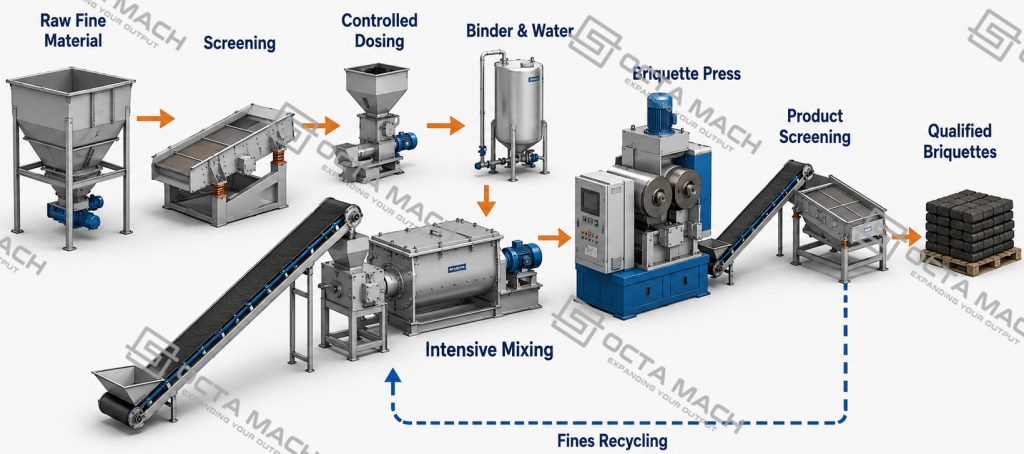
Typical process route:
Material Preparation → Dosing → Binder or Moisture Conditioning → Mixing → Roller Pressing → Discharge → Screening → Fines Recycling
Uniform feeding is essential. Materials with good flow characteristics may use gravity feeding, while poorly flowing or low-density powders may require a screw feeder to force material consistently into the roll nip. Screening after pressing can separate acceptable briquettes from loose fines, with undersize material returned to the mixer or press feed.
Briquette Press Ball Machine Technical Parameters
| Model | Speed Reducer | Ratio | Roller Size | Roller Speed | Motor Model | Motor Power | Capacity | Dimension |
|---|---|---|---|---|---|---|---|---|
| YHQ290 | ZQ350 | 1:23.24 | Φ290 × 220 mm | 20–25 r/min | Y132M-4 | 5.5 kW | 2–3 t/h | 1.2 × 1.0 × 1.4 m |
| YHQ360 | ZQ350 | 1:31.5 | Φ360 × 250 mm | 15–17 r/min | Y132M-4 | 7.5 kW | 3–5 t/h | 2.26 × 1.53 × 1.98 m |
| YHQ400 | ZQ400 | 1:31.5 | Φ400 × 250 mm | 15–17 r/min | Y160M-4 | 11 kW | 4–7 t/h | 2.3 × 1.38 × 1.96 m |
| YHQ500 | ZQ500 | 1:31.5 | Φ500 × 300 mm | 15–17 r/min | Y180L-4 | 22 kW | 8–10 t/h | 2.61 × 1.75 × 2.35 m |
| YHQ650 | ZQ650 | 1:31.5 | Φ650 × 300 mm | 12–16 r/min | Y200L-4 | 30 kW | 12–20 t/h | 3.42 × 2.0 × 2.4 m |
| YHY750 | ZQ750 | 1:31.5 | Φ750 × 380 mm | 12–15 r/min | Y225M-4 / Y250M-4 | 45–55 kW | 25–30 t/h | 3.7 × 2.55 × 2.6 m |
| YHY850 | ZQ850 | 1:31.5 | Φ850 × 380 mm | 10–15 r/min | Y250M-4 / Y280S-4 | 55–75 kW | 35–40 t/h | 3.9 × 2.6 × 2.7 m |
| YHY1000 | ZQ1000 | 1:31.5 | Φ1000 × 530 mm | 10–13 r/min | Y315S-4 / Y315M-4 | 110–132 kW | 40–45 t/h | 4.0 × 2.8 × 2.8 m |
Final motor, reducer, roller, electrical and installation data should be confirmed in the project-specific technical agreement.
Main Machine Structure
| Main Component | Function |
|---|---|
| Feed hopper | Receives prepared powder and maintains a controlled feed supply |
| Metering or screw feeder | Distributes material uniformly across the effective roller width |
| Forming rollers | Compress the feed and determine briquette shape and dimensions |
| Roller pockets | Form matching halves of the pillow, oval, ball or customized briquette |
| Main motor | Supplies drive power to the pressing system |
| Speed reducer | Reduces rotational speed and increases transmitted torque |
| Coupling and gears | Transfer power and synchronize the two forming rollers |
| Bearing assemblies | Support the rollers under radial and pressing loads |
| Machine frame | Maintains roll alignment and provides structural rigidity |
| Discharge unit | Removes newly formed briquettes from below the roller nip |
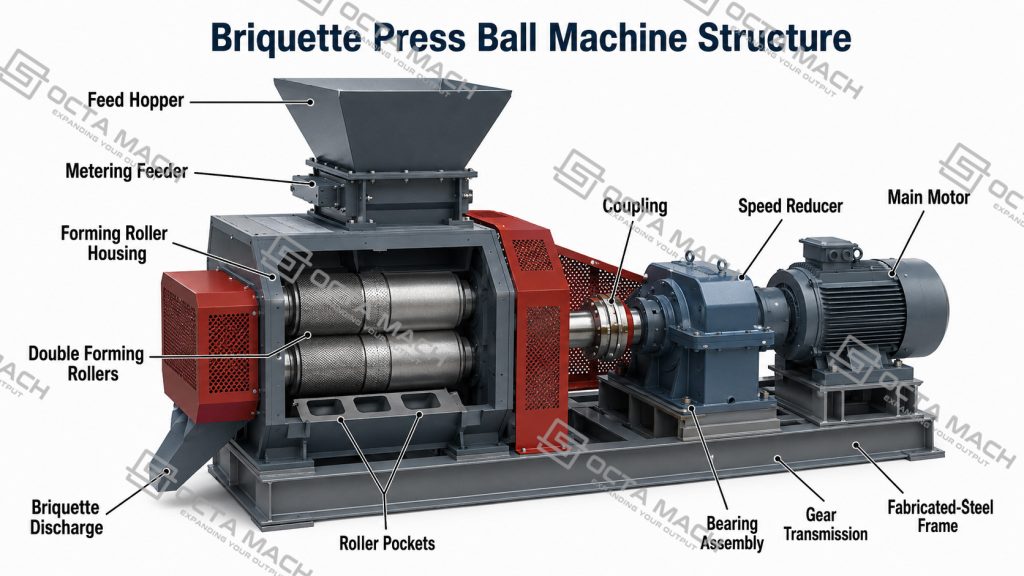
Because roller wear is strongly influenced by the abrasiveness of the feed, final roller material, heat treatment, surface hardness and pocket configuration should be confirmed against the actual powder before production.
Materials for Industrial Briquetting
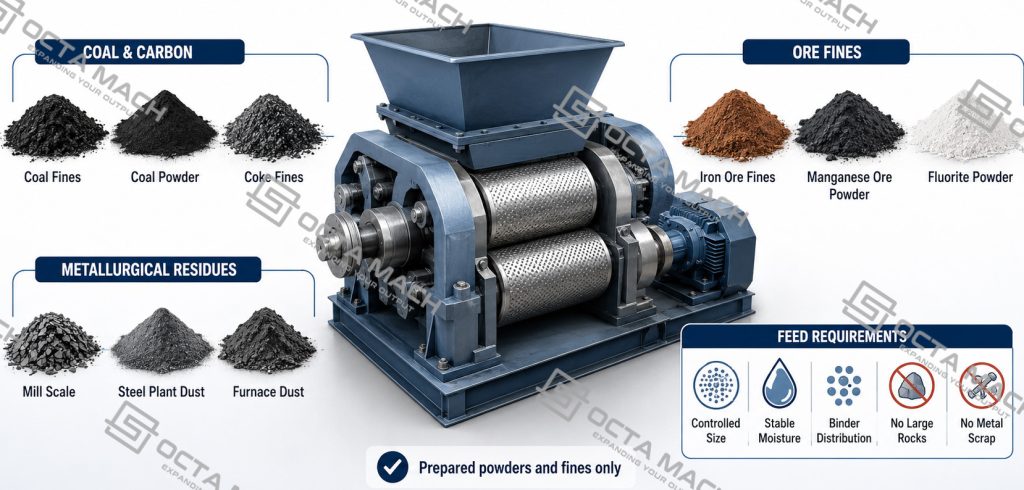
Coal and Coke Fines
As a coal briquette press machine, the equipment can process prepared coal powder, coal fines, lignite fines and selected carbonaceous materials. Coal fines that do not bond adequately under pressure may require a binder selected according to combustion, handling and downstream process requirements.
A coal powder briquette machine can form fuel or process briquettes into pillow, oval or ball shapes. A coke fines briquette machine may also be used to recover undersize coke or carbon fines, provided the feed recipe produces sufficient green and cured strength. Industrial references identify coal and coke fines as established roll-briquetting applications, often using binders when natural adhesion is insufficient.
Mineral Powder and Ore Fines
A mineral powder briquette machine is used after crushing, grinding, beneficiation or dust collection has produced a fine feed requiring agglomeration. Candidate materials can include:
- Iron ore fines and iron-bearing concentrates
- Manganese ore powder
- Fluorite or fluorspar powder
- Chrome ore fines
- Selected limestone or flux fines in prepared blends
- Other mineral powders verified through material testing
An iron ore fines briquetting machine does not press large hematite or magnetite rocks directly. The ore must first be reduced to an appropriate particle-size distribution and mixed to a controlled moisture and binder condition where required. Research and industrial sources identify roller pressing as one of the established agglomeration routes for iron ore fines and prepared metallurgical feed.
A manganese ore powder briquette machine or fluorite powder briquetter should likewise be selected from representative material tests. Mineral type alone is not enough to determine whether a powder will form a strong briquette. Particle shape, surface area, moisture sensitivity, binder compatibility and downstream furnace requirements must also be considered.
Metallurgical Dust and Plant Residues
The same machine family may be configured as a:
- Mill scale briquetting machine
- Steel-plant residue briquetter
- Flue-dust briquetting press
- Iron powder briquette press machine
- Converter-dust or furnace-dust briquetter
Ore fines, mill scale, flue dust and other metallurgical residues can be mixed with suitable binders or fluxes before pressing. The objective is normally to recover fine material, reduce dust during handling and prepare a consistent agglomerated feed for a defined downstream process. The complete route generally requires a dosing unit, mixer, briquetting press and, depending on the recipe, curing or drying equipment.
Feed boundary: This equipment is designed for prepared powders and fines. River pebbles, granite, basalt, diabase, andesite and quartzite lumps are crusher feed, not direct briquette-press feed.
Briquette Shape and Roller-Pocket Design
The final product shape is determined mainly by the matching pockets machined into the two roller surfaces. Common products include:
| Briquette Shape | Typical Selection Consideration |
|---|---|
| Pillow | Common industrial form with stable release from the roller pockets |
| Oval or egg | Frequently used for coal, coke and fuel briquettes |
| Round or ball | Suitable where a compact, symmetrical product is preferred |
| Square or rectangular | Used for specific packaging, furnace or handling requirements |
| Customized shape | Designed according to volume, strength and downstream equipment |
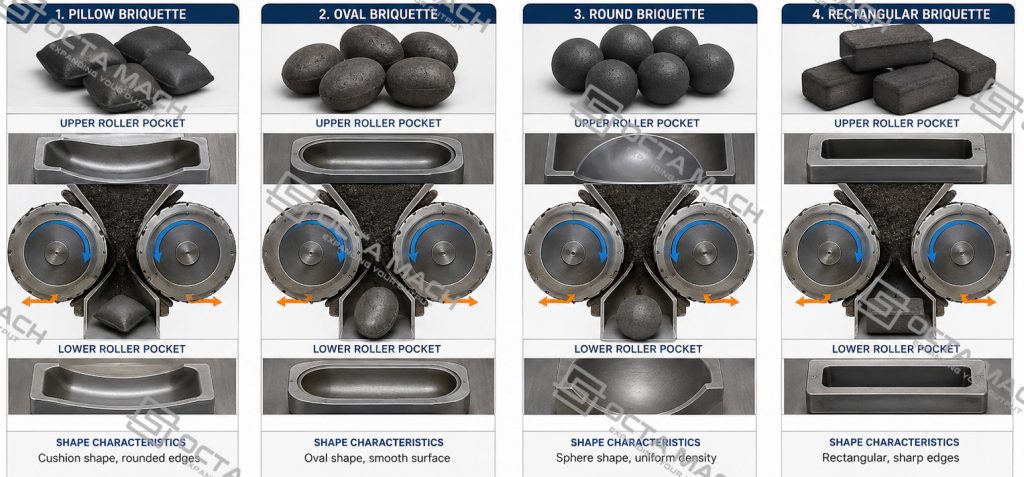
Changing the required briquette shape normally requires a corresponding roller or roller-shell configuration. Shape selection should account for pocket filling, product release, edge breakage, conveyor handling and downstream furnace or process requirements. The reference product pages also describe twin-roller equipment using interchangeable or customized mould patterns for oval, pillow, round, egg and square briquettes.
Binder-Free and Binder-Assisted Briquetting
Some powders have sufficient natural binding properties to form briquettes under pressure alone. Others require a binder to retain their shape after leaving the rollers.
Binder-free cold briquetting is appropriate only when the material develops adequate internal bonding under pressure and controlled moisture.
Binder-assisted cold briquetting requires accurate binder dosing and thorough mixing. Binder selection must consider not only green strength but also curing time, thermal behavior, ash contribution, chemical compatibility and the requirements of the downstream process.
A binder that produces a strong briquette during handling may still be unsuitable if it introduces unwanted elements into a metallurgical furnace or interferes with later processing. Representative material testing is therefore more reliable than selecting a recipe from material name alone.
Model Selection Inputs
Selecting an industrial briquette press machine requires more than matching the nominal capacity.
Feed material: Identify the main powder, mineral, concentrate or residue, including its abrasiveness and chemical composition.
Particle-size distribution: Confirm the percentage of fines, oversize particles and agglomerates entering the mixer and press.
Moisture and binder: Determine the operating moisture range, binder type, dosage method and required curing or drying route.
Required capacity: Specify normal and peak feed rates rather than relying only on annual production.
Briquette requirements: Define shape, dimensions, density, green strength, cured strength and acceptable fines generation.
Process interfaces: Confirm upstream crusher, grinder, dryer, dosing unit and mixer, together with downstream conveyor, screen, fines-return system and curing equipment.
Site data: Provide voltage, frequency, control requirements, foundation space, dust collection and maintenance access.
Industrial briquetting specialists recommend representative-material testing because roller speed, pressing force, feeder type, moisture, binder and product geometry are all material-dependent. Pilot work may also assess compression strength, tumble strength, abrasion resistance, product density and usable briquette yield.
Operating and Maintenance Considerations
Stable feed distribution is one of the most important operating conditions. Uneven feeding can leave part of the roller width underloaded while another area is overloaded, producing inconsistent briquettes and uneven pocket wear.
Roller alignment, pocket condition and synchronized rotation should be checked regularly. Worn or damaged pockets can change briquette volume, cause incomplete mould filling and increase loose fines.
The discharge area should remain clear so that newly formed briquettes can separate without accumulating beneath the rollers. Where the product generates excessive undersize, a screen and controlled fines-return loop should be included instead of repeatedly feeding uncontrolled material back into the hopper.
Guards, roller housings and dust extraction should be maintained around the feed and pressing areas. Industrial roller-press designs use housings both for machine safety and to limit dust escape around the pressing zone.
Why Choose Octa Mach
Octa Mach supplies Briquette Press Ball Machine models from YHQ290 to YHY1000, covering published capacities of 2–45 t/h. Model selection is based on the prepared feed, required throughput, particle-size distribution, moisture condition, binder system and target briquette shape—not motor power or nominal capacity alone.
For coal fines, coke powder, mineral powder, iron ore fines and metallurgical residues, we review the roller diameter, roller width, pocket geometry, feeding method, reducer configuration and wear-part arrangement separately. Abrasive mineral feeds are not treated as standard coal applications; the forming-roller specification and expected wear conditions must be matched to the actual material.
We can also coordinate the briquette press with upstream dosing and mixing equipment and downstream conveyors, screens, fines-return systems and drying or curing units. Each technical proposal can define the selected model, capacity basis, 65Mn roller configuration, motor and reducer data, voltage, installation dimensions, auxiliary equipment and process interfaces, helping reduce equipment mismatch and later project changes
FAQ
Q: What materials can a Briquette Press Ball Machine process?
A: It can process prepared coal fines, coke fines, iron ore fines, selected mineral powders, mill scale, flue dust and other industrial residues. The material must have a controlled particle size, moisture and feed recipe.
Q: Can the machine press raw rocks directly?
A: No. Hematite, magnetite, manganese ore, fluorite and limestone must first be crushed or ground into a suitable fine feed. Granite, basalt and river pebbles are normally crusher applications rather than briquetting materials.
Q: Is a binder always required?
A: No. Some materials can be cold-briquetted without binder, but powders with insufficient natural adhesion require a compatible binder and uniform mixing.
Q: How is the correct model selected?
A: Selection should consider required capacity, bulk density, particle-size distribution, moisture, binder system, roller-pocket shape, briquette strength, voltage and upstream/downstream equipment. Representative material testing is recommended for new feed recipes.