
Tracked Mobile Crushing Plant is a crawler-mounted crushing system used for on-site primary crushing of iron ore, quarry rock, hard aggregate and mining material. It integrates a feeder, jaw crusher, tracked chassis, main conveyor, iron remover, generator set, electrical cabinet and hydraulic folding system into one movable plant.
Octa Mach configures each tracked mobile crusher according to feed size, material hardness, required capacity, conveyor layout and site mobility. In the TC series, the core crushing unit is a jaw crusher, which reduces large feed material before screening, cone crushing, impact crushing or downstream processing.
The TC series is mainly used as a tracked jaw crusher plant for large-feed primary reduction. For limestone shaping, concrete recycling or asphalt recycling, a tracked impact crusher can be reviewed separately.
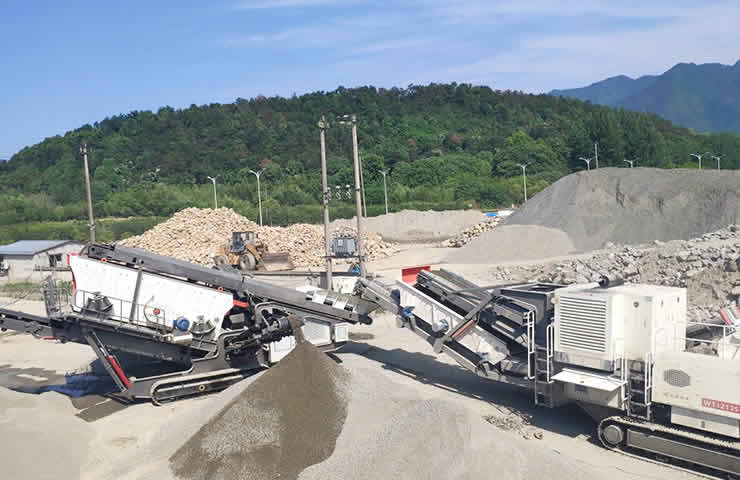
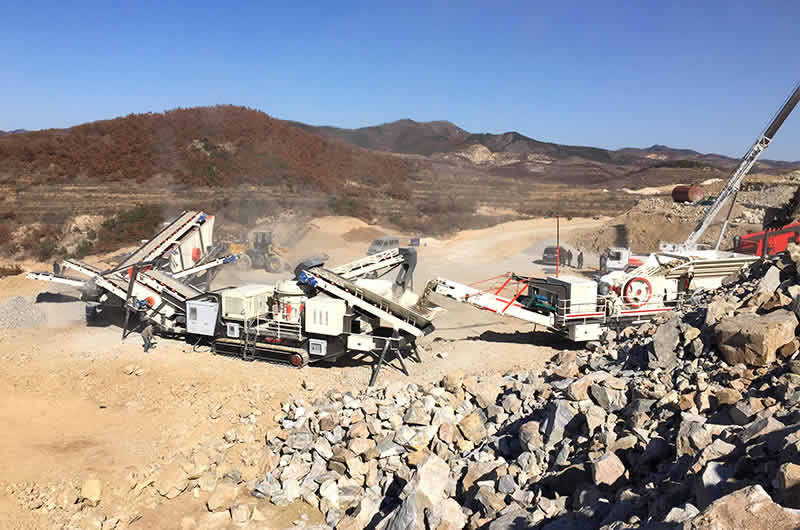
TC Series Tracked Jaw Crusher Technical Parameters
The TC series includes TC96, TC106, TC116 and TC120. The larger models support larger feed size, higher crusher motor power and stronger material handling capacity.
| Model | TC96 | TC106 | TC116 | TC120 |
|---|---|---|---|---|
| Feeding machine | GZD9638 | ZSW1042 | GZD1142 | GZD1248 |
| Feeder motor | 5.5 kW × 2 | 7.5 kW × 2 | 7.5 kW × 2 | 7.5 kW × 2 |
| Crusher model | SC96 | SC106 | SC116 | SC120 |
| Max feeding size | 550 mm | 650 mm | 700 mm | 800 mm |
| Crusher motor | 90 kW | 110 kW | 132 kW | 160 kW |
| Hydraulic tracked chassis | 35T | DL385V | DL385V | NS415E |
| Base frame | Q345B welding | Q345B welding | Q345B welding | Q345B welding |
| Main conveyor | B1000 × 12.9 m | B1000 × 12 m | B1000 × 12 m | B1000 × 12.9 m |
| Main conveyor drive | 11 kW | 11 kW | 11 kW | 15 kW |
| Main belt specification | EP300-B1000×5(6.0+1.5) | EP300-B1000×5(6.0+1.5) | EP300-B1000×5(6.0+1.5) | EP300-B1200×5(6.0+1.5) |
| Generator set | 240 kW engine block | 300 kW engine block | 300 kW engine block | 300 kW engine block |
| Iron remover | RCYQ-13 | RCYQ-13 | RCYQ-13 | RCYQ-13 |
TC96 is suitable for smaller primary crushing duties with feed size up to 550 mm and a 90 kW crusher motor. TC120 is the largest listed model, with feed size up to 800 mm, a 160 kW crusher motor, NS415E tracked chassis and B1200 main belt specification.
Track Crusher Structure and Working Process
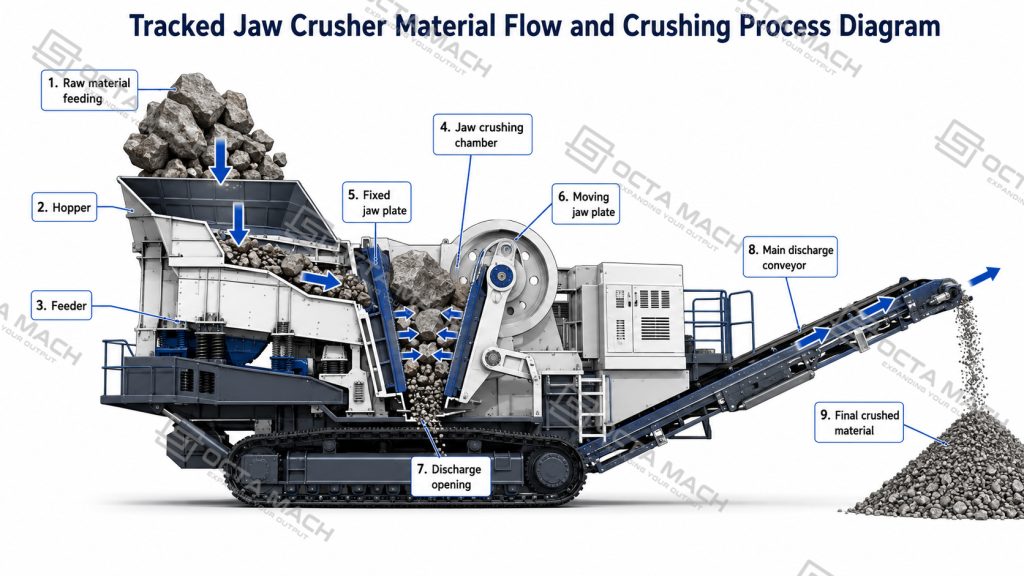
A track crusher is not only a crusher mounted on tracks. It is a complete mobile crushing unit designed to feed, crush, discharge and move within the site.
The material flow is simple:
- Raw material enters the feeding machine.
- The feeder sends material into the jaw crusher.
- The crusher reduces large material by compression.
- Crushed material moves to the main conveyor.
- The iron remover separates magnetic metal when required.
- The material goes to stockpile, screening equipment or the next crushing stage.
This process is suitable for primary crushing. If the project needs final aggregate sizes, a vibrating screen should be added after the tracked jaw crusher. If the project requires better particle shape, a cone crusher or tracked impact crusher may be used as the next stage.
Tracked Mobile Crusher Power, Conveyor and Hydraulic Configuration
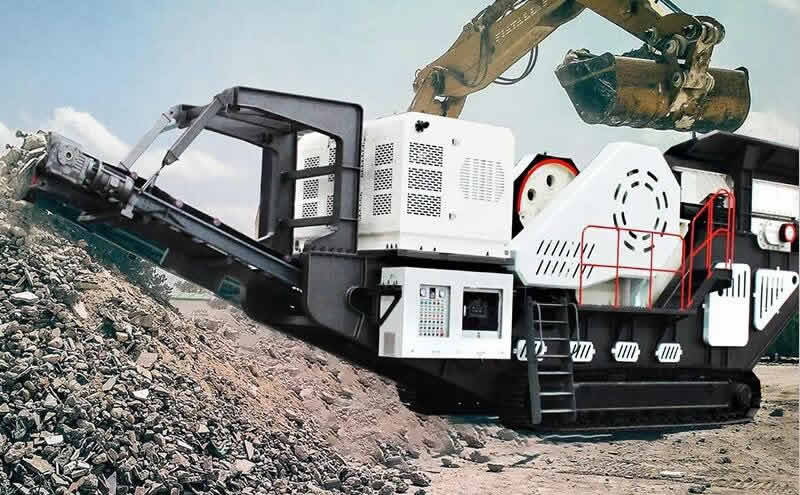
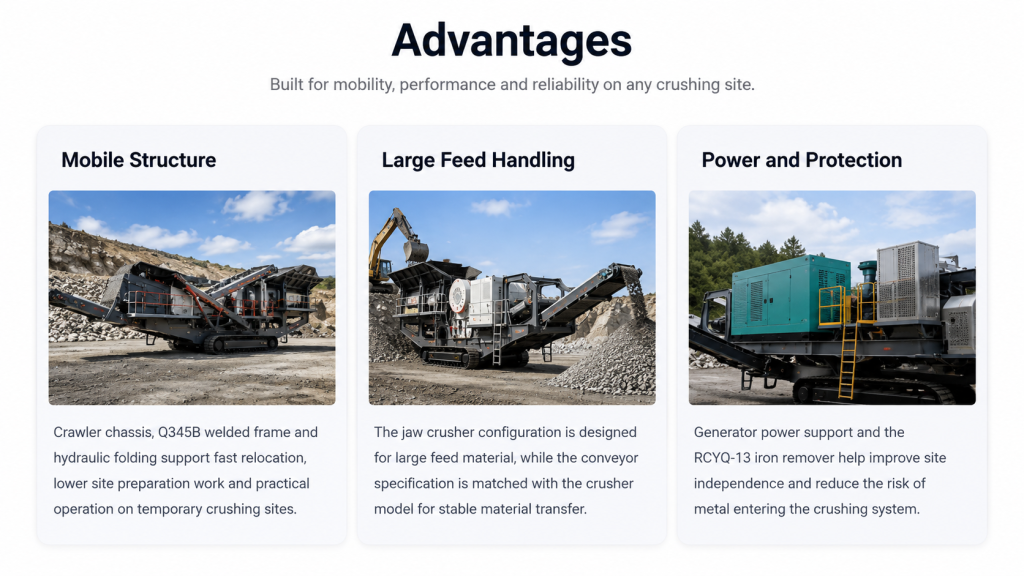
For a tracked mobile crusher, the auxiliary systems affect daily operation as much as the crusher itself. The TC series uses motor-driven feeding and crushing, generator power support, hydraulic folding and magnetic metal removal.
The TC96 uses a 240 kW engine block, while TC106, TC116 and TC120 use 300 kW engine blocks. The electrical cabinet uses soft start for the jaw crusher motor and direct start for other motors, with Schneider listed as the main electrical component brand.
The hydraulic system supports automatic folding of the silo and belt conveyor cylinder. This helps reduce setup work during relocation. The RCYQ-13 iron remover is useful when tramp iron or magnetic metal may enter the material stream, especially in ore crushing, quarry material handling or concrete block pre-crushing.
Tracked Jaw Crusher Applications and Material Selection
Large-feed primary crushing is the main working duty of the TC series tracked jaw crusher. Its parameter range—550–800 mm maximum feed size, 90–160 kW crusher motor power, B1000–B1200 main belt specification and 240–300 kW generator support—shows that this plant is designed to reduce oversized material before screening, cone crushing, impact crushing or downstream processing.
In iron ore and hard rock mining, the plant is usually placed near the working face so large ore lumps can be reduced before the next process. The larger models, especially TC116 and TC120, should be reviewed when feed size is close to 700–800 mm or when the crushing duty is heavy. Ore abrasiveness, jaw plate wear, crusher load stability and the downstream screen or crusher capacity should be checked together.
Quarry production has a different selection focus. Granite, basalt, river stone and hard limestone often arrive as large, irregular blasted rock, so the plant must accept coarse feed and discharge steadily into the next stage. In this case, crusher chamber size, jaw plate material, discharge setting, main belt specification and service access are more important than capacity alone.
Road construction projects usually need raw stone reduced before screening into road base, sub-base or graded aggregate. The TC series can handle the primary reduction stage, but final product sizing normally depends on a vibrating screen or secondary crusher after the jaw crusher. This distinction is important: the tracked jaw crusher prepares material; it does not replace a full aggregate classification system.
Oversized concrete blocks can also be processed when the project needs pre-crushing before recycling. Because rebar or magnetic metal may be mixed into the feed, the RCYQ-13 iron remover should be reviewed as part of the process protection system. When better particle shape is required after pre-crushing, a tracked impact crusher can be added downstream.
The practical selection rule is straightforward: use this tracked mobile crusher when the project needs large-feed acceptance, mobile primary reduction and stable transfer to the next process. Final model choice should be based on feed size, material hardness, abrasiveness, discharge requirement, conveyor capacity and site mobility, not on model number alone.
Tracked Mobile Crushing Plant Applications
Tracked mobile crushing plants are used for on-site crushing of common quarry and construction stone materials. The correct plant configuration depends on the raw material hardness, abrasiveness, feed size and required final product size. Granite, limestone and river stone are three typical materials processed by tracked mobile crushing equipment in aggregate, road construction and mining-related projects.
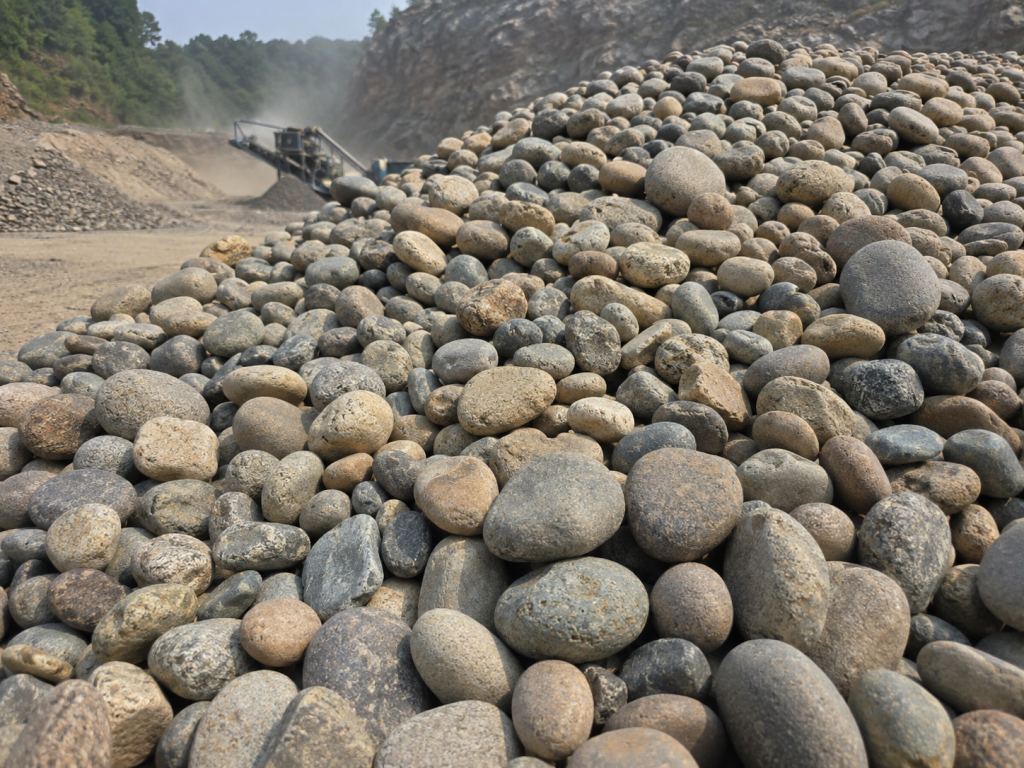
River Stone Processing
River stone is hard, smooth and rounded, which makes stable feeding and controlled crushing especially important. A tracked jaw crusher can be used to reduce larger river stones before cone crushing or screening. This application is often used in sand and aggregate production where consistent particle size, continuous operation and flexible site movement are required under demanding quarry and remote project site conditions.
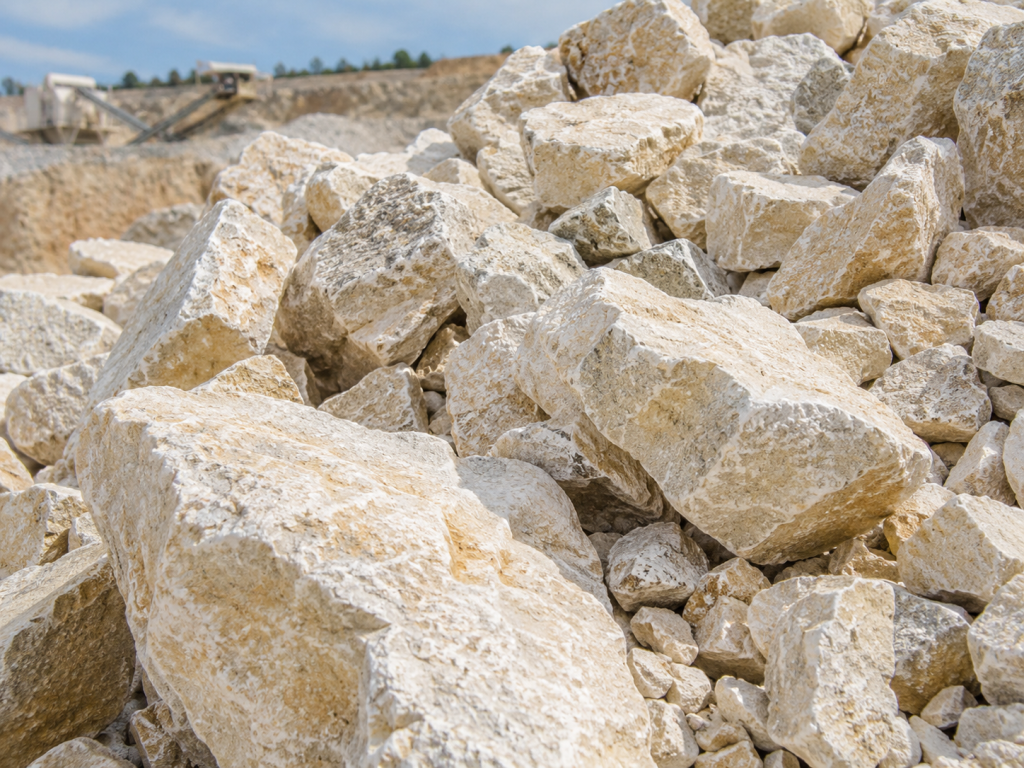
Limestone Processing
Limestone is easier to crush than granite and is widely used for road base, concrete aggregate and general construction material. A tracked mobile crushing plant can efficiently process limestone directly at the quarry or project site. Depending on the final product requirement, jaw crushing can be used for primary reduction, while impact crushing may be reviewed when better particle shape is required.
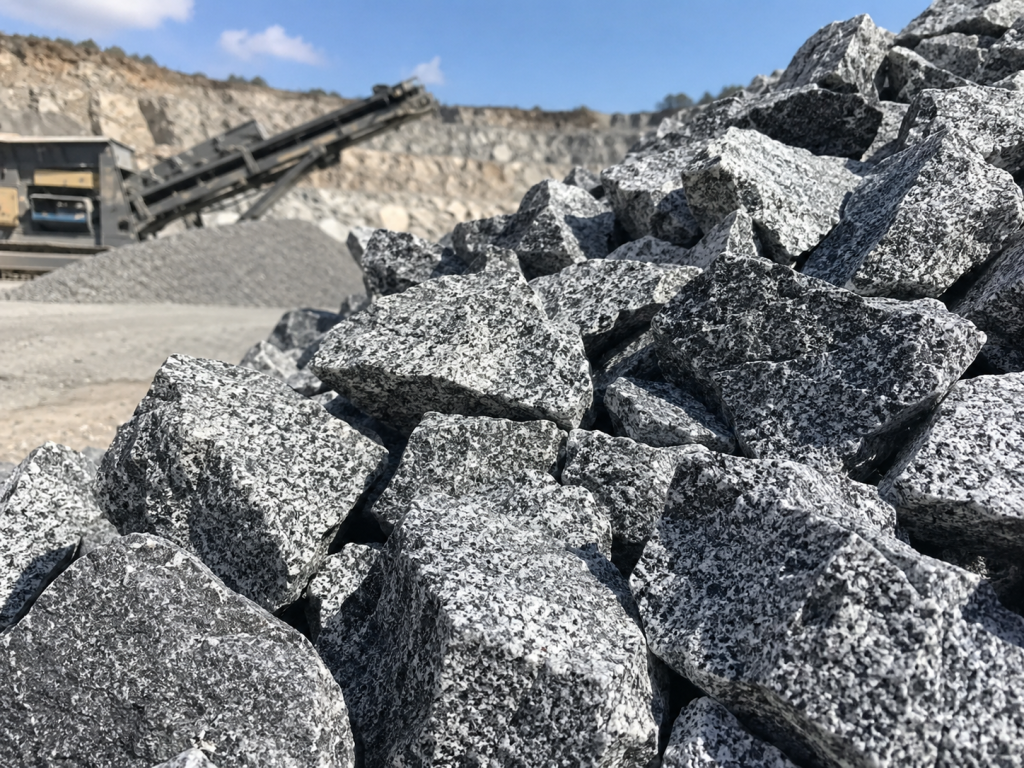
Granite Processing
Granite is a hard and abrasive rock, so primary crushing usually requires a strong jaw crusher configuration. A tracked mobile jaw crusher can reduce large granite feed near the quarry face before cone crushing, screening or aggregate stockpiling. This application is common in high-strength aggregate production where wear resistance, stable feeding and reliable coarse crushing are important.
Tracked Jaw Crusher vs Tracked Impact Crusher
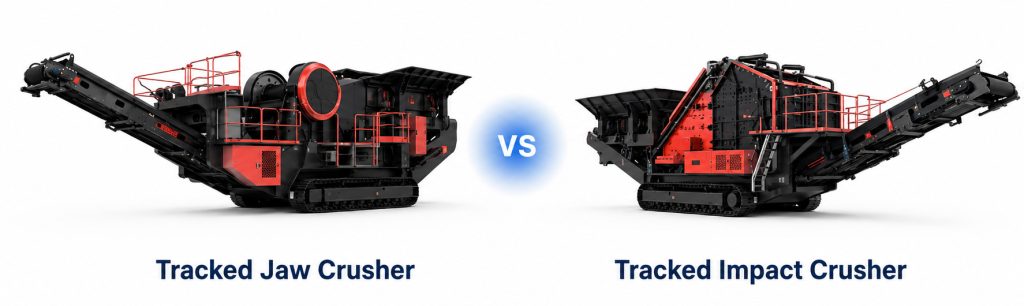
| Tracked Jaw Crusher | Comparison Item | Tracked Impact Crusher |
|---|---|---|
| Uses compression between fixed and moving jaw plates. | Crushing Principle | Uses a high-speed rotor and impact force to break material. |
| Large, hard, abrasive and irregular feed material. | Suitable Materials | Medium-hard materials, limestone, concrete waste and asphalt waste. |
| Mainly used for primary crushing and initial size reduction. | Crushing Stage | Commonly used for secondary crushing, recycling and particle shaping. |
| Accepts relatively large feed and prepares material for screening or cone crushing. | Main Duty | Produces better particle shape and processes recycled construction materials efficiently. |
| Hard rock and ore reduction, quarry primary crushing and aggregate production. | Typical Applications | Construction-waste recycling, asphalt recycling, limestone crushing and aggregate shaping. |
| Select when the project requires large feed acceptance, primary crushing or hard-rock reduction. | Selection Basis | Select when the project prioritizes recycling, medium-hard material crushing or improved particle shape. |
| The TC series described in this article uses a tracked jaw crusher configuration and is intended primarily for initial size reduction. | TC Series Configuration | Not applicable to the TC series configuration described in this article. |
Advantages of Octa Mach Tracked Mobile Crushing Plant
How to Choose a Tracked Mobile Crushing Plant for Sale
Before comparing a tracked mobile crushing plant for sale, confirm the crushing duty first. Capacity and motor power are not enough for model selection.
Use these points for quick selection:
- Feed size up to 550 mm: review TC96.
- Feed size up to 650 mm: review TC106.
- Feed size up to 700 mm: review TC116.
- Feed size up to 800 mm: review TC120.
- For iron ore, granite or basalt: check jaw plate wear and crusher load.
- For final aggregate sizes: add screening equipment.
- For recycling or shaping: review tracked impact crusher configuration.
- For frequent relocation: check crawler chassis, hydraulic folding and transport access.
- For site power: confirm generator set and electrical cabinet requirements.
A suitable tracked mobile crushing plant should match feed size, material hardness, output requirement, site access, conveyor layout and downstream process together.
FAQ
Q: What is a tracked mobile crushing plant used for?
A: It is used for on-site crushing of iron ore, quarry rock, hard aggregate and mining material. The TC series is mainly a tracked jaw crusher plant for primary crushing before screening or secondary crushing.
Q: What is the difference between a track crusher and a stationary crusher plant?
A: A track crusher is mounted on a crawler chassis and can move within the site. A stationary crusher plant usually requires fixed foundation work and is better for long-term fixed production.
Q: When should I choose a tracked jaw crusher?
A: Choose a tracked jaw crusher when the feed material is large, hard or irregular. It is normally used as the first crushing stage before screening, cone crushing or impact crushing.
Q: Is a tracked impact crusher better than a tracked jaw crusher?
A: Not always. A tracked impact crusher is better for recycling, limestone and shaping. A tracked jaw crusher is better for large feed and primary crushing of hard material.