
Impact Hammer Crusher is a size-reduction machine that uses a high-speed rotor and swinging hammer heads to fracture medium-hard, brittle materials. Feed entering the crushing chamber is struck repeatedly, projected against the liner plates, and retained above the grate bars until it is small enough to pass through the selected openings. This combines impact crushing and discharge-size control within one compact crushing stage.
The OctaMach range includes PC400 × 300 to PC1200 × 1200 models, with maximum feed sizes of 100–250 mm, discharge sizes of 10–19 mm, and nominal capacities of 5–200 t/h. Typical materials include limestone, coal, gypsum, coke, coal gangue, and selected cement raw materials. Actual output depends on material brittleness, abrasivity, moisture, feed distribution, hammer wear, grate condition, and downstream discharge capacity.
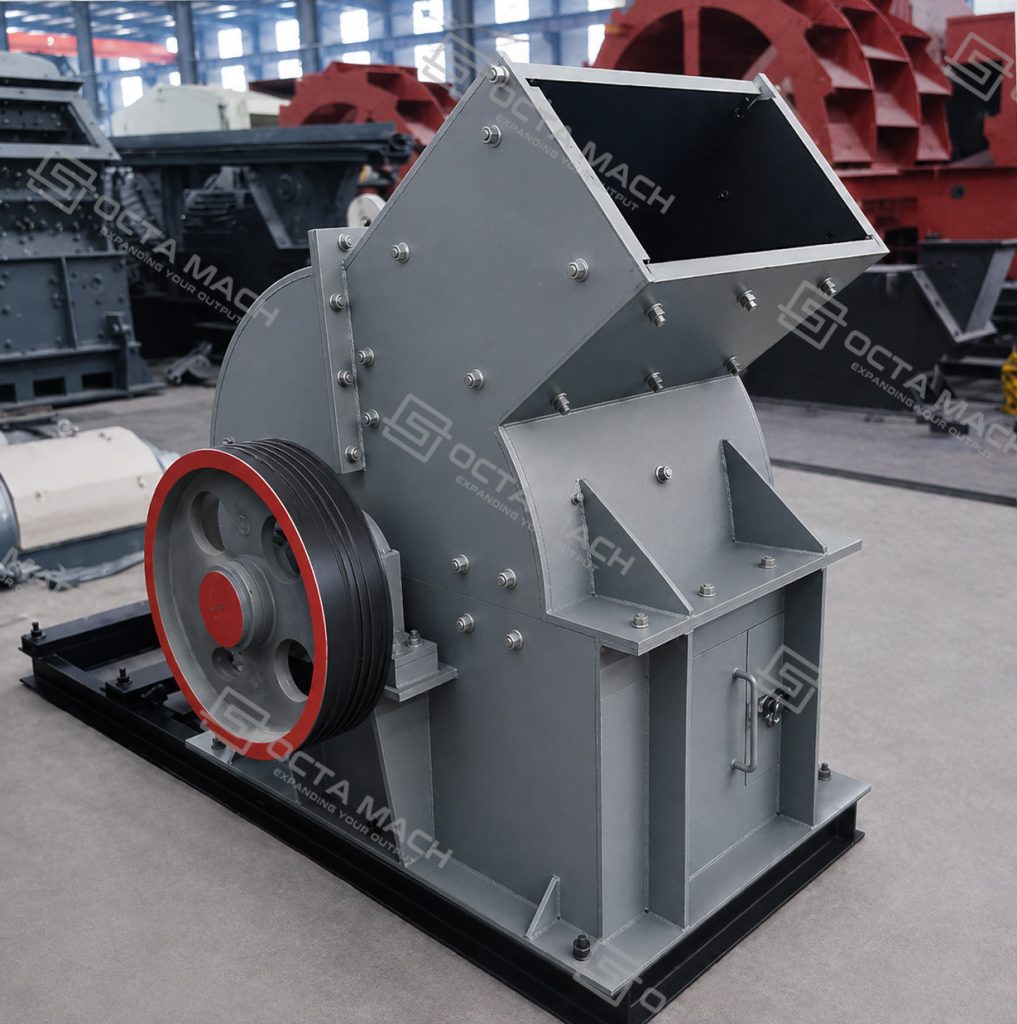
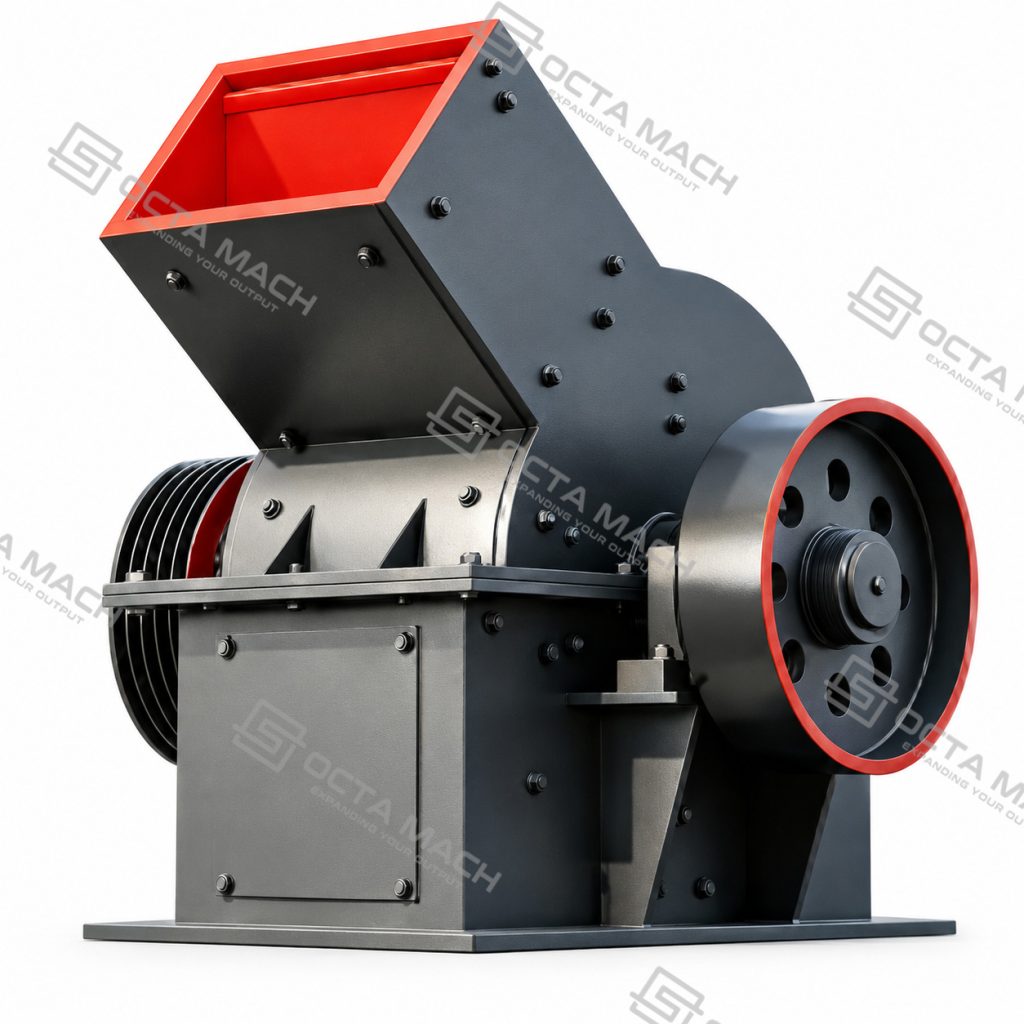
PC Series Technical Specifications and Model Range
| Model | Maximum Feed Size (mm) | Discharge Size (mm) | Crushing Capacity (t/h) | Motor Power (kW) | Machine Weight (t) |
|---|---|---|---|---|---|
| PC400 × 300 | ≤100 | ≤10 | 5–10 | 7.5 | 0.8 |
| PC600 × 400 | ≤120 | ≤15 | 10–25 | 18.5 | 1.5 |
| PC800 × 600 | ≤120 | ≤15 | 20–35 | 55 | 3.1 |
| PC1000 × 800 | ≤200 | ≤13 | 20–40 | 115 | 7.9 |
| PC1000 × 1000 | ≤200 | ≤15 | 30–80 | 132 | 8.7 |
| PC1200 × 1200 | ≤250 | ≤19 | 80–200 | 240 | 13.6 |
The series can be broadly positioned as follows:
- PC400 × 300 and PC600 × 400: Small-capacity crushing of prepared limestone, coal, gypsum, and similar brittle feed.
- PC800 × 600: Medium-duty crushing where a controlled product below approximately 15 mm is required.
- PC1000 × 800 and PC1000 × 1000: Continuous industrial duties requiring larger feed acceptance and higher motor power.
- PC1200 × 1200: Large-feed applications requiring coordinated feeding, discharge conveying, foundation, and motor-starting arrangements.
Working Principle, Main Components and Operating Advantages
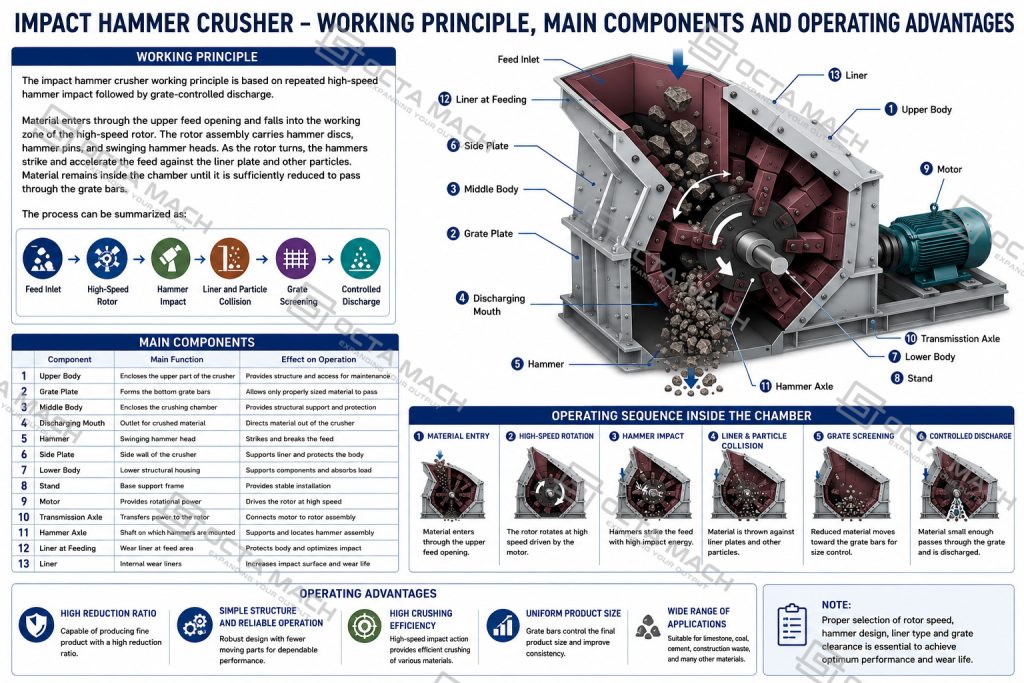
The impact hammer crusher working principle is based on repeated high-speed hammer impact followed by grate-controlled discharge.
Material enters through the upper feed opening and falls into the working zone of the high-speed rotor. The rotor assembly carries hammer discs, hammer pins, and swinging hammer heads. As the rotor turns, the hammers strike and accelerate the feed against the liner plate and other particles. Material remains inside the chamber until it is sufficiently reduced to pass through the grate bars.
The process can be summarized as:
Feed Inlet → High-Speed Rotor → Hammer Impact → Liner and Particle Collision → Grate Screening → Controlled Discharge
Main Components
| Component | Main Function | Effect on Operation |
|---|---|---|
| Rotor assembly | Carries the rotating hammer system | Generates the impact energy required for crushing |
| Main shaft | Transfers drive torque to the rotor | Supports continuous high-speed rotation |
| Hammer head | Strikes and breaks the feed | Provides the main crushing action |
| Hammer disc | Positions and supports the hammer arrangement | Maintains the hammer distribution around the rotor |
| Hammer pin | Connects each hammer to the disc | Allows swinging movement and hammer replacement |
| Liner plate | Protects the crusher housing | Provides an additional impact surface |
| Grate bars | Screen reduced particles | Define the principal output particle-size limit |
| Bearing housing | Supports and locates the shaft | Maintains stable rotor alignment |
| Crusher housing | Encloses the crushing chamber | Provides structural support and wear protection |
Operating Advantages
The PC-series hammer crusher machine offers several practical advantages for suitable materials:
- High-speed repeated impact provides effective reduction of brittle feed.
- Grate bars provide direct control of the principal discharge-size range.
- The compact single-rotor hammer crusher arrangement fits secondary and fine-crushing duties.
- Hammer heads, liner plates, pins, and grate bars are replaceable wear parts.
- The machine can be integrated with vibrating feeders, belt conveyors, and screening equipment.
- A broad model range supports capacities from 5 to 200 t/h under suitable conditions.
- Internal parts can be inspected through the crusher housing without dismantling the entire process line.
These benefits depend on correct material selection. A PC-series crusher should not be treated as a universal hard-rock crusher; highly abrasive feed can rapidly increase hammer and liner consumption.
Discharge Control, Wear and Stable Operation
The discharge size and operating stability of an Impact Hammer Crusher depend on more than the nominal grate opening. Hammer condition, rotor balance, feed moisture, material flow, and effective grate area must be reviewed together.
| Operating Factor or Symptom | Effect on Performance | Inspection Priority |
|---|---|---|
| Grate opening | Defines the main discharge-size limit | Check spacing, wear, bending, and local enlargement |
| Hammer wear | Reduces impact energy and may produce coarser material | Check hammer-tip profile and remaining mass |
| Grate blockage | Restricts discharge and lowers crushing capacity | Check moisture, sticky fines, and open area |
| Uneven feeding | Causes unstable rotor load and irregular wear | Check feeder continuity and full-width distribution |
| Rotor imbalance | Increases vibration and bearing load | Check hammer arrangement, pins, and rotor condition |
| Rising bearing temperature | May indicate poor lubrication, overload, or misalignment | Check lubricant, bearing housing, and motor load |
| High motor current | Can result from oversized feed or restricted discharge | Check feed size, feed rate, and discharge path |
| Abnormal noise | May indicate loose wear parts or tramp metal | Stop and inspect hammers, pins, liners, and grate bars |
A coarser product should not immediately be corrected by reducing the grate opening or increasing the feed rate. Hammer wear, liner condition, grate-bar spacing, and blocked screening area should be checked first.
Hammer replacement should be based on wear profile, weight difference, rotor vibration, and product-size stability rather than operating hours alone. When several hammers are replaced, their weight distribution must remain balanced around the rotor to avoid abnormal vibration.
How to Choose the Right Impact Hammer Crusher
Selecting the correct Impact Hammer Crusher requires matching material brittleness, maximum feed size, target discharge size, moisture, and continuous plant capacity with the rotor, hammer, and grate configuration.
| Selection Factor | Information to Confirm | Effect on Selection |
|---|---|---|
| Feed material | Hardness, brittleness, and abrasivity | Confirms whether hammer crushing is suitable |
| Maximum feed size | Largest regular lump | Determines the required PC model |
| Required product size | Target size and acceptable fines | Defines grate opening and reduction duty |
| Required capacity | Continuous output in t/h | Determines crusher, motor, and feeder duty |
| Moisture and clay | Surface moisture and sticky fines | Affects grate flow and blockage risk |
| Wear conditions | Expected hammer, liner, and grate wear | Determines wear-part material and spare quantity |
| Feed distribution | Continuous and even material flow | Supports stable motor load and uniform wear |
| Downstream equipment | Conveyor, screen, mill, or storage capacity | Determines actual plant output |
| Installation | Foundation, lifting space, and maintenance access | Defines equipment layout |
The selected PC model must accept the largest regular lump without repeated impact overload while maintaining the required continuous capacity. A finer required product normally increases sensitivity to grate blockage, hammer wear, and moisture.
Working Conditions and Material Applications
The PC-series fine crushing hammer crusher is best suited to brittle and relatively low- to medium-abrasion materials.
- Limestone crushing: A limestone hammer crusher is used for secondary or fine reduction before screening, grinding, or cement preparation. Silica content should be reviewed because it directly affects hammer wear.
- Coal crushing: A coal hammer crusher can reduce prepared coal before screening, combustion, or further processing. Moisture and sticky fines are the main grate-blockage risks.
- Cement material crushing: The machine can reduce prepared limestone, gypsum, and other brittle cement materials before grinding or blending.
- Gypsum crushing: A gypsum hammer crusher is suitable for relatively soft material requiring controlled fine reduction. Wet or clay-contaminated gypsum may restrict the grate area.
- Coke crushing: A coke hammer crusher uses repeated impact to reduce brittle coke. Feed distribution and excessive fines should be monitored.
- Coal gangue crushing: A coal gangue hammer crusher can process selected brittle gangue after metal removal and abrasivity evaluation.
- Slag crushing: A slag hammer crusher is suitable only for brittle slag with controlled metallic inclusions. Tramp iron must be removed before the crusher.
- Mining applications: A mining hammer crusher can be used for suitable low- to medium-abrasion mineral feed before screening or grinding.
The PC hammer crusher is generally not the preferred choice for granite, basalt, quartzite, or highly abrasive ore. These materials can cause rapid hammer wear, liner wear, increased vibration, and higher operating cost.
Why Choose OctaMach
OctaMach supplies PC-series Impact Hammer Crushers from PC400 × 300 to PC1200 × 1200 and matches each model to the material, maximum feed size, required capacity, output size, motor supply, and connected process equipment. As an impact hammer crusher manufacturer and impact hammer crusher supplier, OctaMach can also provide hammer heads, hammer pins, liner plates, grate bars, bearings, installation drawings, technical documentation, electrical matching, and export packing support.
FAQ
Q1:How is an Impact Hammer Crusher different from a conventional impact crusher?
A1:An Impact Hammer Crusher uses swinging hammer heads and bottom grate bars; material remains in the chamber until it can pass through the grate openings. A conventional impact crusher uses rigid blow bars and impact aprons, with product size controlled mainly by rotor speed and apron clearance.
Q2:Why does the discharge become coarser even when the grate opening has not changed?
A2:Hammer-tip wear reduces impact velocity and changes the effective clearance between the hammers, liners, and grate. Worn or deformed grate bars can also enlarge local openings, allowing coarser particles to leave the chamber.
Q3:Can an Impact Hammer Crusher process wet or sticky material?
A3:It can handle moderately moist brittle feed, but sticky fines may cover the grate openings and reduce the effective discharge area. When material builds up, capacity falls, motor load rises, and product grading becomes less stable.
Q4:When is a jaw crusher required before a PC hammer crusher?
A4:Pre-crushing is required when the largest regular feed lumps exceed the PC model’s inlet limit or when the feed contains hard, blocky material that cannot be reliably broken by hammer impact alone. The jaw crusher should produce a continuous, controlled feed size rather than occasional oversized lumps.