
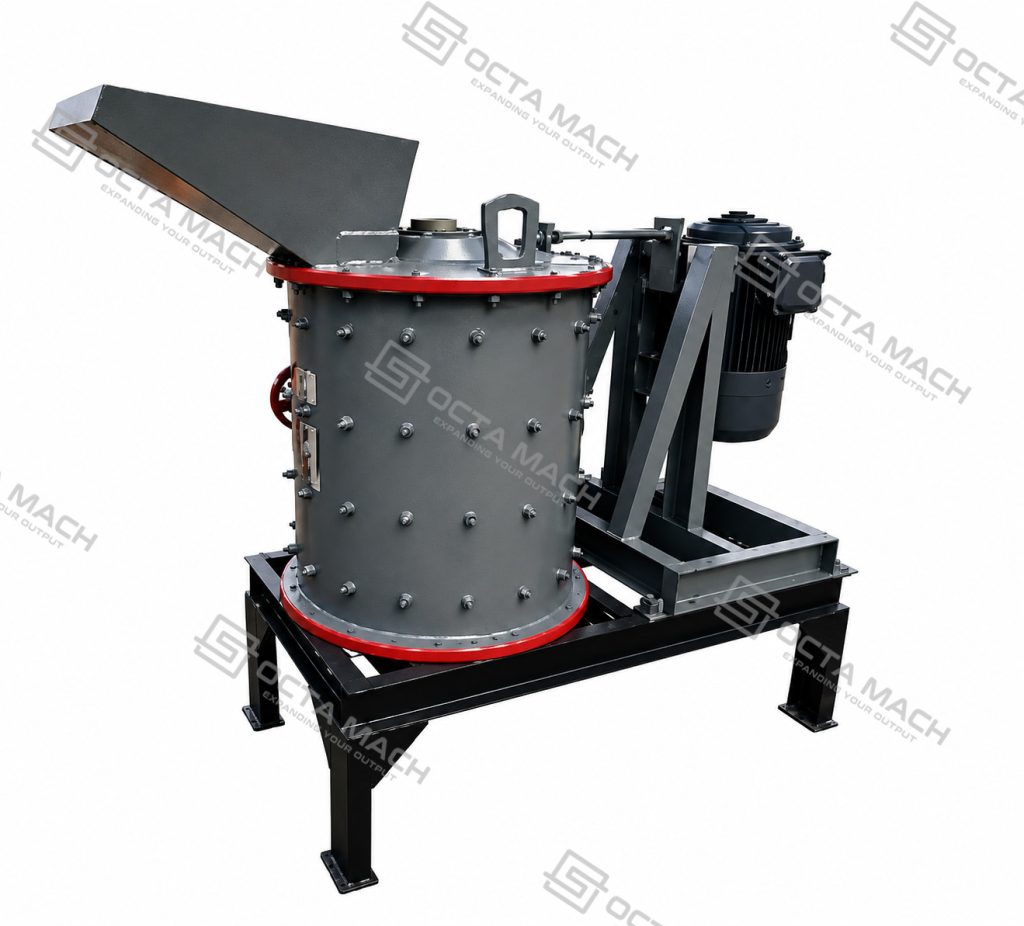
Vertical Compound Crusher is a PFL-series vertical shaft compound crusher designed for fine crushing and coarse grinding of medium-hard, brittle materials such as cement clinker, limestone, coal gangue, gypsum, sandstone, and selected slag. It combines hammering, high-speed impact, particle collision, extrusion, and attrition within a vertically arranged crushing chamber, making it suitable for preparing finer feed before grinding, screening, blending, or material recovery.
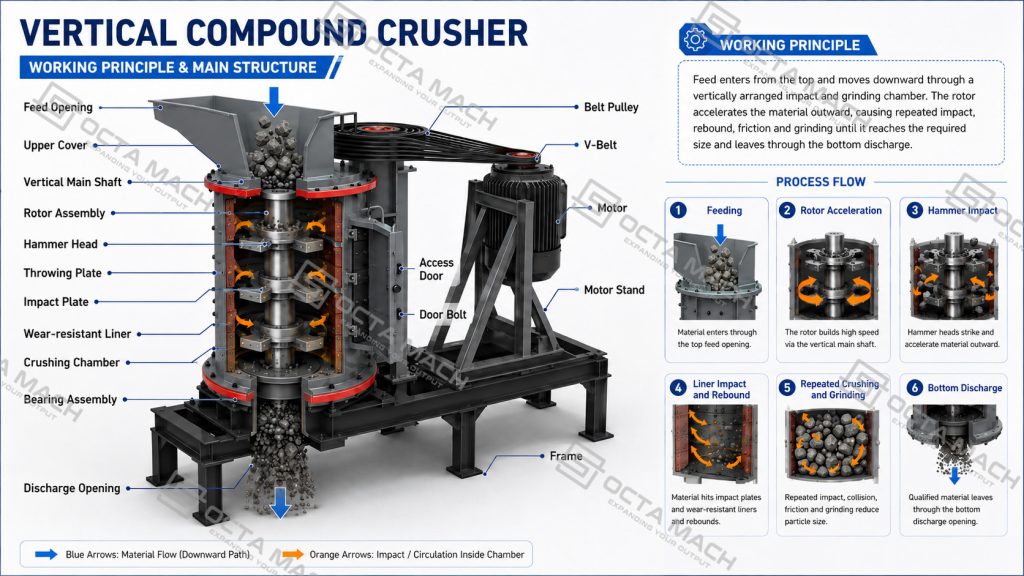
Material enters through the top inlet and falls toward the high-speed rotor driven by the vertical main shaft. Hammer heads and the throwing plate accelerate the feed against the impact plates and wear-resistant liners, while rebounding particles undergo repeated impact, collision, extrusion, and attrition as they move downward. The screenless chamber allows sufficiently reduced material to discharge continuously from the bottom. The PFL series covers models from PFL-600 to PFL-2000, with feed sizes below 100–220 mm, capacities of 3–190 t/h, and a published fine-product range in which 60–90% of the discharge is below approximately 3–5 mm under suitable operating conditions.
PFL Models, Technical Specifications and Selection Range
| Model | Maximum Feed Size (mm) | Output Particle Size | Capacity (t/h) | Main-Shaft Speed (r/min) | Motor Power (kW) | Overall Dimensions (mm) |
|---|---|---|---|---|---|---|
| PFL-600 | <100 | 60–90% below 3–5 mm | 3–10 | 934 | 7.5 | 1300 × 800 × 1200 |
| PFL-800 | <100 | 60–90% below 3–5 mm | 10–20 | 934 | 18.5–22 | 2100 × 1200 × 1700 |
| PFL-1000 | <120 | 60–90% below 3–5 mm | 20–40 | 769 | 37–45 | 2600 × 1400 × 1900 |
| PFL-1250 | <150 | 60–90% below 3–5 mm | 40–70 | 530 | 75 | 2800 × 1600 × 2100 |
| PFL-1500 | <180 | 60–90% below 3–5 mm | 70–100 | 495 | 132 | 3300 × 1900 × 2200 |
| PFL-1750 | <200 | 60–90% below 3–5 mm | 130–190 | 424 | 160 | 3710 × 2360 × 2390 |
| PFL-2000 | <220 | 60–90% below 3–5 mm | 100–160 | 370 | 185 | 4100 × 2660 × 2620 |
The models can be considered in the following operating ranges:
- PFL-600 and PFL-800: Small prepared feed and low-capacity fine-crushing duties.
- PFL-1000 and PFL-1250: Medium-capacity clinker, gypsum, sandstone, coal, and slag crushing.
- PFL-1500: Continuous industrial reduction of larger cement materials and coal gangue.
- PFL-1750 and PFL-2000: Larger-feed duties requiring coordinated feeder, foundation, motor, and downstream equipment selection.
Working Principle, Main Structure and Operating Advantages
The vertical compound crusher working principle is based on continuous downward material movement through a vertically arranged impact and grinding chamber. Feed enters through the upper inlet and falls toward the rotor assembly driven by the vertical main shaft. The high-speed rotor carries the hammer heads and throwing plate, accelerating material outward under centrifugal force. The feed then strikes the impact plates and wear-resistant liners, rebounds into the chamber, and collides with newly introduced particles.
Top Feeding → Vertical Main Shaft → High-Speed Rotor → Hammer and Throwing Plate → Impact Plate and Liner → Repeated Impact and Grinding → Bottom Discharge
Material is not reduced by a single impact. As it moves downward, it undergoes repeated impact, extrusion, friction, and material-on-material collision until it reaches the required particle size and leaves through the bottom discharge. This extended crushing path allows the machine to combine fine crushing and coarse grinding within one compact vertical chamber.
| Component | Main Function | Effect on Operation |
|---|---|---|
| Feed opening | Introduces material from above | Supports continuous gravity-assisted feeding |
| Vertical main shaft | Transfers torque from the drive system | Rotates the crushing assembly |
| Rotor assembly | Carries the rotating wear parts | Generates high-speed impact action |
| Hammer head | Strikes and accelerates material | Performs initial size reduction |
| Throwing plate | Directs particles toward the chamber wall | Increases repeated collision |
| Impact plate | Provides a fixed breaking surface | Supports secondary impact crushing |
| Wear-resistant liner | Protects the crusher shell | Maintains the crushing-chamber profile |
| Crushing chamber | Contains the reduction process | Provides impact, extrusion, and grinding |
| Bearing assembly | Supports and locates the main shaft | Maintains stable rotor movement |
| Bottom discharge | Releases reduced material | Supports continuous downward flow |
Operating Advantages
The main operating benefits come from the machine’s vertical arrangement and combined reduction mechanism:
- Fine crushing and coarse grinding are completed within one chamber.
- Repeated impact extends the effective crushing path.
- Material-on-material impact supplements hammer and liner crushing.
- The screenless structure does not rely on a fixed discharge grate.
- Top feeding and bottom discharge support continuous material movement.
- The vertical body provides a relatively compact installation footprint.
- Hammer heads, impact plates, and liners are replaceable wear parts.
- The PFL range covers small and medium plants as well as larger industrial duties.
The screenless chamber reduces problems associated with fixed grate openings, but it does not make the machine immune to blockage. Excessive clay, sticky fines, unstable feeding, or severely worn internal components can still restrict material flow.
How to Choose the Right Vertical Compound Crusher
Selecting the right Vertical Compound Crusher requires more than matching catalogue capacity. The material’s hardness, abrasivity, maximum feed size, moisture, and temperature determine whether the crushing mechanism is suitable, while the required product size and continuous throughput define the PFL model, motor duty, and downstream equipment. These factors must be reviewed together because unstable material flow, excessive wear, or restricted discharge can prevent the crusher from reaching its published capacity.
| Selection Factor | Information to Confirm | Effect on Selection |
|---|---|---|
| Feed material | Type, hardness, fracture behavior, and abrasivity | Confirms whether impact and grinding are suitable |
| Maximum feed size | Largest regular lump | Determines the required PFL model |
| Required output | Target particle size and passing percentage | Defines the reduction duty |
| Required capacity | Continuous plant output in t/h | Determines model, motor, and feeder duty |
| Moisture content | Surface moisture, clay, and stickiness | Affects chamber flow and cleaning |
| Feed temperature | Particularly important for clinker | Influences bearings, liners, and lubrication |
| Wear conditions | Expected hammer and liner wear | Determines wear-part material and spares |
| Process position | Before screening, milling, or conveying | Defines downstream matching |
| Installation | Feed height, foundation, lifting space, and access | Determines equipment layout |
Final model selection should first confirm that the material is suitable for impact-and-grinding reduction, then verify that the largest feed lump, required product size, and continuous capacity fall within the selected PFL model’s operating range. Moisture, clinker temperature, expected hammer and liner wear, feeder stability, discharge-conveyor capacity, and maintenance access must also be reviewed together, because any one of these limits can reduce actual throughput or shorten wear-part life. The preferred model is the smallest PFL unit that can handle the confirmed duty with stable feeding, acceptable motor load, and sufficient downstream capacity.
Working Conditions and Applications
The vertical shaft compound crusher is mainly applied where prepared material requires additional reduction before grinding, screening, blending, or reuse.
- Cement raw material crushing: Reduces prepared limestone and blended cement raw materials before the grinding stage. Feed abrasivity and required mill-feed size should be reviewed together.
- Cement clinker fine crushing: Reduces clinker before milling. Clinker temperature, maximum feed size, abrasivity, and target output must be considered when selecting the model and wear-part material.
- Coal gangue crushing: Repeated impact and extrusion reduce brittle coal gangue before screening, blending, or reuse. Clay and metal contamination should be controlled upstream.
- Gypsum crushing: Suitable for relatively soft, brittle gypsum requiring finer preparation before grinding or cement production.
- Blast-furnace slag crushing: Used for selected brittle slag after metallic inclusions have been removed. Hammer and liner wear require regular review.
- Sandstone crushing: Prepares sandstone for fine aggregate production or downstream grinding. Silica content is an important wear-cost factor.
- Iron ore fine crushing: Applicable only where ore hardness and abrasivity remain within the confirmed operating range of the PFL crusher.
- Coal crushing: Suitable for prepared coal feed when moisture, sticky fines, and dust-control requirements are properly managed.
- Limestone fine crushing: Used in cement and mineral-processing lines where a finer product is required before milling or screening.
- Metallurgical slag crushing: Selected brittle slag can be processed before recovery or reuse, provided tramp metal and highly abrasive inclusions are removed.
The machine is not automatically suitable for highly abrasive quartz-rich rock, heavily clay-bound feed, or uncontrolled tramp metal. Material testing and wear-part evaluation are recommended for uncertain applications.
Why Choose OctaMach
OctaMach supplies PFL vertical compound crushers from PFL-600 to PFL-2000 and selects each model according to the material, feed size, required capacity, output size, motor supply, and downstream process. As a vertical compound crusher manufacturer, OctaMach also provides parameter confirmation, wear and spare parts, feeder and conveyor coordination, installation drawings, technical documentation, and export packing support.
FAQ
Q1:When should a PFL vertical compound crusher be selected instead of a VSI or hammer crusher?
A1:Select a PFL vertical compound crusher when prepared feed requires repeated impact and coarse grinding before milling or screening. A VSI is more suitable for particle shaping and sand production, while a conventional hammer crusher normally relies more heavily on direct hammer impact and a discharge grate.
Q2:Why can the discharged product become coarser even when the main-shaft speed has not changed?
A2:Worn hammer heads, throwing plates, and liners reduce impact intensity and alter the crushing-chamber profile. Unstable feeding, excessive moisture, or restricted bottom discharge can also shorten effective residence time and produce a coarser product.
Q3:Can a vertical compound crusher process hot clinker or moisture-containing material?
A3:It can process suitable clinker and moderately moist brittle feed, but clinker temperature, sticky fines, bearing lubrication, chamber buildup, and wear-part material must be checked. A screenless chamber reduces fixed-grate blockage risk but does not eliminate adhesion or material buildup.
Q4:How should the correct PFL model be selected when catalogue capacity ranges overlap?
A4:Select the model from maximum feed size, required fine-product percentage, material hardness, moisture, continuous plant capacity, motor load, and downstream mill or conveyor duty. Catalogue capacity is only a preliminary range; the preferred model is the smallest unit that can maintain stable feed and the required output without sustained overload.