
Roll Crusher is a size-reduction machine that uses two counter-rotating cylindrical rolls to grip material at the nip point and reduce it by compression and shear. The crushed material then passes through the adjustable roll gap, producing a controlled discharge size with limited excessive fines.
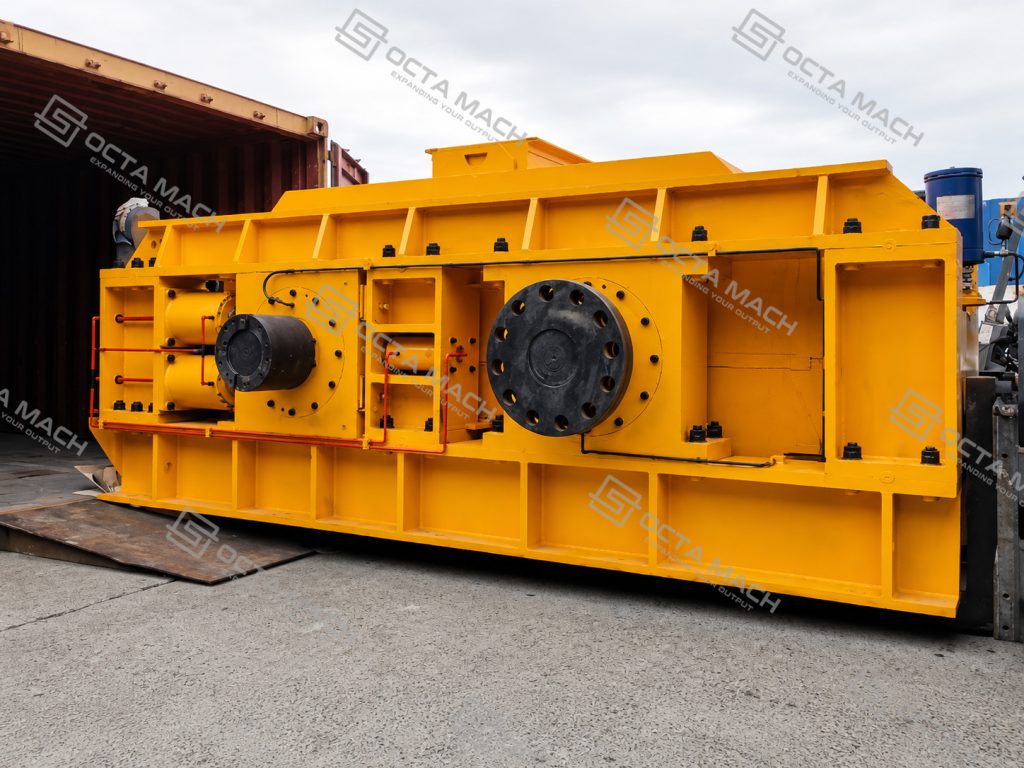
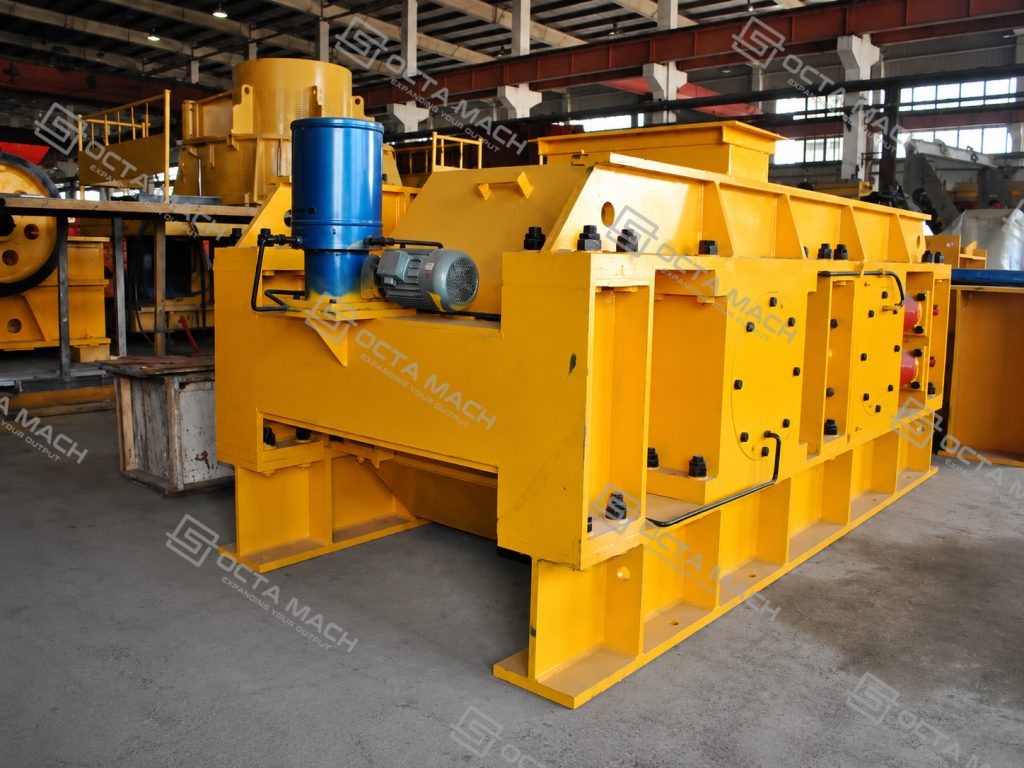
The OctaMach supply range includes the 2PG smooth double roll crusher and the 2PGC double-geared roller crusher. Smooth rolls are used for smaller, prepared feed requiring controlled fine or intermediate reduction. Toothed rolls provide stronger gripping and shearing action for larger lumps such as coal, coke, coal gangue, limestone, clinker and other suitable brittle materials.
Technical Specifications
The two product groups use different roll surfaces and feed ranges. Model selection should begin with the material, maximum feed size and required product—not capacity alone.
Double Roller Crusher
| Model | Roll Diameter × Width (mm) | Feed Size (mm) | Output Size (mm) | Capacity (t/h) | Motor Power (kW) | Weight (t) |
|---|---|---|---|---|---|---|
| 2PG250 × 400 | 250 × 400 | <32 | 2–8 | 5–10 | 2 × 5.5 | 1.9 |
| 2PG400 × 600 | 400 × 600 | <36 | 2–9 | 10–20 | 2 × 11 | 3.6 |
| 2PG600 × 400 | 600 × 400 | <40 | 2–10 | 15–30 | 2 × 15 | 5.2 |
| 2PG750 × 500 | 750 × 500 | <40 | 2–10 | 20–40 | 2 × 15 | 7.6 |
| 2PG800 × 600 | 800 × 600 | <40 | 2–10 | 30–50 | 2 × 22 | 12.8 |
| 2PG1000 × 800 | 1000 × 800 | <40 | 3–10 | 40–70 | 2 × 55 | 22 |
| 2PG1200 × 1000 | 1200 × 1000 | <40 | 3–12 | 50–120 | 2 × 75 | 45.8 |
Geared Roller Crusher
| Model | Roll Diameter × Width (mm) | Feed Size (mm) | Output Size (mm) | Capacity (t/h) | Motor Power (kW) | Weight (t) |
|---|---|---|---|---|---|---|
| 2PGC450 × 500 | 450 × 500 | 100–200 | 25–100 | 12–32 | <11 | 3.1 |
| 2PGC600 × 700 | 600 × 700 | 300–600 | 50–125 | 50–75 | <22 | 7.4 |
| 2PGC900 × 900 | 900 × 900 | <800 | 75–150 | 60–110 | <30 | 13.7 |
| 2PGC920 × 1200 | 920 × 1200 | <800 | 40–100 | 90–150 | <75 | 16.7 |
| 2PGC1200 × 1500 | 1200 × 1500 | <1000 | ≈100 | 150–260 | 2 × 55 | 52 |
Working Principle, Structure and Operating Advantages
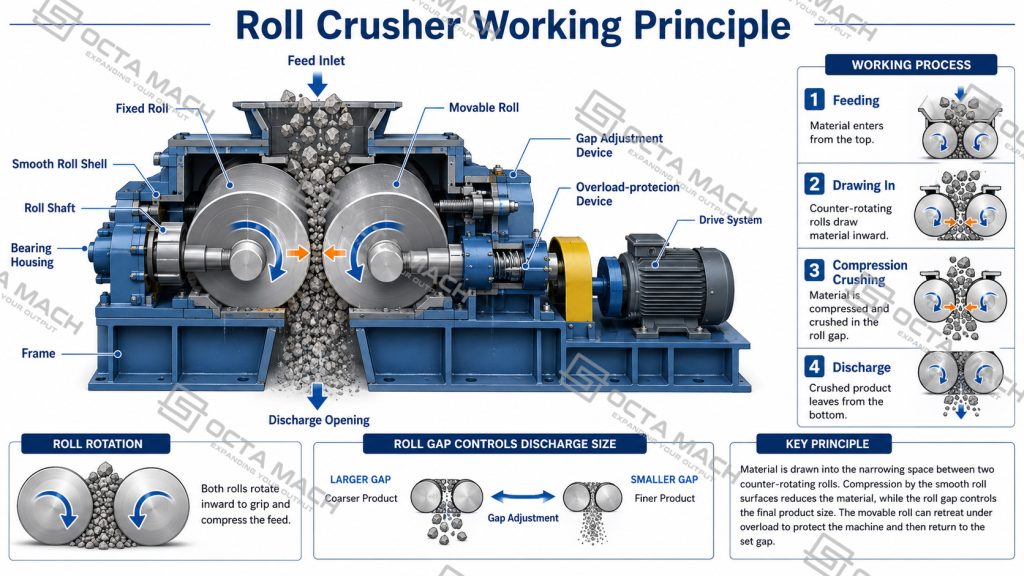
The roll crusher working principle is based on material being drawn into the narrowing space between two rolls rotating toward each other. At the entry point, friction or the tooth profile creates the angle of nip required to grip the feed. Smooth rolls reduce material mainly by compression, while toothed rolls add penetration and shear crushing to handle larger and less uniform lumps.
After reduction, particles pass through the lower roll gap. Increasing the gap produces a coarser discharge and normally allows higher throughput. Reducing the gap produces a finer output but increases roll load and does not compensate for an incorrect roll diameter or surface configuration.
Main Components
| Component | Technical Function | Operating Effect |
|---|---|---|
| Fixed roll | Provides a stable crushing surface | Maintains the selected crushing position |
| Movable roll | Moves during gap adjustment or overload | Supports product-size control and tramp release |
| Smooth roll shell | Applies compression to prepared feed | Produces a controlled fine or intermediate product |
| Toothed roll surface | Grips, splits and shears larger lumps | Improves feeding of coarse material |
| Roll shaft | Transfers torque to the roll body | Carries radial crushing load |
| Bearing housing | Supports the roll shaft | Maintains alignment and rotation |
| Gap-adjustment device | Changes the distance between rolls | Controls the principal discharge size |
| Overload-protection device | Allows the movable roll to retreat | Reduces damage from uncrushable material |
| Drive system | Powers the counter-rotating rolls | Maintains continuous material draw |
| Frame | Supports the crushing and drive assemblies | Provides structural stability |
Key operating advantages include:
- Adjustable roll gap for discharge-size control
- Smooth and toothed roll configurations for different feed conditions
- Compression crushing with limited high-speed impact
- Nipping and shear action for larger feed in toothed models
- Controlled product-size distribution
- Low excessive-fines generation under suitable brittle-feed conditions
- Overload protection and tramp-metal release
- Replaceable roll shells or tooth components
- Compact arrangement with accessible inspection points
Smooth and Toothed Roll Configurations
The roll surface should be selected from the feed size, material behavior and required reduction duty.
| Configuration | Feed Condition | Crushing Action | Typical Duty | Main Selection Limit |
|---|---|---|---|---|
| 2PG smooth roll crusher | Small, prepared and relatively uniform feed | Mainly compression crushing | Fine or intermediate reduction | Unsuitable for uncontrolled large lumps |
| 2PGC toothed roll crusher | Larger lumps requiring stronger gripping | Nipping, compression and shear | Coarse or intermediate crushing | Tooth profile must match the feed |
| Narrow-gap smooth rolls | Brittle material requiring a smaller output | Compression through a reduced gap | Fine product preparation | Roll wear changes the actual gap |
| Large-feed toothed rolls | Coal, coke, gangue and similar bulk feed | Tooth penetration and splitting | Larger-feed reduction | Tramp-metal removal remains necessary |
A smooth roll crusher is not automatically the better choice for every fine product. It requires feed small enough to enter the nip zone reliably. A toothed roll crusher accepts larger material, but the teeth, roll speed and discharge gap must still be matched to the required product size.
Roll Gap, Nip Angle and Product Control
Discharge size is influenced by more than the mechanical gap setting. Roll diameter, surface shape, feed geometry and wear condition all affect how material enters and leaves the machine.
| Operating Factor | Main Effect | What to Check |
|---|---|---|
| Adjustable roll gap | Controls the principal discharge range | Actual gap under operating load |
| Roll diameter | Influences feed gripping and reduction | Maximum regular feed lump |
| Roll width | Defines available crushing area | Required capacity and feed distribution |
| Angle of nip | Determines whether material is gripped | Lump size, roll surface and friction |
| Roll surface | Determines compression or added shear | Smooth or toothed configuration |
| Roll speed | Influences material draw and residence time | Feed behavior and fines production |
| Roll wear | Changes the actual gap and product size | Shell diameter and tooth profile |
| Feed distribution | Determines loading across the roll width | Feeder width and material spread |
| Overload release | Allows uncrushable material to pass | Protection setting and metal removal |
A narrower roll gap normally produces a smaller output but also increases crushing load. Excessive adjustment can reduce capacity, accelerate roll wear and cause repeated overload release. For this reason, discharge size control should be coordinated with the correct roll diameter, surface configuration and downstream screening requirement.
How to Choose the Right Roll Crusher
A roll crusher machine is used to reduce feed to a controlled discharge size; the correct model should therefore be selected according to material properties and the complete process duty rather than catalogue capacity alone.
| Selection Factor | Information to Confirm | Selection Result |
|---|---|---|
| Material properties | Hardness, brittleness and abrasivity | Confirms whether roll crushing is suitable |
| Maximum feed size | Largest regular lump and lump shape | Determines roll diameter and surface |
| Required output | Target particle-size range | Determines roll gap and reduction duty |
| Roll configuration | Smooth or toothed rolls | Defines compression or compression-plus-shear action |
| Required capacity | Continuous plant target in t/h | Determines roll width, speed and feeder duty |
| Moisture and clay | Sticky-material content | Affects flow and roll cleaning |
| Tramp material | Metal and other uncrushable objects | Determines protection and metal-removal requirements |
Select a 2PG double roll crusher for smaller prepared feed where controlled fine or intermediate output is required. Select a 2PGC double roller crusher when larger lumps require stronger nipping and shear action.
Working Conditions and Applications
The equipment is mainly used for soft to medium-hard, brittle or relatively low-abrasion feed. Smooth and toothed models serve different process positions.
- Coal roll crusher: Toothed rolls grip larger coal lumps for coarse or intermediate reduction. Smooth rolls are used when smaller, more uniform coal product is required.
- Coke roll crusher: Compression and shear reduce brittle coke without relying on high-speed impact. Tooth profile and feed size should be checked carefully.
- Limestone roll crusher: Smooth rolls provide controlled secondary or fine reduction where prepared limestone feed and limited excessive fines are required.
- Clinker roll crusher: Used for brittle cement clinker after feed temperature, roll material and required product size are confirmed.
- Slag roll crusher: Suitable for selected brittle slag with controlled metal contamination. Magnetic separation or tramp-metal removal should be installed upstream.
- Gypsum roll crusher: Smooth rolls reduce relatively soft gypsum through an adjustable roll gap before screening or further processing.
- Coal gangue crusher: Toothed rolls provide stronger gripping and splitting for irregular lumps requiring coarse or intermediate reduction.
- Mineral roll crusher: Used for suitable low- to medium-abrasion ores and mineral materials where a controlled product size is required.
- Cement material crushing: Applied to limestone, clinker, gypsum and other suitable brittle raw materials before screening, grinding or blending.
Roll crushers are not automatically suitable for highly abrasive hard rock, sticky clay-rich feed or uncontrolled tramp metal. Material behavior and roll-surface wear should be reviewed before the final model is selected.
Why Choose OctaMach
OctaMach supplies 2PG smooth double roller crushers and 2PGC double-geared roller crushers for different feed and output requirements. As a roll crusher manufacturer, OctaMach reviews the material, maximum feed size, required product, roll diameter, roll width and overload-protection requirement before confirming the configuration.
FAQ
Q1:What determines the maximum feed size of a double roll crusher?
A1:Maximum feed size depends on roll diameter, angle of nip, lump shape, surface friction, and tooth profile. Material must be gripped reliably at the nip point rather than bouncing or bridging above the rolls.
Q2:How should a 2PG smooth roll crusher and a 2PGC toothed roll crusher be selected?
A2:Select a 2PG smooth roll crusher for smaller, prepared, brittle feed requiring controlled fine or intermediate output. Use a 2PGC toothed roll crusher when larger lumps require stronger nipping, splitting, and shear action.
Q3:Why does the roll-crusher product become coarser without changing the gap setting?
A3:Roll-shell or tooth wear, bearing clearance, movable-roll displacement, and uneven feeding can increase the effective operating gap. The gap should therefore be checked under load, not only when the crusher is stopped.
Q4:Why can actual roll crusher capacity be lower than the catalogue range?
A4:Actual capacity is affected by feed gradation, moisture, material strength, roll wear, full-width feed distribution, operating gap, and downstream restrictions. Catalogue capacity should be used for preliminary model selection rather than as guaranteed plant output.