
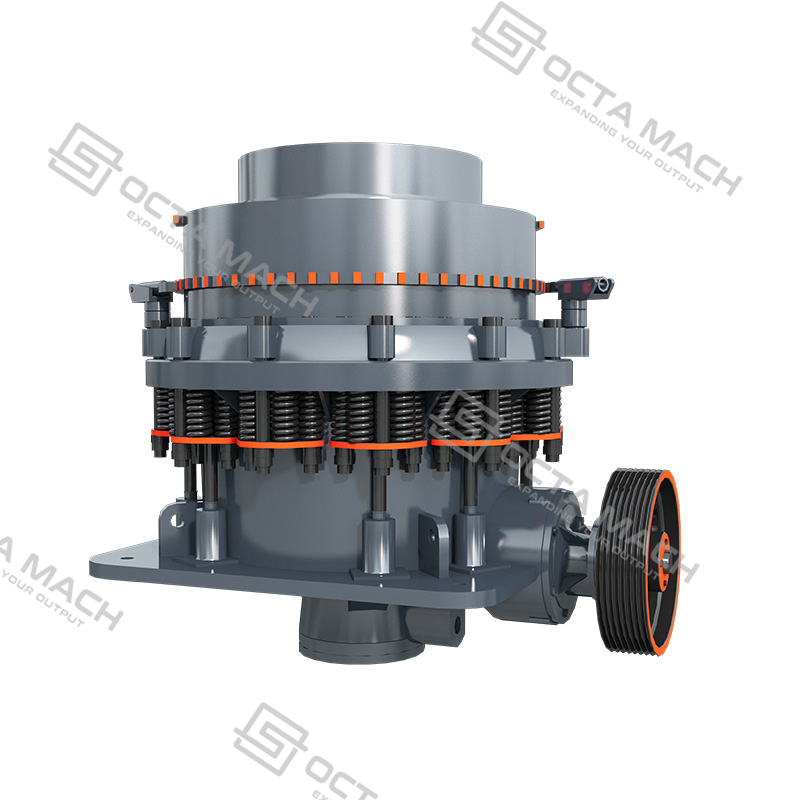
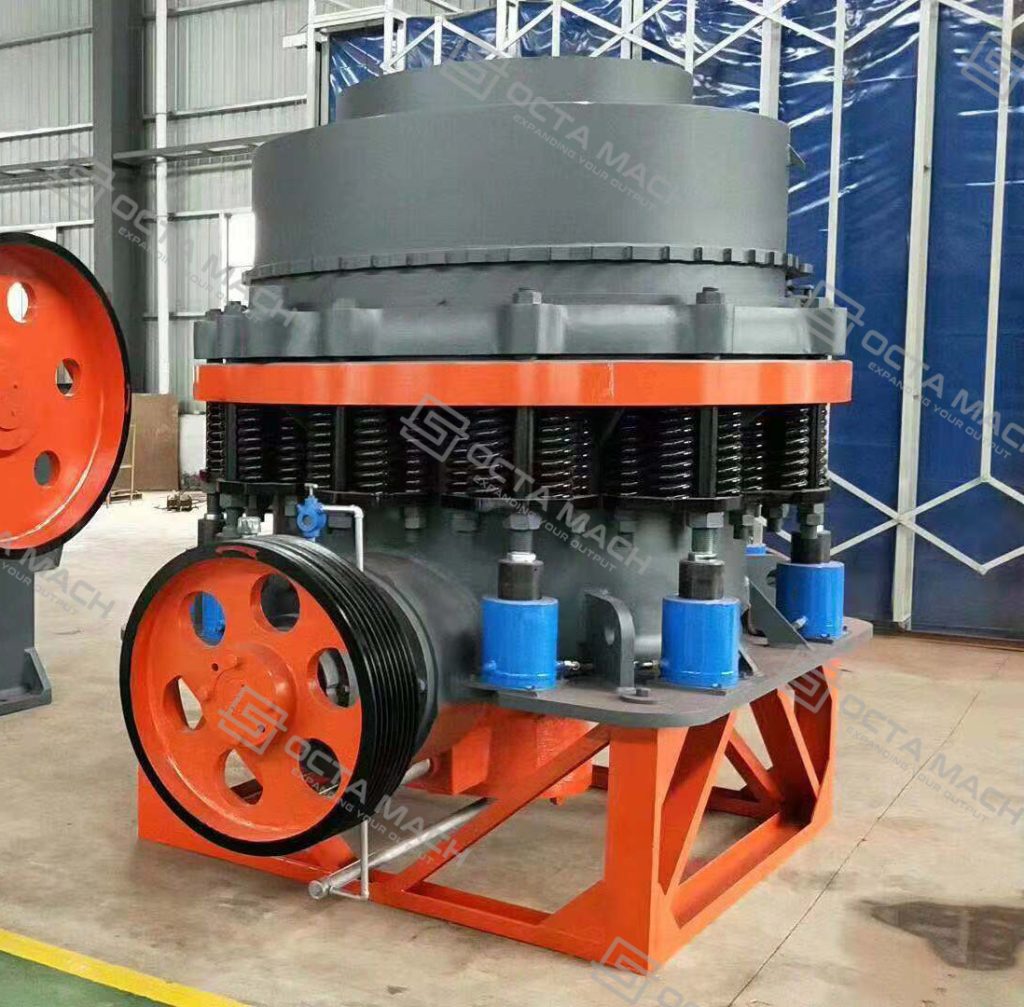
Spring Cone Crusher is a compression-type machine designed for secondary, tertiary, and fine crushing of medium-hard to hard materials such as granite, basalt, and iron ore. During operation, the motor transfers power through the horizontal drive shaft and bevel gears to the eccentric sleeve, causing the moving cone to gyrate inside the crushing chamber. Material is repeatedly compressed between the mantle and concave, while the optimized crushing stroke and inter-particle lamination support stable throughput, controlled grading, and a more cubical final product.
The CS spring cone crusher range includes standard CS-B models and short-head CS-D models. Different coarse, medium, and fine cavity configurations allow the same basic spring cone crusher machine to be matched to granite, basalt, diabase, quartzite, river pebble, iron ore, copper ore, and other aggregate or mining materials. The spring safety device provides mechanical overload protection when tramp metal or other uncrushable material enters the chamber.
Standard and Short-Head Technical Specifications
| Standard Model | Moving Cone Diameter (mm) | Cavity Type | Closed-Side Feed Opening (mm) | Open-Side Feed Opening (mm) | Discharge Opening (mm) | Spindle Speed (r/min) | Motor Power (kW) | Capacity (t/h) | Weight (t) | Dimensions (mm) |
|---|---|---|---|---|---|---|---|---|---|---|
| CS-75B | 900 | Fine | 83 | 102 | 9–22 | 580 | 75 | 45–91 | 15 | 2821 × 1880 × 2164 |
| CS-75B | 900 | Coarse | 159 | 175 | 13–38 | 580 | 75 | 59–163 | 15 | 2821 × 1880 × 2164 |
| CS-110B | 1200 | Fine | 127 | 131 | 9–31 | 485 | 110 | 63–188 | 20 | 2821 × 1974 × 2651 |
| CS-110B | 1200 | Medium | 156 | 156 | 13–38 | 485 | 110 | 100–200 | 20 | 2821 × 1974 × 2651 |
| CS-110B | 1200 | Coarse | 178 | 191 | 19–51 | 485 | 110 | 141–308 | 20 | 2821 × 1974 × 2651 |
| CS-160B | 1295 | Fine | 109 | 137 | 13–31 | 485 | 185 | 109–181 | 27 | 2800 × 2342 × 2668 |
| CS-160B | 1295 | Medium | 188 | 210 | 16–38 | 485 | 185 | 132–253 | 27 | 2800 × 2342 × 2668 |
| CS-160B | 1295 | Coarse | 216 | 241 | 19–51 | 485 | 185 | 172–349 | 27 | 2800 × 2342 × 2668 |
| CS-240B | 1650 | Fine | 188 | 209 | 16–38 | 485 | 240 | 181–327 | 55 | 3911 × 2870 × 3771 |
| CS-240B | 1650 | Medium | 213 | 241 | 22–51 | 485 | 240 | 258–417 | 55 | 3911 × 2870 × 3771 |
| CS-240B | 1650 | Coarse | 241 | 268 | 25–64 | 485 | 240 | 299–635 | 55 | 3911 × 2870 × 3771 |
| CS-315B | 2134 | Fine | 253 | 278 | 19–38 | 435 | 315 | 381–726 | 110 | 4613 × 3251 × 4732 |
| CS-315B | 2134 | Medium | 303 | 334 | 25–51 | 435 | 315 | 608–998 | 110 | 4613 × 3251 × 4732 |
| CS-315B | 2134 | Coarse | 334 | 369 | 31–64 | 435 | 315 | 789–1270 | 110 | 4613 × 3251 × 4732 |
| Short head Model | Moving Cone Diameter (mm) | Cavity Type | Closed-Side Feed Opening (mm) | Open-Side Feed Opening (mm) | Discharge Opening (mm) | Spindle Speed (r/min) | Motor Power (kW) | Capacity (t/h) | Weight (t) | Dimensions (mm) |
|---|---|---|---|---|---|---|---|---|---|---|
| CS-75D | 914 | Fine | 13 | 41 | 3–13 | 580 | 75 | 27–90 | 15 | 2821 × 1880 × 2410 |
| CS-75D | 914 | Coarse | 33 | 60 | 3–16 | 580 | 75 | 27–100 | 15 | 2821 × 1880 × 2410 |
| CS-110D | 1218 | Fine | 29 | 57 | 5–16 | 485 | 110 | 50–132 | 20 | 2560 × 1942 × 2928 |
| CS-110D | 1218 | Medium | 44 | 73 | 10–16 | 485 | 110 | 90–145 | 20 | 2560 × 1942 × 2928 |
| CS-110D | 1218 | Coarse | 56 | 89 | 13–19 | 485 | 110 | 141–181 | 20 | 2560 × 1942 × 2928 |
| CS-160D | 1295 | Fine | 29 | 64 | 3–16 | 485 | 160 | 36–163 | 27 | 2800 × 2342 × 2668 |
| CS-160D | 1295 | Medium | 54 | 89 | 6–16 | 485 | 160 | 82–163 | 27 | 2800 × 2342 × 2668 |
| CS-160D | 1295 | Coarse | 70 | 105 | 10–25 | 485 | 160 | 109–227 | 27 | 2800 × 2342 × 2668 |
| CS-240D | 1676 | Fine | 35 | 70 | 5–13 | 485 | 240 | 90–209 | 55 | 3917 × 2870 × 3771 |
| CS-240D | 1676 | Medium | 54 | 89 | 6–19 | 485 | 240 | 136–281 | 55 | 3917 × 2870 × 3771 |
| CS-240D | 1676 | Coarse | 98 | 133 | 10–25 | 485 | 240 | 190–336 | 55 | 3917 × 2870 × 3771 |
Working Principle, Main Structure and Product Advantages
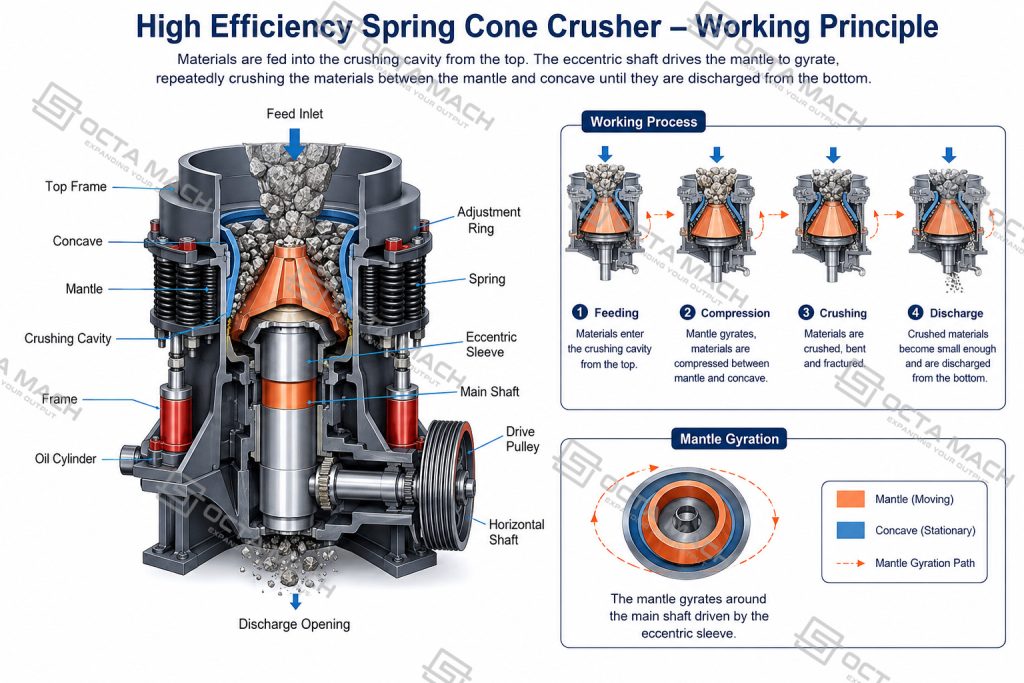
The spring cone crusher working principle begins with the motor driving the horizontal shaft and pinion. The pinion transfers torque to the large bevel gear, which rotates the eccentric sleeve around the main shaft. This eccentric movement causes the moving cone to follow a continuous gyratory path inside the fixed concave.
When the mantle approaches the concave or bowl liner, material is compressed, bent, and fractured. When the crushing chamber opens, the reduced particles move downward under gravity. This cycle continues around the chamber until the particles are small enough to pass through the lower discharge opening.
Under continuous and evenly distributed feeding, material is also compressed against adjacent particles. This laminated crushing action can improve particle-size control and reduce the proportion of elongated material compared with unstable, partially filled operation.
| Component | Technical Function | Effect on Operation |
|---|---|---|
| Horizontal drive shaft | Transfers motor power to the pinion | Provides the initial drive input |
| Pinion and bevel gear | Transmit torque to the eccentric assembly | Maintains continuous cone movement |
| Eccentric sleeve | Generates the gyratory motion | Controls the moving-cone path |
| Main shaft | Supports the moving-cone assembly | Carries crushing and structural loads |
| Moving cone | Moves around the chamber | Applies compression to the material |
| Mantle | Forms the moving crushing surface | Contacts and reduces the feed |
| Concave / bowl liner | Forms the fixed crushing surface | Defines cavity profile and reduction duty |
| Adjustment ring | Changes the position of the bowl assembly | Controls the discharge opening |
| Spring safety device | Responds to abnormal chamber load | Provides overload release |
| Support sleeve | Moves when the springs compress | Temporarily enlarges the discharge opening |
| Labyrinth seal | Limits dust entry into internal components | Protects bearing and lubrication surfaces |
| Lubrication system | Supplies oil to gears, bearings, and eccentric parts | Controls friction and operating temperature |
Spring Overload Protection
When tramp iron or another uncrushable object enters the crushing chamber, the abnormal load is transferred to the spring safety device. The springs compress and allow the support sleeve and bowl assembly to lift, temporarily increasing the discharge opening so the obstruction can pass.
After the chamber load returns to the normal range, the springs restore the assembly to its working position. This mechanical overload-protection process reduces the risk of damage to the main shaft, mantle, concave, gears, and frame, but it does not replace upstream metal removal or correct feed control.
Key operating advantages include:
- Mechanical spring overload protection for uncrushable material
- Adjustable discharge opening for different output requirements
- Standard and short-head configurations for different crushing stages
- Coarse, medium, and fine cone crusher cavity types
- Continuous compression crushing around the annular chamber
- Laminated crushing under stable chamber filling
- Labyrinth sealing to restrict fine-dust entry
- Centralized lubrication of gears, bearings, and eccentric components
- Replaceable mantle and bowl liner for wear-part maintenance
- Multiple model sizes for secondary, tertiary, and fine crushing
How to Choose the Right Spring Cone Crusher
A spring cone crusher should first be selected according to the crushing stage and the largest regular feed size. The standard type accepts larger prepared feed and is mainly used for secondary crushing, while the short-head type uses a different chamber profile for smaller feed, higher reduction, and tertiary or fine crushing.
The spring safety device provides mechanical overload protection by allowing the support sleeve and bowl assembly to lift when uncrushable material enters the chamber. It does not compensate for oversized feed, an incorrect cavity, or an excessively small discharge opening.
| Selection Factor | What to Confirm | Selection Result |
|---|---|---|
| Crushing stage | Secondary, tertiary, or fine crushing | Determines standard or short-head configuration |
| Maximum feed size | Largest regular lump after upstream crushing | Determines model and coarse, medium, or fine cavity |
| Material condition | Hardness, abrasivity, moisture, and fines | Affects liner wear, chamber filling, and lubrication requirements |
| Required product | Target particle sizes and screen aperture | Determines cavity profile and discharge-opening range |
| Required capacity | Net plant output and closed-circuit return load | Determines crusher size and screen duty |
| Feed and protection | Central feeding, tramp-metal removal, and stable lubrication | Supports even liner wear and prevents repeated spring release |
For larger feed and secondary reduction, select a standard model with sufficient feed-opening clearance. For smaller controlled feed and finer products, use a short-head configuration matched to the downstream screen. The final model should be confirmed from the complete circuit rather than from motor power or catalogue capacity alone.
Repeated spring movement during operation indicates an abnormal condition rather than normal crushing. Oversized feed, tramp metal, uneven material distribution, or an overly narrow discharge opening should be corrected at the feeder, upstream crusher, or adjustment system.
Working Conditions and Applications
The spring cone crusher is mainly used in fixed crushing plants where the feed has already been reduced by a jaw crusher. Standard models are selected for larger prepared feed and secondary crushing, while short-head models are used for smaller feed, tertiary reduction, and fine crushing. The spring safety system provides mechanical overload release when tramp material enters the chamber, but stable feeding and upstream metal removal are still required.
- Granite and basalt aggregate production: Standard spring cone crushers are installed after primary jaw crushing for secondary reduction. Short-head models can be added before final screening when smaller aggregate sizes are required. High abrasivity requires regular mantle and bowl-liner inspection.
- Diabase and quartzite crushing: Compression crushing is suitable for these hard, abrasive materials. Model selection should prioritize cavity profile, liner wear, lubrication cleanliness, and sufficient motor load margin rather than catalogue capacity alone.
- River-pebble crushing: Rounded particles can segregate in the feed chute, so the crusher should receive continuous and centrally distributed material. A standard cavity is normally used for secondary crushing, followed by screening or a short-head stage where finer products are required.
- Iron and copper ore reduction: Standard models are used after coarse crushing, while short-head configurations provide tertiary reduction before screening or grinding. The required mill feed size should determine the cavity and discharge opening.
- Roadstone and railway aggregate: Spring cone crushers are suitable for basalt, diabase, and other hard rock where stable compression crushing is required. Closed-circuit screening controls product grading and returns oversize material for further crushing.
- Conventional quarry crushing lines: The mechanical spring-protection structure is suitable for stationary plants with straightforward maintenance access. The crusher should be matched with a vibrating feeder, jaw crusher, screen, return conveyor, lubrication system, and upstream metal-removal equipment.
The spring cone crusher is not recommended for sticky feed, excessive clay, or uncontrolled oversize. Frequent spring release usually indicates tramp metal, an incorrect cavity, an excessively narrow discharge opening, or unstable feeding and should be corrected at the upstream equipment.
Why Choose OctaMach
OctaMach matches the crusher model to the actual material, feed size, required product, crushing stage, and plant layout. As a spring cone crusher manufacturer and system supplier, OctaMach can coordinate the cone crusher with upstream feeding and primary crushing equipment as well as downstream screening and conveying systems.
FAQ
Q1:How do I choose between a standard and short-head spring cone crusher?
A1:Select the standard type for larger prepared feed and secondary crushing. Use the short-head type for smaller controlled feed, tertiary reduction, or fine crushing, then confirm the cavity, discharge-opening range, and screen aperture together.
Q2:What does frequent spring release indicate during operation?
A2:Frequent spring movement is not a normal crushing condition. It usually indicates tramp metal, oversized feed, an incorrect cavity, uneven feeding, or an excessively narrow discharge opening, and the upstream cause should be corrected before production continues.
Q3:Can the discharge opening be reduced to produce a finer product?
A3:It can only be reduced within the permitted range of the selected cavity. An excessively narrow opening increases chamber load, liner wear, circulating oversize, and spring release; a finer cavity or short-head configuration should be used when a smaller product is required.
Q4:Why is actual spring cone crusher capacity lower than the catalogue range?
A4:Actual capacity is affected by feed gradation, hardness, moisture, fines, chamber filling, liner wear, discharge opening, screen efficiency, and return load. Model selection should therefore be based on total circuit duty rather than catalogue capacity alone.