
A shaking table is a wet gravity-separation machine engineered to recover liberated mineral particles according to differences in specific gravity, particle size and particle shape. The 6-S mineral processing shaking table integrates a precision-riffled deck, stable reciprocating head motion, adjustable transverse inclination and controlled wash-water distribution to separate the feed into concentrate, middling and tailings streams.
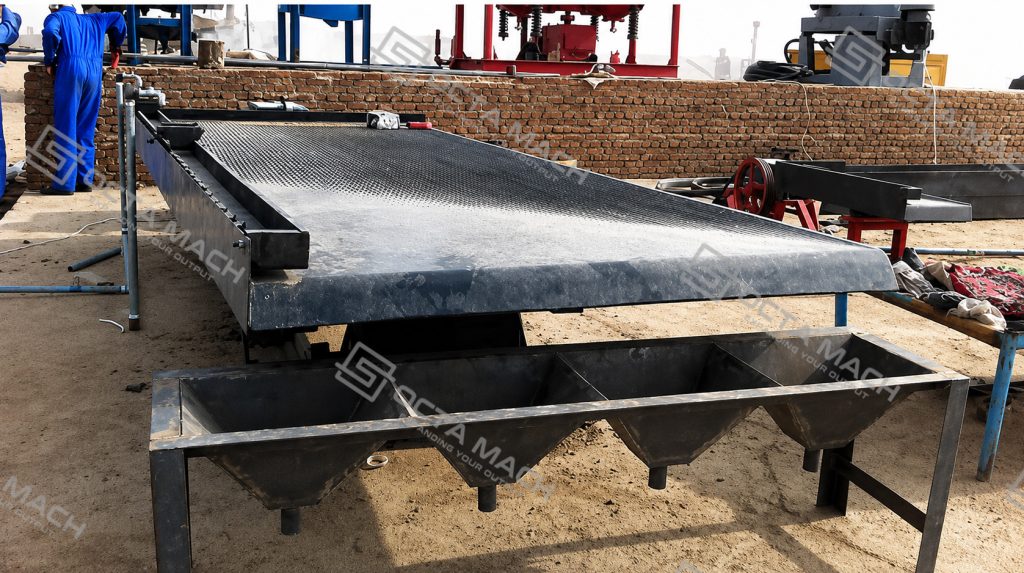
It is commonly applied in gravity-concentration circuits for the recovery or cleaning of gold, tin, tungsten and other high-density minerals. Separation performance depends on proper feed preparation, consistent slurry concentration and coordinated adjustment of stroke length, stroke frequency, deck angle and wash-water rate. Octa Mach provides application-based model selection, suitable deck configuration, operating guidance, spare-parts support and technical documentation, helping customers achieve more reliable installation, easier commissioning and stable long-term operation.
6-S Shaking Table at a Glance
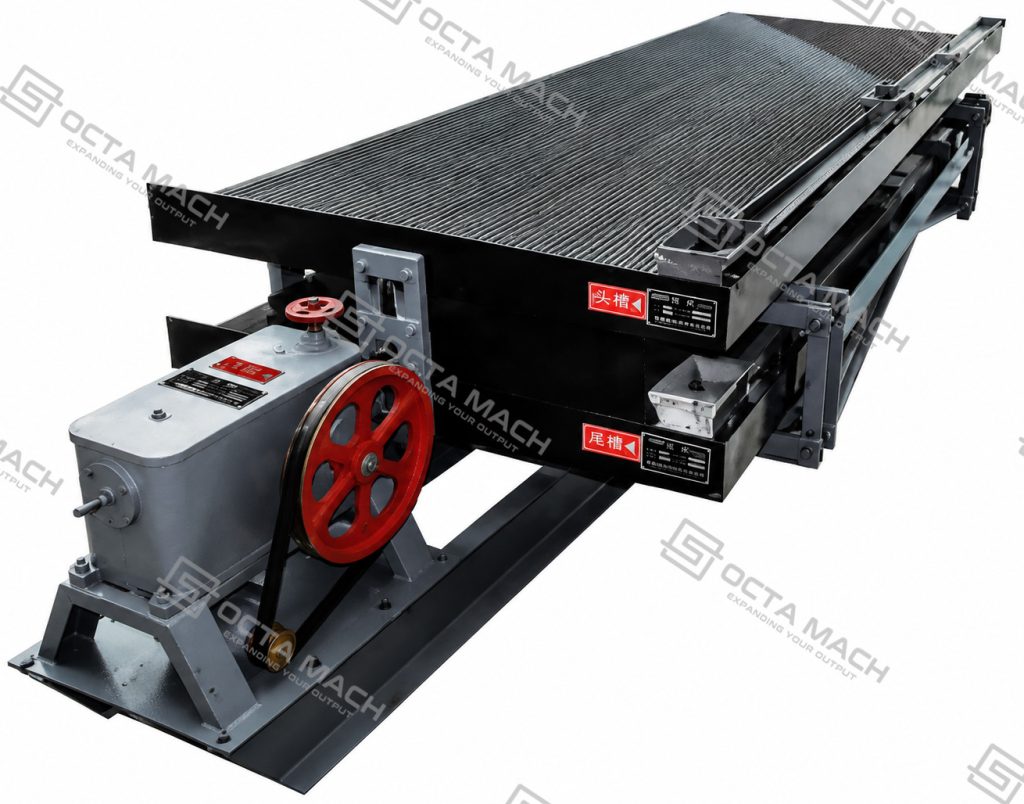
Model: L-S Type (6-S)
Feed Size: 0.074–2 mm
Processing Capacity: 0.5–1.2 t/h
Feed Slurry Concentration: 15–30%
Stroke: 10–30 mm
Stroke Frequency: 240–360 times/min
Deck Inclination: 0–8°
Wash-Water Requirement: 0.4–0.8 t/h
Motor Power: 1.1 kW
The 6-S shaking table is designed for classified fine-mineral feed within the confirmed operating range. Actual throughput and separation performance depend on mineral density contrast, liberation size, feed grading, slurry stability and the required concentrate quality.
6-S Shaking Table Technical Parameters
| Technical Item | 6-S Shaking Table |
| Model designation | L-S Type (6-S) |
| Deck dimensions | 1,520 × 1,825 × 4,500 mm |
| Overall dimensions | 5,454 × 1,825 × 1,242 mm |
| Machine weight | 1,012 kg |
| Motor power | 1.1 kW |
| Processing capacity | 0.5-1.2 t/h |
| Feed size | 0.074-2 mm |
| Wash-water consumption | 0.4-0.8 t/h |
| Stroke adjustment | 10-30 mm |
| Stroke frequency | 240-360 times/min |
| Deck inclination | 0-8° |
| Recommended feed concentration | 15-30% |
Foundation space, feed-box position, water connections and product launders should be confirmed against the final equipment drawing before installation.
Shaking Table Working Principle
The shaking table working principle combines longitudinal reciprocating motion with transverse water flow and gravity.
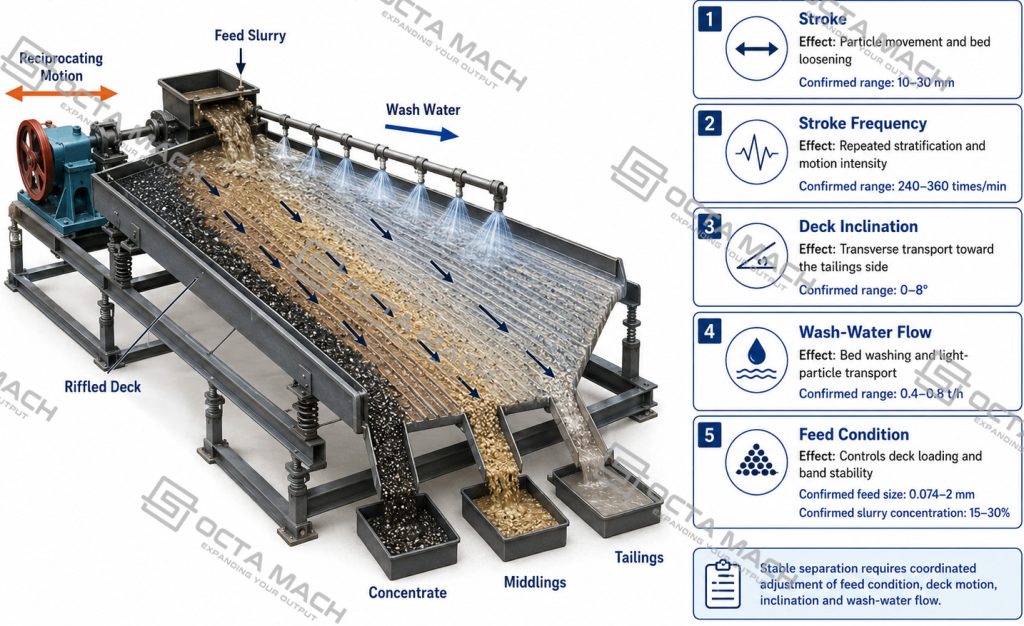
Feed slurry enters near the upper feed side of the deck. As the deck moves backward and forward, the riffles create repeated acceleration, stratification and differential transport of the mineral particles.
High-density particles tend to settle closer to the deck surface and move along the riffles toward the concentrate end. Lower-density particles remain nearer the upper slurry layer and are carried across the inclined deck by wash water toward the tailings side. Intermediate particles form a middling band between the concentrate and tailings zones.
The final separation pattern is controlled by five main variables:
| Operating Variable | Effect on Separation |
| Stroke length | Influences particle movement and bed loosening |
| Stroke frequency | Controls the number and intensity of deck movements |
| Deck inclination | Changes transverse transport toward the tailings side |
| Wash-water flow | Controls bed washing and light-particle removal |
| Feed condition | Determines whether particles can stratify and separate cleanly |
Increasing one setting does not automatically improve recovery. The variables must be balanced according to the actual ore and target separation.
Main Components
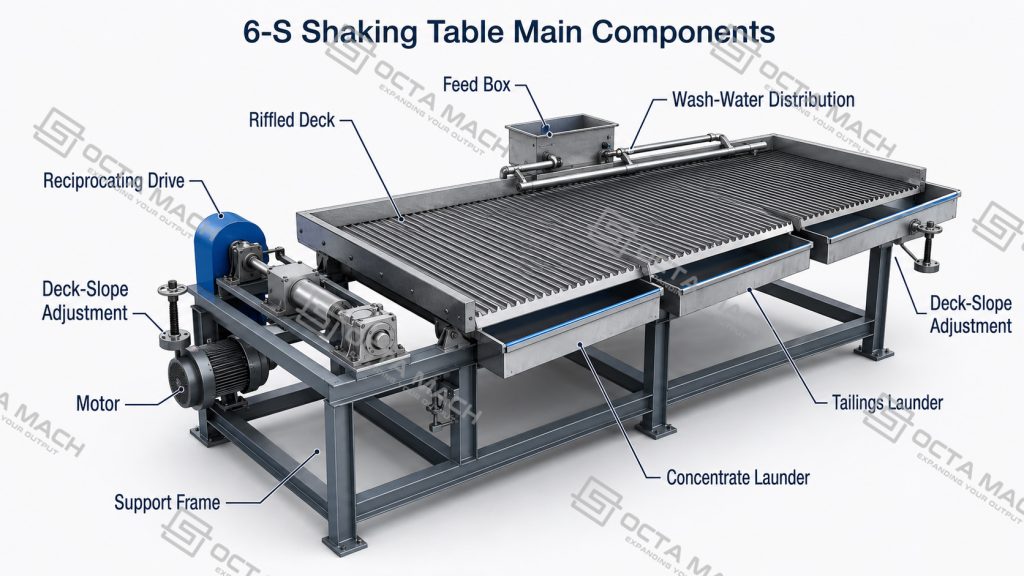
Riffled Deck:The deck provides the working surface for mineral stratification and separation. Its riffles retain and guide the denser particle layer while wash water transports lighter material across the deck.
Reciprocating Drive:The drive mechanism generates the controlled longitudinal motion required to loosen, stratify and move the particle bed.
Feed Box:The feed box distributes prepared slurry onto the deck. Uniform feed distribution is important because sudden changes in flow or concentration can disturb the separation bands.
Wash-Water System:The water-distribution system supplies controlled transverse flow over the deck. Water volume must be sufficient to wash lighter particles without displacing valuable heavy-mineral particles.
Deck-Slope Adjustment:The adjustment mechanism changes the transverse inclination within the listed 0-8° range, allowing the operator to control the travel of light and heavy fractions.
Product Launders:Separate collection areas receive concentrate, middlings and tailings after visible mineral bands form across the deck.
Mineral Separation Applications
The mining shaking table can be used for roughing, cleaning or scavenging duties where valuable minerals are sufficiently liberated and have a usable density contrast with the gangue.
Typical applications include:
- Gold and other dense metallic mineral concentration
- Tin and tungsten ore treatment
- Niobium and tantalum-bearing heavy-mineral separation
- Chromite and selected manganese-mineral concentration
- Titanium-bearing mineral and mineral-sand treatment
- Lead-zinc and polymetallic gravity pre-concentration
- Cleaning of gravity concentrate from jigs or spiral chutes
- Recovery of liberated heavy minerals from classified mill products
A gold shaking table is particularly useful for treating a classified gravity concentrate or recovering liberated gold particles within the confirmed feed-size range. It should not be presented as a universal solution for unliberated ore, clay-rich feed or ultrafine gold below the machine’s confirmed operating range.
Position in a Gravity-Processing Circuit
A typical process route is:
Crushing → Grinding → Classification → Jig or Spiral Chute → Shaking Table → Concentrate Dewatering.
The shaking table is often used after size classification because a narrowly controlled feed generally produces more stable mineral bands than a feed containing excessive coarse and fine particles together.
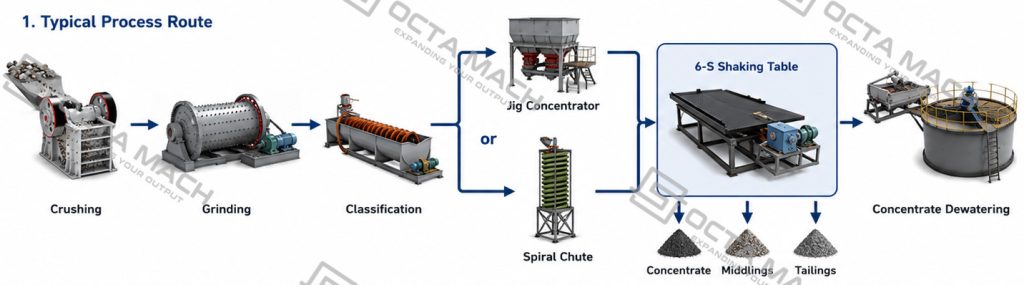
In some plants, the machine receives:
- Classified mill discharge
- Jig concentrate
- Spiral-chute concentrate
- Centrifugal-concentrator concentrate
- Reprocessed middlings
- Selected fine tailings containing liberated heavy minerals
These upstream machines are not substitutes for the table. They perform different gravity-separation duties and may be combined in the same flowsheet.
Shaking Table Selection Criteria
Selecting a shaking table concentrator starts with the ore characteristics and required separation duty, not the nominal capacity alone. The most important inputs can be grouped into three areas.
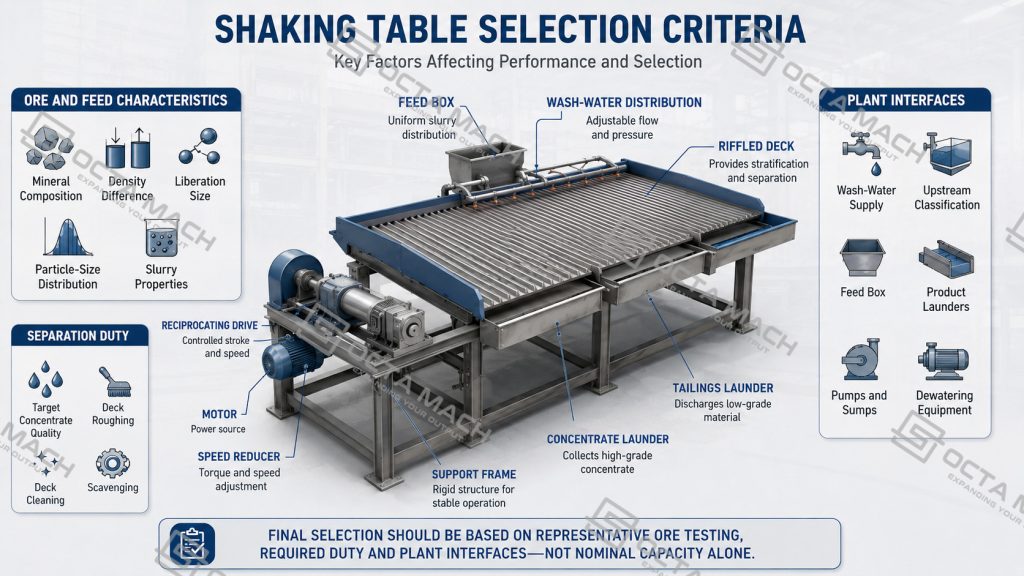
1. Ore and Feed Characteristics
- Mineral composition: identifies the valuable minerals and associated gangue.
- Density difference: determines whether gravity separation is technically feasible.
- Liberation size: confirms whether the valuable mineral has been sufficiently released from the gangue.
- Particle-size distribution: affects stratification, deck loading and the stability of the separation bands.
- Slurry concentration: influences slurry mobility and mineral movement across the deck.
2. Separation Duty
- Roughing: prioritizes recovery and initial volume reduction.
- Cleaning: focuses on improving concentrate grade at a controlled feed rate.
- Scavenging: recovers remaining valuable minerals from selected middlings or tailings.
- Target concentrate quality: determines deck adjustment and whether additional cleaning stages are required.
3. Plant Interfaces
The selection must also consider the available wash-water supply, upstream classification equipment and downstream product handling. Feed boxes, launders, pumps, sumps and dewatering equipment should be matched to the final process layout.
Representative ore testing is recommended before final selection. Ores containing the same valuable mineral may require different operating settings because of differences in liberation, particle shape, feed grading and gangue composition.
Operating and Installation Requirements
For stable operation, the gravity separation shaking table should be installed on a rigid, level foundation with sufficient clearance for deck movement and maintenance.
The feed should remain reasonably constant in flow, particle size and slurry concentration. Operators should also check:
- Lubrication and drive condition
- Deck surface and riffle wear
- Feed distribution across the deck
- Wash-water pressure and distribution
- Stroke and frequency settings
- Deck inclination
- Concentrate, middling and tailings discharge positions
- Loose fasteners and abnormal vibration
Adjustment should be made gradually. Changing several parameters at the same time makes it difficult to identify which setting caused a change in the separation bands.
Why Choose Octa Mach
Octa Mach supplies the 6-S shaking table as either an individual gravity-separation unit or part of a complete mineral-processing circuit. Rather than selecting equipment by nominal capacity alone, our technical team evaluates the ore characteristics, feed-size range, slurry condition, required recovery duty and plant layout before recommending a suitable model and deck configuration.
Our project support may include:
- Application-based model and deck selection
- Gravity-process flow matching
- Feed, concentrate, middling and tailings interface review
- Foundation and equipment-layout drawings
- Water and electrical connection requirements
- Integration with grinding, classification, jigging and spiral concentration equipment
- Installation and commissioning guidance
- Wear-part and spare-part planning
- Technical documentation for operation and maintenance
This coordinated approach helps reduce interface problems, simplify installation and ensure that the shaking table is configured for the actual ore and process duty rather than selected only from catalogue capacity data.
FAQ
Q: What feed size is suitable for this Shaking Table?
A: The confirmed feed size range is 0.074-2 mm. Best results are usually obtained when the feed is already well classified and the valuable minerals are sufficiently liberated.
Q: Can this machine be used as a gold shaking table?
A: Yes. This machine can be used as a gold shaking table for liberated fine gold or gold-bearing heavy-mineral feed, especially in concentrate cleaning or selective gravity recovery duties.
Q: What is the processing capacity of the 6-S Shaking Table?
A: The catalogue lists a capacity of 0.5-1.2 t/h. The actual throughput depends on ore density difference, feed size distribution, slurry concentration and the required separation sharpness.
Q: Which parameters are adjusted during operation?
A: The main adjustable parameters are stroke (10-30 mm), stroke frequency (240-360 times/min), deck slope (0-8°) and wash-water flow (0.4-0.8 t/h). These should be adjusted together according to ore behavior.
Q: Is a shaking table the same as a jig or spiral chute?
A: No. All three are gravity-separation machines, but they work differently. A shaking table is typically used for more controlled fine separation or concentrate cleaning, while jigs and spirals often serve pre-concentration or classification-related duties.