
An Impact Crusher is a rotor-driven crushing machine used to reduce brittle and medium-hard rock, concrete, asphalt, and construction waste through repeated impact rather than compression. The motor drives a horizontal rotor fitted with blow bars. When feed enters the crushing chamber, the blow bars accelerate the material toward adjustable impact plates. Oversized particles rebound into the rotor impact zone and continue breaking until they can leave through the lower discharge opening.
The machine handles limestone, dolomite, concrete, asphalt, coal gangue, construction waste, and other brittle or medium-hard materials. For highly abrasive quartz-rich rock, the expected consumption of blow bars and impact liners should be compared with the operating cost of a cone crusher before the final equipment is selected.
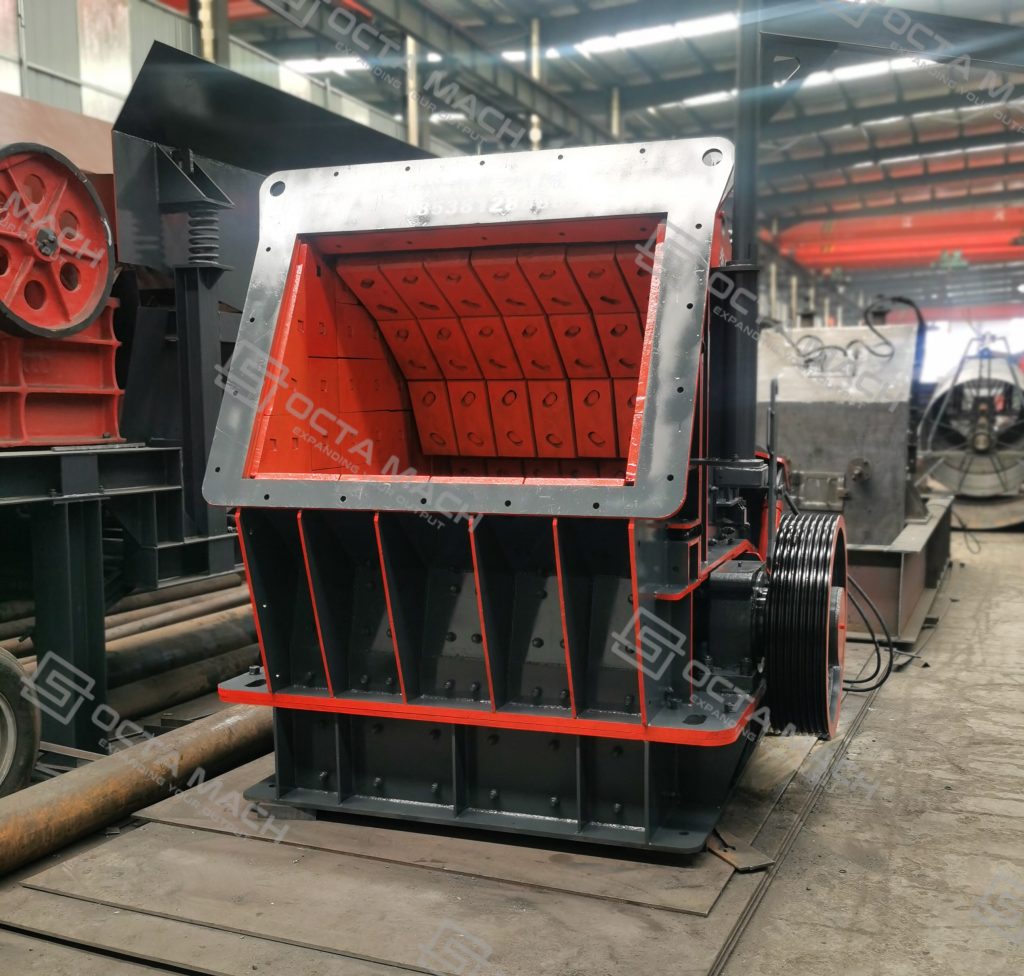
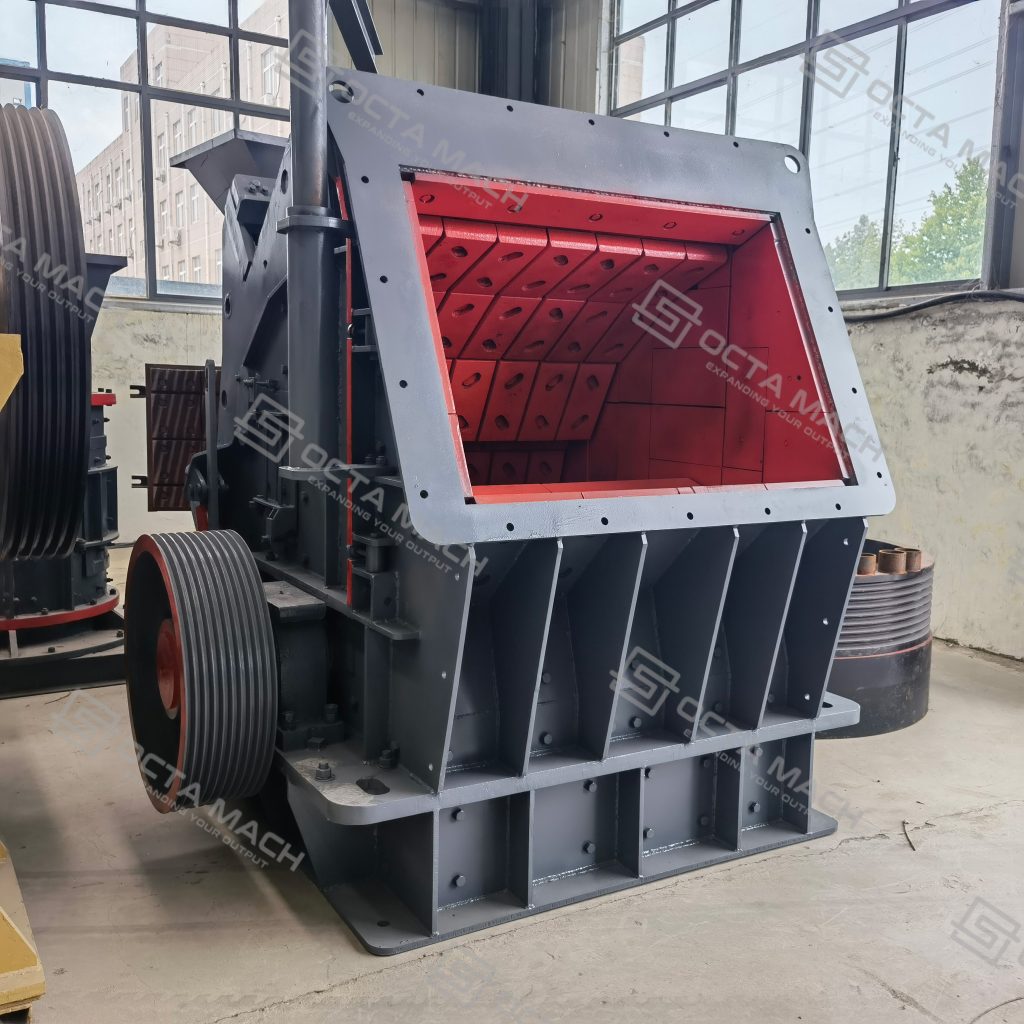
Impact crusher specifications
| Model | Specifications (mm) | Feed Opening (mm) | Feed Size (mm) | Capacity (t/h) | Motor Power (kW) | Dimensions (mm) |
|---|---|---|---|---|---|---|
| PFV-0807 | Φ850 × 700 | 400 × 730 | ≤100 | 15–30 | 30–45 | 2119 × 1654 × 2200 |
| PFV-1010 | Φ1000 × 1050 | 500 × 1080 | ≤150 | 40–70 | 55–75 | 2319 × 2001 × 2558 |
| PFV-1210 | Φ1250 × 1050 | 450 × 1060 | ≤150 | 70–120 | 110–132 | 2585 × 2053 × 2809 |
| PFV-1214 | Φ1250 × 1400 | 450 × 1440 | ≤200 | 100–150 | 132–160 | 2582 × 2403 × 2809 |
| PFV-1315 | Φ1320 × 1500 | 550 × 1530 | ≤300 | 130–280 | 200 | 2930 × 2761 × 3053 |
| PFV-1320 | Φ1320 × 2000 | 610 × 1900 | ≤350 | 180–400 | 250–280 | 3224 × 3175 × 2706 |
| PFV-1520 | Φ1500 × 2000 | 830 × 2040 | ≤350 | 300–550 | 220–250 × 2 | 3959 × 3564 × 3330 |
| PFV-1820 | Φ1800 × 2000 | 1260 × 2040 | ≤400 | 600–800 | 315–400 × 2 | 4400 × 3866 × 4009 |
Working Principle and Crushing Performance
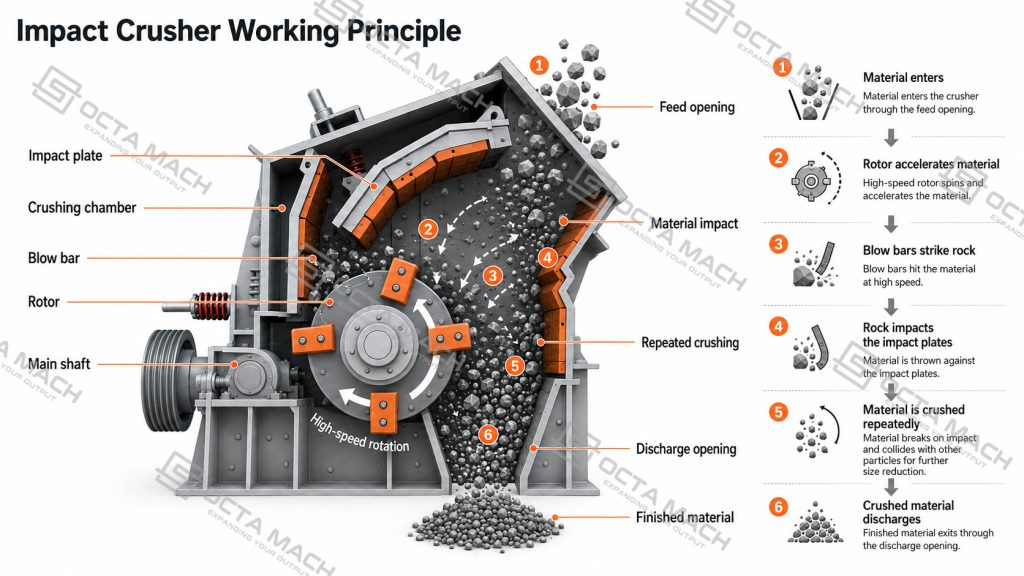
The impact crusher working principle uses a high-speed rotor fitted with blow bars to strike incoming material and throw it against adjustable impact plates. After the first collision, the material rebounds toward the rotor and is struck again, while particle-to-particle impact provides further reduction inside the crushing chamber. Oversized pieces remain in the active impact zone until they reach the required size and pass through the lower discharge opening. Final product grading is mainly controlled by rotor speed, the gap between the blow bars and impact plates, feed consistency, and wear-part condition.
Crushing Sequence
| Working Stage | Machine Action | Crushing Result |
|---|---|---|
| Material feeding | Rock enters through the feed opening and moves toward the rotor | Feed is distributed into the blow-bar impact zone |
| Initial impact | High-speed blow bars strike the incoming material | Large particles receive the primary size reduction |
| Material acceleration | Broken material is projected toward the breaker plates | Impact energy creates further fracture |
| Rebound crushing | Material rebounds from the impact plates toward the rotor | Oversized particles return to the active crushing zone |
| Inter-particle impact | Moving particles collide with each other | Additional reduction and particle shaping occur |
| Discharge control | Material passes through the lower chamber when sufficiently reduced | Finished material leaves the crusher for screening |
The rotor, blow bars, and breaker plates perform most of the crushing work. The impact plates also control the material trajectory and retain oversized pieces inside the chamber. Adjusting their position changes the discharge grading and effective crushing intensity.
Product Advantages
- High reduction ratio: Repeated impact allows one machine to reduce relatively large feed into a smaller product range, reducing the number of crushing stages in suitable applications.
- Controlled aggregate shape: Material tends to fracture along natural weak planes, supporting a more cubical product with fewer elongated particles.
- Adjustable product grading: The gap between the blow bars and impact plates can be adjusted to modify the discharge size.
- Large active crushing area: A wide rotor and feed opening provide room for continuous material penetration and impact.
- Hydraulic maintenance access: Hydraulic frame opening and jacking devices simplify chamber inspection and wear-part replacement.
- Flexible chamber configuration: Two-cavity arrangements suit coarse and medium crushing, while three-cavity arrangements provide additional impact stages for finer reduction.
- Stationary and mobile integration: The crusher can be installed on a fixed foundation or incorporated into a wheeled or crawler mobile impact crusher.
- Compatible with complete crushing circuits: The machine can operate with a feeder, jaw crusher, magnetic separator, vibrating screen, return conveyor, and final-product conveyors.
Impact Crusher Configurations
OctaMach supplies PFV and PFW horizontal shaft impact crusher models for stationary and mobile crushing plants. Selection depends mainly on feed size, required capacity, crushing stage, and final product grading.
| Configuration | Reference Feed Size | Reference Capacity | Main Use |
|---|---|---|---|
| PFV Series Impact Crusher | ≤100–400 mm | 15–800 t/h | General coarse, medium and secondary crushing |
| PFW Two-Chamber Impact Crusher | ≤500–700 mm | 130–480 t/h | Larger feed and coarse crushing |
| PFW Three-Chamber Impact Crusher | ≤250–350 mm | 90–350 t/h | Medium and fine crushing with improved particle shaping |
| Wheeled Mobile Impact Crusher | Depends on installed model | Depends on plant configuration | Temporary and road-accessible crushing projects |
| Crawler Mobile Impact Crusher | ≤600–800 mm | 100–500 t/h | Quarry, demolition and on-site crushing |
The two-chamber PFW design is selected for larger feed and higher coarse-crushing demand, while the three-chamber design provides additional impact stages for finer reduction and better aggregate shape.
Stationary units suit long-term fixed production lines. Mobile configurations combine feeding, crushing and conveying equipment for projects that require frequent relocation or on-site material processing.
How to Choose the Right Impact Crusher
Select the crusher from the actual feed and circuit requirements, not from capacity alone. The first checks are maximum feed size, material abrasivity, target output, and whether the machine will perform coarse, secondary, or fine crushing.
| Selection Factor | What to Confirm | Selection Direction |
|---|---|---|
| Maximum feed size | Largest lump after feeding or pre-screening | PFV models handle up to 100–400 mm; PFW two-chamber models accept larger feed up to 500–700 mm |
| Required capacity | Continuous plant output in t/h | Match crusher capacity with feeder, screen and conveyor capacity |
| Crushing stage | Primary, secondary or medium-fine crushing | Two-chamber PFW for coarse crushing; three-chamber PFW for finer reduction and shaping |
| Material abrasivity | Silica content, hardness and metal contamination | Higher abrasivity requires suitable blow-bar material and closer wear-cost review |
| Final product size | Required grading and screen aperture | Finer output requires a smaller impact gap and normally reduces throughput |
| Installation type | Fixed plant or mobile operation | Stationary units suit long-term production; mobile units suit changing work sites |
For limestone, concrete and other medium-hard materials, an impact crusher is selected where high reduction and cubical aggregate shape are required. For highly abrasive rock, compare expected blow-bar consumption with a cone-crusher circuit before confirming the model.
Working Conditions and Applications
Impact crushers are mainly used for limestone, dolomite, concrete, asphalt and other medium-hard materials where high reduction and a cubical product shape are required.
| Application | Typical Use | Key Operating Point |
|---|---|---|
| Limestone aggregate production | Installed after feeding or jaw crushing, before final screening | Control feed size, clay content and impact-plate setting |
| Concrete recycling | Breaks demolition concrete and releases embedded steel before magnetic separation | Remove long rebar and maintain uniform feeding |
| Asphalt recycling | Reduces reclaimed asphalt pavement before screening and reuse | Avoid excessive fines by controlling rotor speed and discharge gap |
| Secondary aggregate crushing | Processes jaw-crusher discharge for further reduction and shaping | Match crusher output with screen aperture and return load |
| Mobile site crushing | Used in quarry, roadwork and demolition projects close to the material source | Confirm feeder, conveyor, screen and transport configuration |
For highly abrasive rock, blow-bar consumption and wear cost should be reviewed before selecting an impact rock crusher instead of a cone crusher.
Why Choose Octa Mach
Octa Mach matches each impact crusher to the material, feed size, required output, abrasion level, installation method, and complete plant arrangement. The objective is not to supply an isolated machine with a catalogue capacity; it is to configure a crushing system that can be fed continuously, maintained safely, and connected correctly to the downstream screen and conveyors.
FAQ
Q1:What is the difference between a two-chamber and three-chamber horizontal shaft impact crusher?
A1:A two-chamber design provides a shorter crushing path and larger feed acceptance for coarse crushing. A three-chamber impact crusher adds another impact stage for finer reduction, tighter grading, and improved aggregate shaping.
Q2:Why is the actual impact crusher capacity lower than the rated capacity?
A2:Actual capacity decreases when the feed contains excessive fines, moisture, clay, oversized lumps, or uneven material flow. A narrow discharge gap, worn impact plates, and an undersized downstream screen can also restrict throughput.
Q3:How does the impact plate gap affect the final product size?
A3:A smaller gap produces finer material but increases wear and normally reduces capacity. A wider gap improves throughput but creates a coarser product, so the setting should match the required grading and screen aperture.
Q4:When should an impact crusher be selected instead of a cone crusher?
A4:Select an impact crusher for limestone, concrete, asphalt, and other medium-hard materials when high reduction and cubical shape are priorities. For quartz-rich or highly abrasive rock, compare blow-bar wear cost with a cone-crusher circuit before selection.